New Weight Editing Technique Fixes Vision Model Retrieval Errors Without Retraining
A mathematical correction applied directly to model projections widens embedding margins and reduces retrieval errors across multiple neural network architectures.

A new weight-editing technique allows vision-language models to correct retrieval errors without retraining or changing their underlying architecture. By applying a closed-form mathematical correction directly to model weights, researchers boosted retrieval accuracy across twenty-one different neural network checkpoints.
Image-text retrieval systems rely on dual encoders that map visual and textual data into a shared embedding space. A persistent issue in these models is the modality gap, where images and text occupy distinct regions of the vector space. When a text caption attempts to retrieve its corresponding image, high-scoring incorrect matches frequently interfere with correct selections. The authors Hani Alomari, Md Atabuzzaman, and Chris Thomas from Virginia Tech investigated whether closing this gap would resolve retrieval failures. Their experiments revealed that attempting to completely remove the modality gap post-hoc actually degrades retrieval performance across every tested checkpoint.
How do specific directions in embedding space favor incorrect matches?
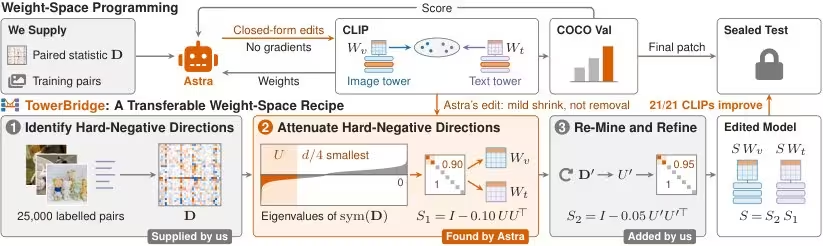
To identify the root cause of retrieval errors, the authors formulated a paired statistic that highlights specific geometric directions where both network towers agree more on misleading incorrect matches than on proper pairs. Examining the spectrum of this statistic revealed negative eigenvalues marking directions dominated by problematic competition. Rather than removing these directions entirely, the team developed a method called TowerBridge, which mildly attenuates these specific dimensions by ten percent in both output projections. This operation preserves the overall modality gap while widening the margin between correct pairs and hard negatives.
Why does mild attenuation outperform complete removal of the gap?
Complete removal of the modality gap disrupts useful semantic information carried by leading directions, causing a sharp drop in retrieval scores. By contrast, a controlled shrink of twenty-five percent of the representation space reduces the influence of error-prone dimensions while retaining essential content. As detailed in a study available on the arXiv preprint server, this intervention lowers hubness, which occurs when a single popular image is incorrectly retrieved for a vast number of unrelated captions. Across tested models, the median share of text-to-image errors landing on these popular hubs fell from twenty-eight percent down to nineteen percent.
What are the computational advantages over traditional fine-tuning?
Traditional adaptation methods require gradient-based optimization, hyperparameter tuning, and expensive computational passes over large datasets. TowerBridge operates through weight-space programming, utilizing an autonomous agent during initial development to inspect model weights and formulate closed-form updates without backpropagation. The resulting two-round recipe computes in seconds from twenty-five thousand labeled pairs without requiring any model-specific fine-tuning. The procedure improves Microsoft COCO test retrieval by sixteen point eight RSUM points on average across all twenty-one evaluated checkpoints, while limiting changes to ImageNet classification accuracy to a negligible fraction.
What limitations remain for widespread deployment?
While the recipe successfully transfers across diverse architectures and pretraining data sources, it requires labeled image-text pairs to compute the initial paired statistic. Furthermore, the approach currently targets contrastive dual encoders rather than generative vision-language models. The authors plan to release their complete source code, prompts, and logs to facilitate further research into closed-form model editing.
The study was posted to the arXiv preprint server on November 23, 2026.
This article has been fact checked for accuracy, with information verified against reputable sources. Learn more about us and our editorial process.
Last reviewed on .
Article history
- Latest version
Reference(s)
- Alomari, Hani. “TowerBridge: Bridging the Dual-Encoder Modality Gap via Weight-Space Programming.” arXiv.org <http://arxiv.org/abs/2611.31233v1>.
Cite this page:
- Posted by James Whitmore