Tiny Asteroid Captured By Earth May Actually Be A Lost Piece Of The Moon
Astronomy

Tiny Asteroid Captured By Earth May Actually Be A Lost Piece Of The Moon

Observations from major telescopes suggest a small temporary visitor shares spectral traits with lunar basalt samples
By Karan Das
Published:
Email this Article
Tiny Asteroid Captured By Earth May Actually Be A Lost Piece Of The Moon
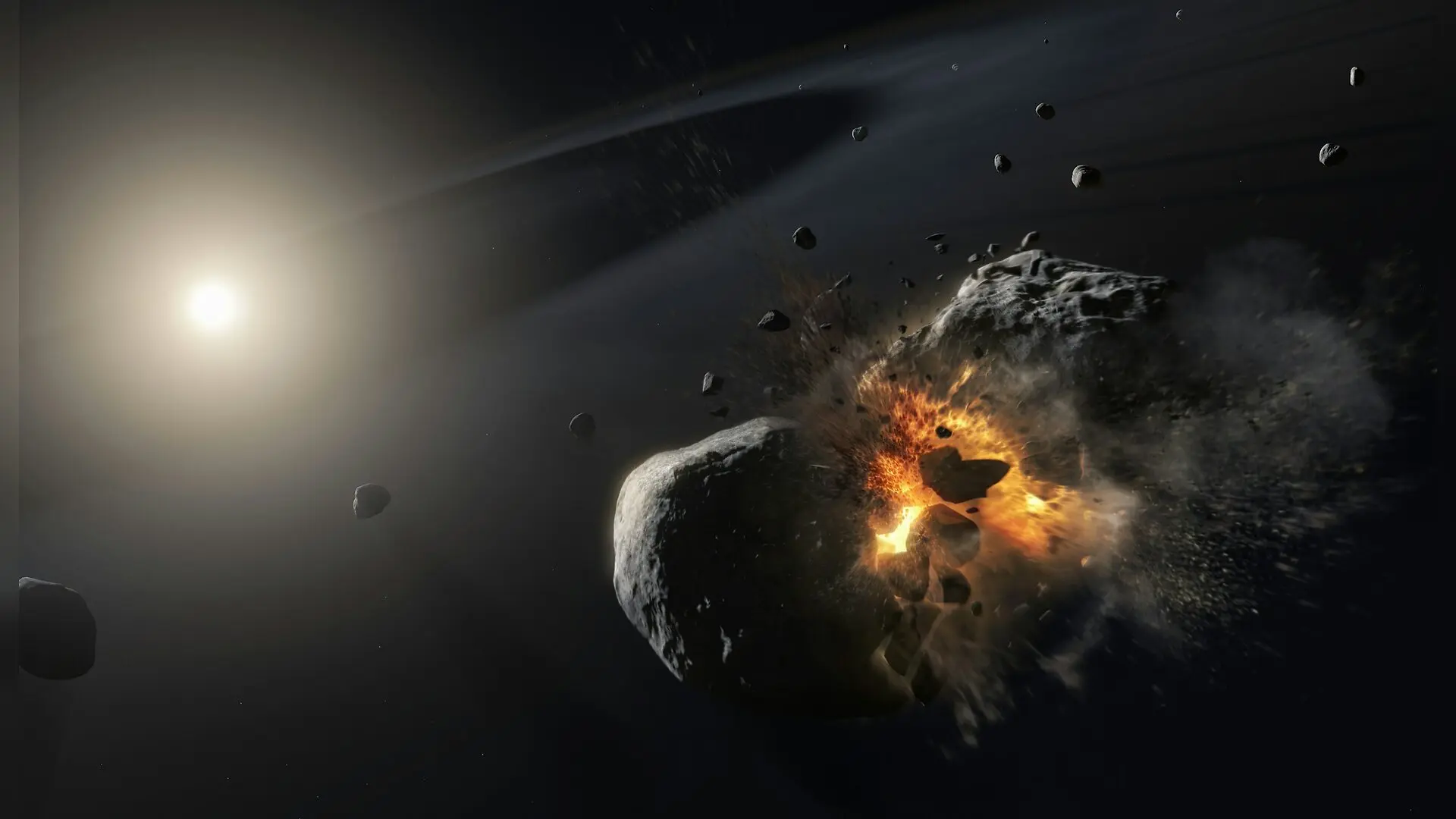
Photo by NASA Hubble Space Telescope on Unsplash

A tiny asteroid captured into temporary orbit around Earth is revealing surprising clues about its origin, leaving scientists debating whether it is a piece of space rock from the main asteroid belt or an ejected fragment of our own Moon.

The object, designated 2026 QQ8, measures between one and two meters across and was discovered on August 19, 2026, by astronomer Krisztián Sárneczky. Following its initial detection, the object was tracked by major observatories around the globe, which measured its colors and gravitational acceleration to understand how it interacts with the Earth-Moon system.

What do the colors of 2026 QQ8 reveal about its past?

Between November 7 and November 21, 2026, a team of researchers used some of the world’s most powerful telescopes, including the Very Large Telescope in Chile, the Keck I Observatory in Hawaii, and the Gemini North telescope, to capture detailed photometry of the passing space rock. The observations, available on the arXiv preprint server, show that 2026 QQ8 has a distinct optical signature, featuring a notable twelve percent drop in reflectance between the near-infrared filters.
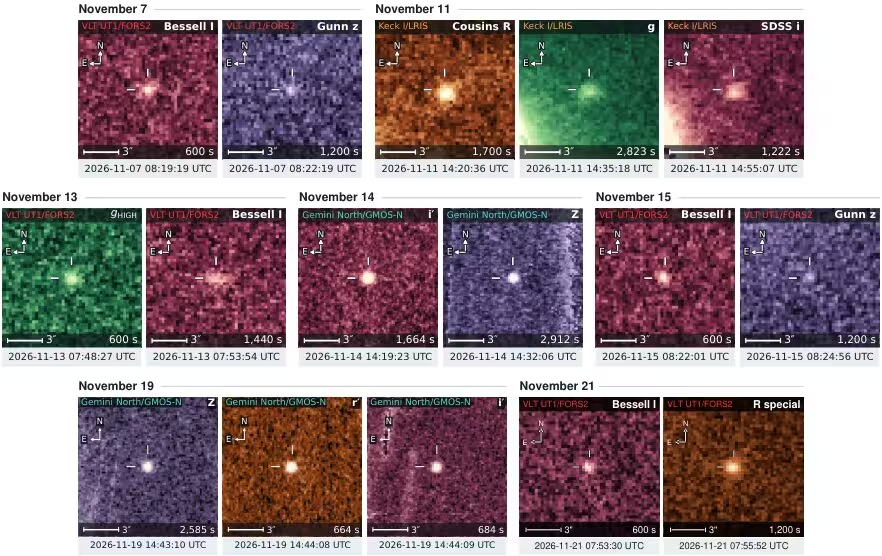
Figure 1: Target-aligned stacks of 2026 QQ8 in chronological order. Integration time appears inside each stamp and exposure-weighted UTC midpoint below. The FORS2 stacks contain ten frames per filter on November 7, 15, and 21, and five gg and six II frames on November 13 after excluding gg exposure 7, crossed by a stellar trail. The November 21 stacks retain trail-subtracted II exposure 17 and the final, unbracketed RR exposure. Table 3 includes the November 14 FORS2 gg and RR sequences. LRIS stacks on November 11 contain 16 Cousins RR, 23 gg, and nine SDSS ii frames. GMOS-N stacks contain four i′i^{\prime} and seven ZZ frames on November 14, and eleven ZZ, four r′r^{\prime}, and four i′i^{\prime} on November 19, excluding trail-crossed ZZ frames N20261114S0078 and N20261119S0164. Ticks mark the November 7 centroid (0​.′′​380\farcs 38 west and 0​.′′​130\farcs 13 north of the prediction) and the predicted position on other nights. Each 12​″×12​″12\arcsec\times 12\arcsec stamp has north up, east l
Target-aligned stacks of 2026 QQ8 in chronological order. Integration time appears inside each stamp and exposure-weighted UTC midpoint below. The FORS2 stacks contain ten frames per filter on November 7, 15, and 21, and five gg and six II frames on November 13 after excluding gg exposure 7, crossed by a stellar trail. The November 21 stacks retain trail-subtracted II exposure 17 and the final, unbracketed RR exposure. Table 3 includes the November 14 FORS2 gg and RR sequences. LRIS stacks on November 11 contain 16 Cousins RR, 23 gg, and nine SDSS ii frames. GMOS-N stacks contain four i′i^{\prime} and seven ZZ frames on November 14, and eleven ZZ, four r′r^{\prime}, and four i′i^{\prime} on November 19, excluding trail-crossed ZZ frames N20261114S0078 and N20261119S0164. Ticks mark the November 7 centroid (0​.′′​380\farcs 38 west and 0​.′′​130\farcs 13 north of the prediction) and the predicted position on other nights. Each 12​″×12​″12\arcsec\times 12\arcsec stamp has north up, east l Credit: Bryce T. Bolin et al. / arXiv

When the researchers compared these colors to spectral databases, they found that the object closely matches both Sq-type asteroids, which are common in the inner Solar System, and specific samples of lunar basalt brought back from the Apollo 17 mission, specifically basalt slab number 75075,197. While the color match to lunar rock is statistically strong, the authors note that further spectroscopy across the one and two micrometers wavelength bands will be needed to definitively separate a lunar origin from a standard stony asteroid surface.

How does Earth capture these meter-scale visitors?

Temporarily captured objects enter a gravitational dance with the Earth-Moon system, crossing into Earth’s Hill radius (the region where Earth’s gravity dominates over the Sun’s pull) while remaining loosely bound before eventually escaping back into interplanetary space. In the case of 2026 QQ8, dynamical modeling shows that it began its temporary capture on April 26, 2026, and is calculated to exit the system on December 7, 2026, spending roughly two hundred and twenty-five days bound to our planet.

Interestingly, the object’s trajectory classifies it differently depending on the coordinate frame used. Measured in Sun-Earth corotating longitude, it qualifies as a temporary flyby because it does not complete a full revolution around Earth. However, when evaluated using a three-dimensional path-curvature criterion, it turns more than one full revolution, placing it in the orbiter class.
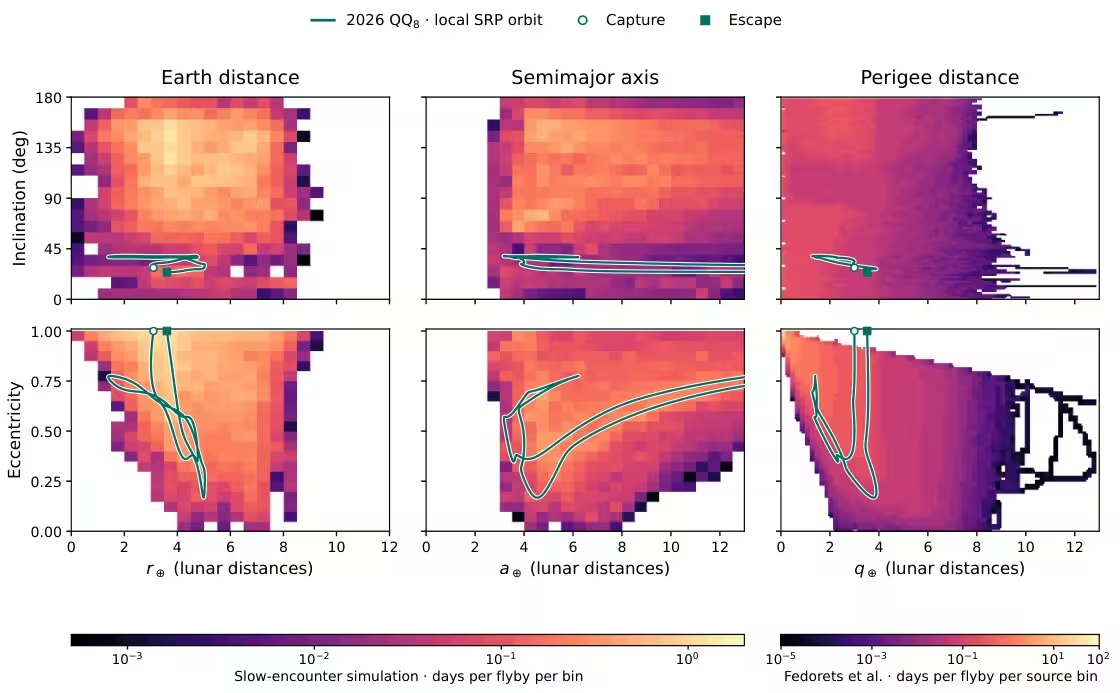
Figure 5: Geocentric inclination to the J2000 ecliptic (top) and eccentricity (bottom) during the 2026 capture of 2026 QQ8. The curve samples the November 22 nominal SRP orbit every 3 h, with both energy crossings evaluated at their refined times. The horizontal axes give Earth distance r⊕r_{\oplus}, osculating semimajor axis a⊕a_{\oplus}, and osculating perigee q⊕q_{\oplus}, in lunar distances (384,400 km). In the distance and perigee panels, open circles mark capture on April 26 and filled squares mark the predicted escape on December 7. At both energy crossings e⊕=1e_{\oplus}=1 and a⊕a_{\oplus} diverges. The left and middle columns show mean days per bin for 378 completed simulated slow-encounter flybys on a common scale. Bins span 0.5 lunar distances and either 10∘10^{\circ} in inclination or 0.05 in eccentricity. The right column gives approximate mean days per original bin on a separate scale, digitized from G. Fedorets et al. [31, Figure 10] with the perigee-axis correction of S. P. Naidu
Geocentric inclination to the J2000 ecliptic (top) and eccentricity (bottom) during the 2026 capture of 2026 QQ8. The curve samples the November 22 nominal SRP orbit every 3 h, with both energy crossings evaluated at their refined times. The horizontal axes give Earth distance r⊕r_{\oplus}, osculating semimajor axis a⊕a_{\oplus}, and osculating perigee q⊕q_{\oplus}, in lunar distances (384,400 km). In the distance and perigee panels, open circles mark capture on April 26 and filled squares mark the predicted escape on December 7. At both energy crossings e⊕=1e_{\oplus}=1 and a⊕a_{\oplus} diverges. The left and middle columns show mean days per bin for 378 completed simulated slow-encounter flybys on a common scale. Bins span 0.5 lunar distances and either 10∘10^{\circ} in inclination or 0.05 in eccentricity. The right column gives approximate mean days per original bin on a separate scale, digitized from G. Fedorets et al. [31, Figure 10] with the perigee-axis correction of S. P. Naidu Credit: Bryce T. Bolin et al. / arXiv

What does the measured acceleration tell us about its density?

One of the most striking findings from the tracking data is a high-significance measurement of outward acceleration caused by solar radiation pressure, which is the physical push exerted by sunlight hitting the surface of the object. By measuring this acceleration alongside the object’s absolute magnitude, the team calculated its area-to-mass ratio and estimated its physical dimensions and bulk density.

Assuming the object shares the typical albedo (reflectivity) of an Sq-type asteroid, the data suggest a diameter of about one point four meters and a bulk density of one point seven grams per cubic centimeter. If it is instead made of darker lunar basalt, it would be larger at roughly two point five meters across, with a lower density of one gram per cubic centimeter. Long-term simulations tracking the object over ten thousand years indicate that while most clones escape into stable orbits, a fraction will eventually collide with Earth, providing a rare natural laboratory for studying the delivery of meter-scale material to our world.

The study was posted to the arXiv preprint server on November 23, 2026.

Fact Checked

This article has been fact checked for accuracy, with information verified against reputable sources. Learn more about us and our editorial process.

Last reviewed on .

Article history

  • Latest version

Reference(s)

  1. Bolin, Bryce. “VLT, Keck, and Gemini characterization of the temporarily captured flyby 2026 QQ$_8$.” arXiv.org <http://arxiv.org/abs/2611.31213v1>.

Cite this page:

Das, Karan. “Tiny Asteroid Captured By Earth May Actually Be A Lost Piece Of The Moon.” BioScience. BioScience ISSN 2521-5760, 24 November 2026. <https://www.bioscience.com.pk/en/subject/astronomy/vlt-keck-and-gemini-characterization-of-the-temporarily-captured-flyby-2026-qq-8>. Das, K. (2026, November 24). “Tiny Asteroid Captured By Earth May Actually Be A Lost Piece Of The Moon.” BioScience. ISSN 2521-5760. Retrieved November 24, 2026 from https://www.bioscience.com.pk/en/subject/astronomy/vlt-keck-and-gemini-characterization-of-the-temporarily-captured-flyby-2026-qq-8 Das, Karan. “Tiny Asteroid Captured By Earth May Actually Be A Lost Piece Of The Moon.” BioScience. ISSN 2521-5760. https://www.bioscience.com.pk/en/subject/astronomy/vlt-keck-and-gemini-characterization-of-the-temporarily-captured-flyby-2026-qq-8 (accessed November 24, 2026).
  • Posted by
End of the article