Artificial Intelligence Ensemble Uncovers Over Fifteen Thousand Cosmic Lenses in Euclid Telescope Data
Comparing five machine learning models reveals unexpected biases and proves that combining algorithms maximizes cosmic discoveries.
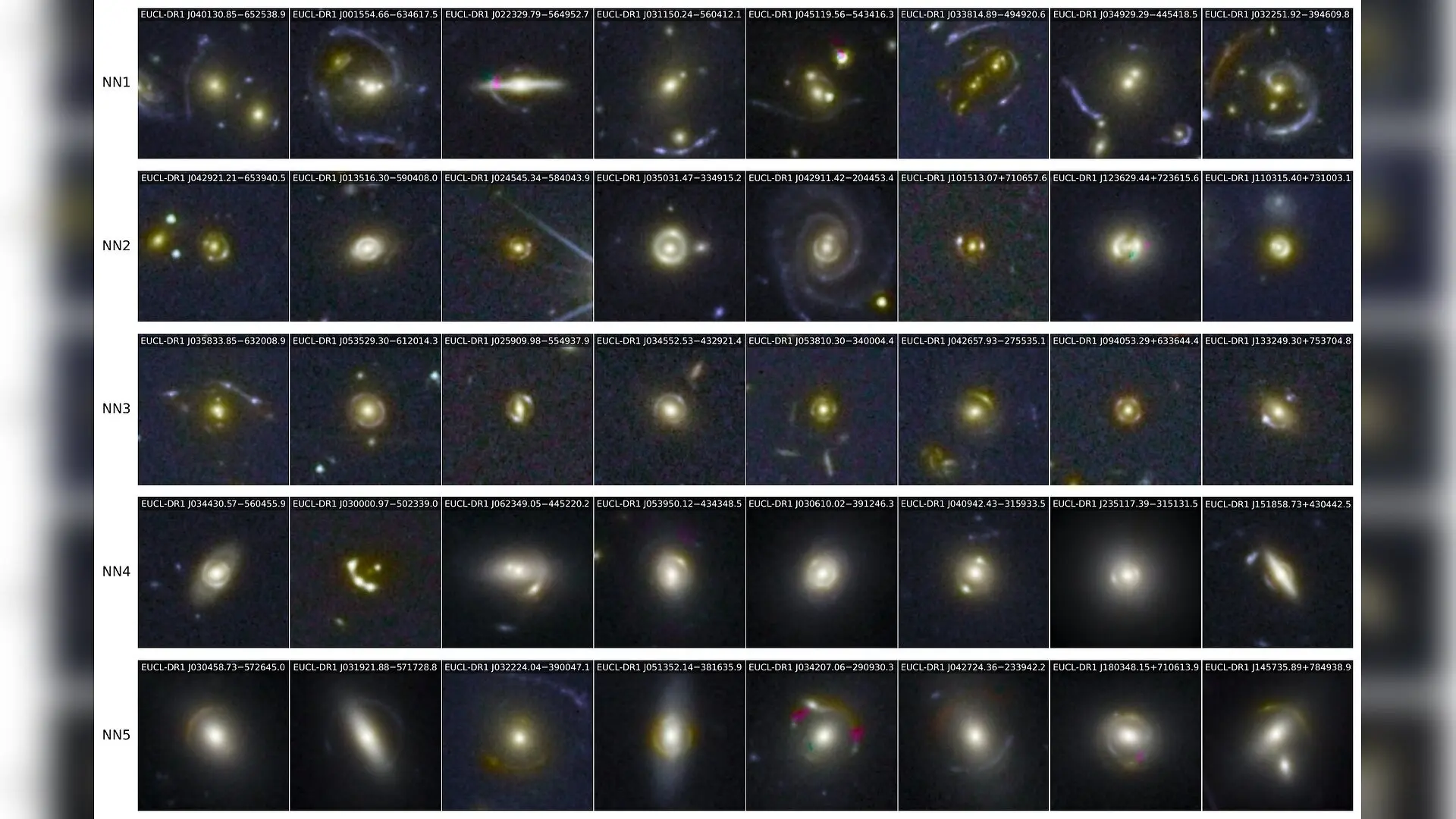
A cosmic census using data from the European Space Agency spacecraft has uncovered over fifteen thousand new gravitational lens candidates across nineteen hundred square degrees of the sky. The massive haul, which dwarfs previous collections by more than an order of magnitude, relies on an artificial intelligence ensemble of five independently trained neural networks scouring nearly sixty-eight million galaxies.
Gravitational lensing occurs when a massive foreground galaxy bends and magnifies the light of a distant background source into glowing arcs or rings. These rare cosmic configurations act as natural telescopes, allowing astronomers to weigh galaxies, map invisible dark matter, and measure the expansion rate of the universe. To unearth them from billions of telescope images, the Euclid Collaboration deployed a mix of convolutional neural networks and vision transformers.
Why Do Five Artificial Intelligence Models Find Different Lenses in the Same Sky?
Led by researcher S. H. Vincken at the University of Applied Sciences and Arts Northwestern Switzerland, the team evaluated all five algorithms on a fifty square degree calibration field to understand how their underlying architectures shape their discoveries. The study, published on the arXiv preprint server, reveals that the models exhibit distinct preferences and blind spots despite training on the exact same pool of simulated data and real telescope observations.
For instance, some networks favored compact lens configurations with tight rings, while others excelled at spotting large, extended systems spanning several arcseconds. One vision transformer called AstroVink proved especially adept at catching wide systems with complex, off-center arcs, whereas another algorithm dubbed Zoobot achieved exceptional precision by prioritizing high-confidence examples during training.
What Happens When Multiple Neural Networks Team Up for a Cosmic Search?
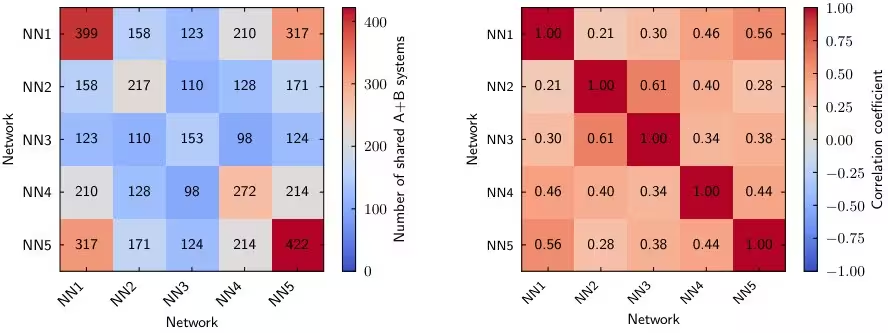
When the researchers combined the top rankings from all five algorithms, the union recovered over five hundred high-confidence lens candidates within the calibration set alone. The analysis demonstrated that the networks are highly complementary rather than redundant, with each system contributing dozens of unique discoveries that the others missed entirely.
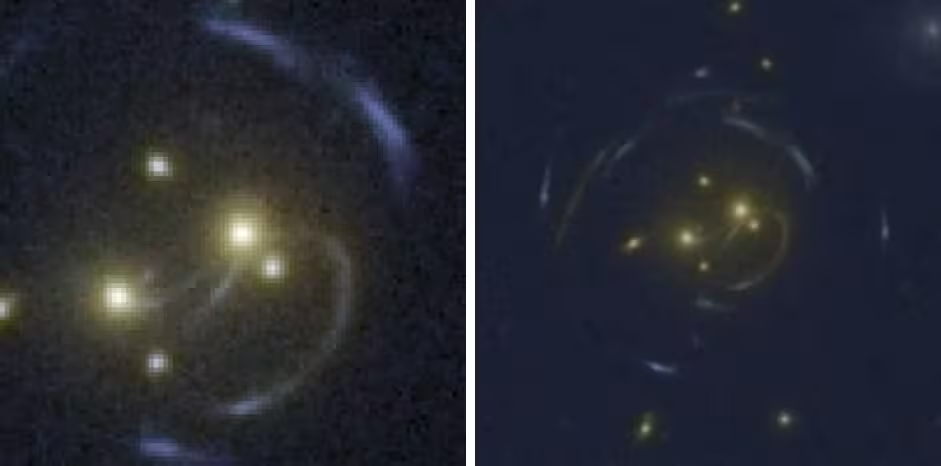
The fifth network, which incorporated near-infrared color bands alongside optical data, successfully identified hidden background sources whose colors differed from the foreground deflector. This multi-band approach occasionally revealed secondary lensed objects that remained invisible in standard single-band images.
What Are the Limitations and Blind Spots of Automated Lens Searches?
Despite their impressive success, the models shared certain systematic biases that could skew future astronomical catalogs. Most algorithms assigned lower rankings to disk-dominated galaxies with low light concentration indices, favoring centrally concentrated early-type elliptical galaxies instead. This shared preference stems partly from training simulations that relied heavily on luminous red galaxies as deflectors.
Furthermore, human visual inspection budgets limit how many top-ranked objects can be verified by experts, meaning unusual lens morphologies that fail to rank near the very top risk being overlooked. The authors emphasize that understanding these algorithmic biases is essential for building representative catalogs for upcoming wide-field surveys such as the Vera C. Rubin Observatory and the Nancy Grace Roman Space Telescope.
The study was posted to the arXiv preprint server on November 23, 2026.
This article has been fact checked for accuracy, with information verified against reputable sources. Learn more about us and our editorial process.
Last reviewed on .
Article history
- Latest version
Reference(s)
- Collaboration, Euclid. “Euclid Data Release 1 (DR1). Learning machine learning: Investigating the complementarity and biases of strong gravitational lens finding networks on Euclid data.” arXiv.org <http://arxiv.org/abs/2611.31231v1>.
Cite this page:
- Posted by John Williams