Simons Observatory Physicists Test Novel Calibration Strategy To Solve Cosmic Birefringence Mystery
A new data-sharing approach between telescope arrays could overcome persistent calibration hurdles in the search for parity-violating physics.
Cosmic light whispers secrets about the birth of the Universe, but scientists studying a mysterious rotation of ancient polarized photons face a stubborn roadblock in telescope calibration.
Researchers tackling this puzzle have developed a new mathematical strategy to transfer absolute polarization calibration between different instruments observing the same patch of the sky. Led by Anto I. Lonappan at the University of California San Diego and the Simons Observatory Collaboration, the team published on the arXiv preprint server a comprehensive analysis exploring how combining ground-based telescope datasets can sharpen measurements of cosmic birefringence, the theoretical phenomenon where the polarization angle of the cosmic microwave background rotates as light travels across the cosmos.
How Does Telescope Miscalibration Impersonate New Physics?
The cosmic microwave background is the oldest light in the Universe, glowing faintly across the sky from an era roughly thirteen billion years ago. As photons travel through space, hypothetical parity-violating physics, such as interactions involving invisible axion-like particles linked to dark energy or dark matter, could twist their linear polarization plane. Detecting this rotation requires extraordinary precision, because a tiny global instrumental error in pointing a detector mimics the exact same signal.
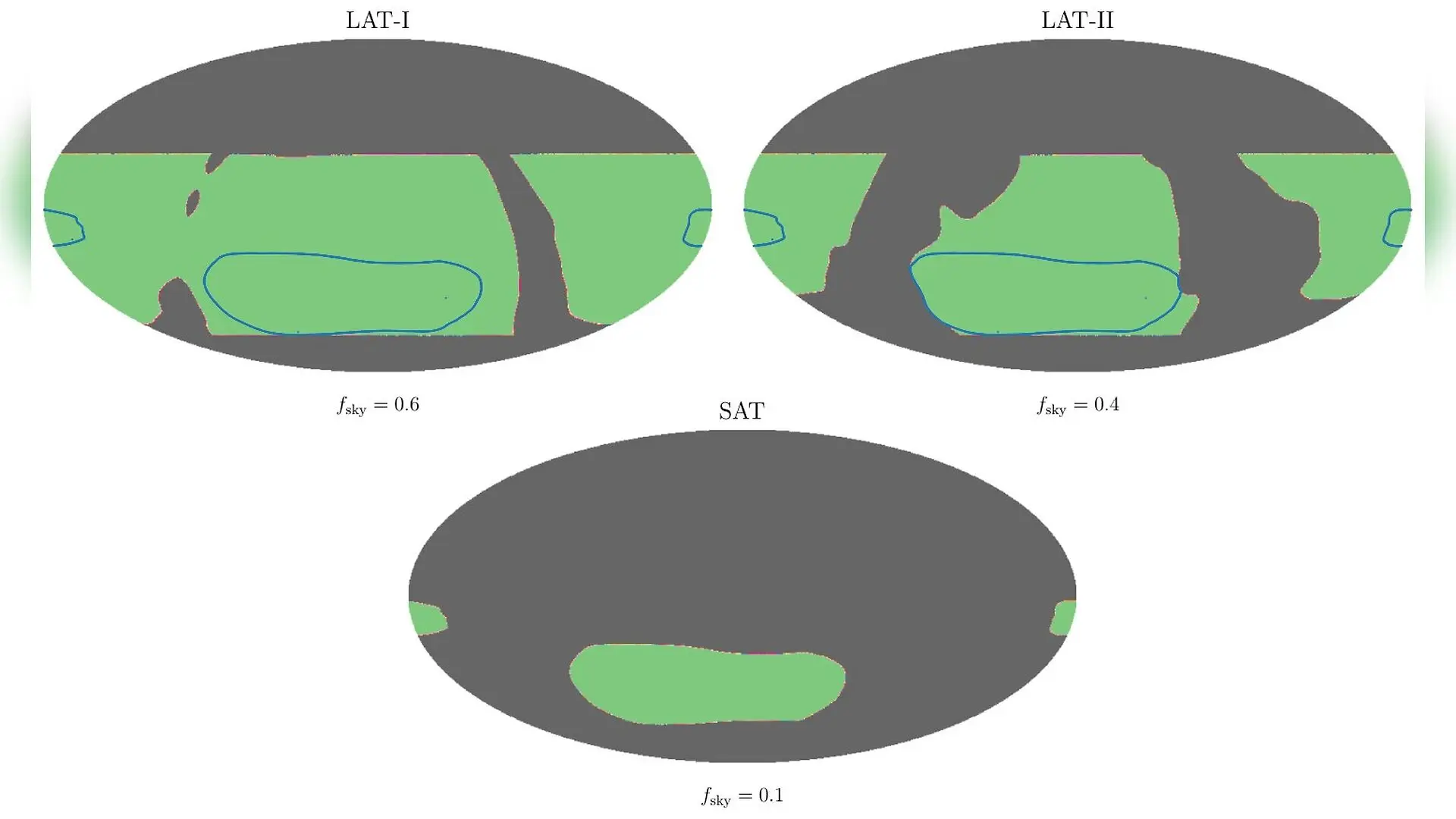
Ground-based experiments like the Simons Observatory, situated at an altitude of 5,200 meters in the Atacama Desert in northern Chile, rely on two distinct instrument types. The installation houses Small Aperture Telescopes designed for degree-scale polarization and a Large Aperture Telescope with a six-meter dish providing high-resolution imaging. Each instrument type faces unique challenges when trying to pin down its absolute orientation on the sky to a fraction of a degree.
Can Telescopes Share Calibration Across Overlapping Skies?
To overcome these limitations, the collaboration constructed map-level simulations incorporating lensed cosmic microwave background polarization, polarized Galactic dust foregrounds, and instrumental noise. The team developed a joint likelihood framework that compares overlapping survey regions observed by both the large and small aperture telescopes. This approach allows an accurate absolute calibration from one instrument to transfer across their common footprint.
The mathematical budget reveals that transferring a calibration is only beneficial if the reference instrument’s uncertainty combined with the relative-angle uncertainty remains lower than the receiving instrument’s native error. When the small aperture telescope acts as the better-calibrated reference, progressive improvements in its calibration translate directly into heightened sensitivity for the combined system. However, the analysis shows that this transfer does not make the two telescope estimates entirely independent; instead, it provides a crucial cross-check and an absolute angle reference across a wider range of angular scales.
What Role Do Galactic Dust and Multipole Ranges Play?
Foreground emission from Galactic dust poses another major hazard because it can contaminate polarization measurements. The team tested their models against complex dust simulations and found that per-frequency amplitude marginalization successfully prevents foreground contamination from biasing the recovered birefringence angle. Furthermore, the analysis demonstrates that expanding the small aperture telescope’s multipole reach, extending its high-resolution data collection, serves as the primary lever for reducing relative-angle uncertainties.
The researchers also evaluated how effectively the Large Aperture Telescope can distinguish between a scale-independent dark energy rotation and scale-dependent axion dark matter models. Thanks to its wide multipole coverage up to a scale of three thousand, the large telescope successfully captures the intricate oscillatory patterns predicted by various dark matter particle masses, yielding strong Bayesian preferences that differentiate cosmological scenarios.
The study was posted to the arXiv preprint server on November 23, 2026.
This article has been fact checked for accuracy, with information verified against reputable sources. Learn more about us and our editorial process.
Last reviewed on .
Article history
- Latest version
Reference(s)
- Collaboration, The. “The Simons Observatory: Analysis of methods for polarization calibration of multiple instruments.” arXiv.org <http://arxiv.org/abs/2611.31235v1>.
Cite this page:
- Posted by Aisha Ahmed