Analytic K-Essence Inflation Model Avoids Singularity Without Slow-Roll Assumptions
New calculations show how background matter fluids can smooth out early Universe pressure spikes in a two-parameter k-essence framework.

A fresh theoretical calculation reveals how the early Universe may have avoided a destructive infinity at the close of inflation without requiring standard slow-roll approximations. The work proposes a mathematical model that aligns with recent cosmic microwave background measurements while eliminating a troubling pressure singularity.
How Can Inflation Happen Without Dynamic Slow-Roll Constraints?
Standard cosmological models rely on the slow-roll assumption, which dictates that a scalar field driving cosmic expansion changes very slowly over time. V. K. Oikonomou from the Aristotle University of Thessaloniki developed an alternative approach within arXiv, examining a specific class of scalar field frameworks known as k-essence theory. Instead of forcing a slow-roll condition into the field equations, the author applied a tracking condition where the time derivative of the scalar field depends inversely on the Hubble expansion rate raised to a positive even integer power.
This formulation allows the Hubble rate, the scale factor, and the scalar field itself to be expressed analytically as exact functions of cosmic time. Because the sound speed of primordial curvature perturbations remains constant in this framework, the model avoids gradient instabilities that often plague modified gravity theories. The resulting equations show that the mathematical setup naturally forces the scalar field velocity to vary slowly during the inflationary period, effectively realizing a slow-roll evolution as a built-in consequence rather than an imposed rule.
What Does the Model Predict for Primordial Observational Indices?
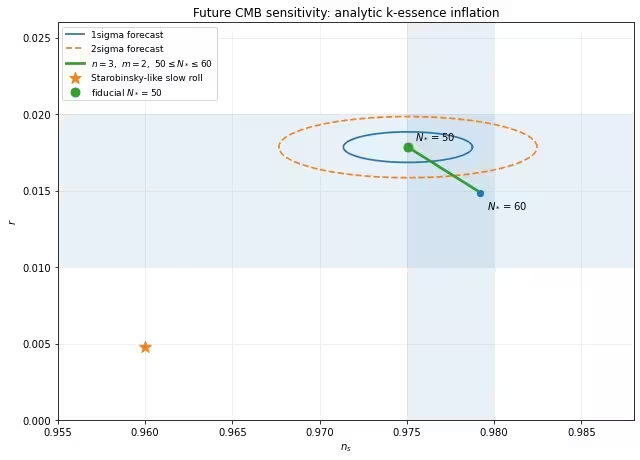
Evaluating the behavior of the early Universe requires comparing theoretical predictions against real astronomical data, such as measurements from the Atacama Cosmology Telescope and the Planck satellite. The author found that the scalar spectral index, which describes how density ripples vary across different physical scales, depends solely on two integer parameters designated as $n$ and $m$. For a benchmark configuration where those parameters are set to 3 and 2, the calculations yield a spectral index of about 0.975 and a tensor-to-scalar ratio of about 0.018 for fifty e-foldings of inflation.
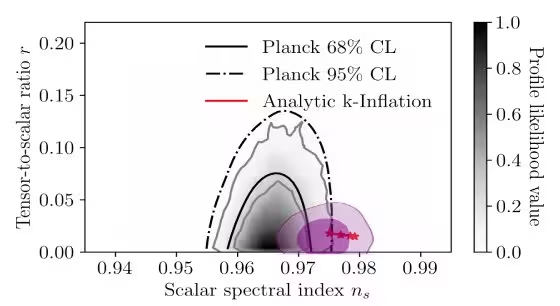
These values fit comfortably within current observational constraints, exhibiting a characteristic blue-tilted spectral index that distinguishes the framework from standard slow-roll scenarios. Furthermore, the tensor-to-scalar ratio remains well below the upper limits set by joint observations from BICEP and Planck. The framework operates as a two-parameter inflation theory, keeping the mathematical description remarkably streamlined while remaining compatible with high-precision cosmic data.
Why Does the Vacuum Model Develop a Pressure Singularity?
Despite its successes during active expansion, analyzing the pure scalar theory in a vacuum reveals a potential mathematical breakdown shortly after inflation ends. Specifically, the analytical Hubble rate drops to zero at a finite time instance while its derivative shoots to infinity, signaling a pressure singularity, or Type II finite-time singularity, about one-eighth of an e-folding past the end of inflation. In a completely empty universe, the effective pressure would diverge to infinity while energy density vanished.
However, the real Universe is not void of matter and radiation during these epochs. Radiation and cold dark matter fluids are present, and while their energy densities are heavily diluted during inflation, they redshift at different rates compared to the scalar field. As the scalar field energy density drops toward zero near the theoretical singularity, the background matter and radiation fluids begin to exert a non-negligible influence on the total cosmic energy budget.
How Do Ordinary Matter Fluids Prevent Mathematical Collapse?
To test whether physical fluids eliminate the theoretical pathology, the author performed a numerical analysis of the full cosmological system without enforcing the tracking condition by hand. The numerical simulations show that the total Hubble rate matches the pure analytical solution throughout the entirety of inflation, only deviating during the final fraction of an e-folding when matter and radiation contributions become significant.
When the background fluids take over, the tracking condition is naturally disrupted, and the numerical Hubble rate passes smoothly through the dangerous epoch instead of diverging. The calculations demonstrate that standard matter components act as a physical safety mechanism, classically avoiding the pressure singularity and allowing the Universe to transition smoothly into subsequent cosmological eras without breaking down.
The study was posted to the arXiv preprint server on November 23, 2026.
This article has been fact checked for accuracy, with information verified against reputable sources. Learn more about us and our editorial process.
Last reviewed on .
Article history
- Latest version
Reference(s)
- Oikonomou, V.. “Analytic $k$-essence Inflation.” arXiv.org <http://arxiv.org/abs/2611.30846v1>.
Cite this page:
- Posted by Farah Siddiqui