JWST Finds Two Scorching Quasars Shining at Ten Thousand Kelvins
Two newly identified ancient black holes reveal a rare, million-year transitional phase between mysterious dusty cocoons and bright quasars.
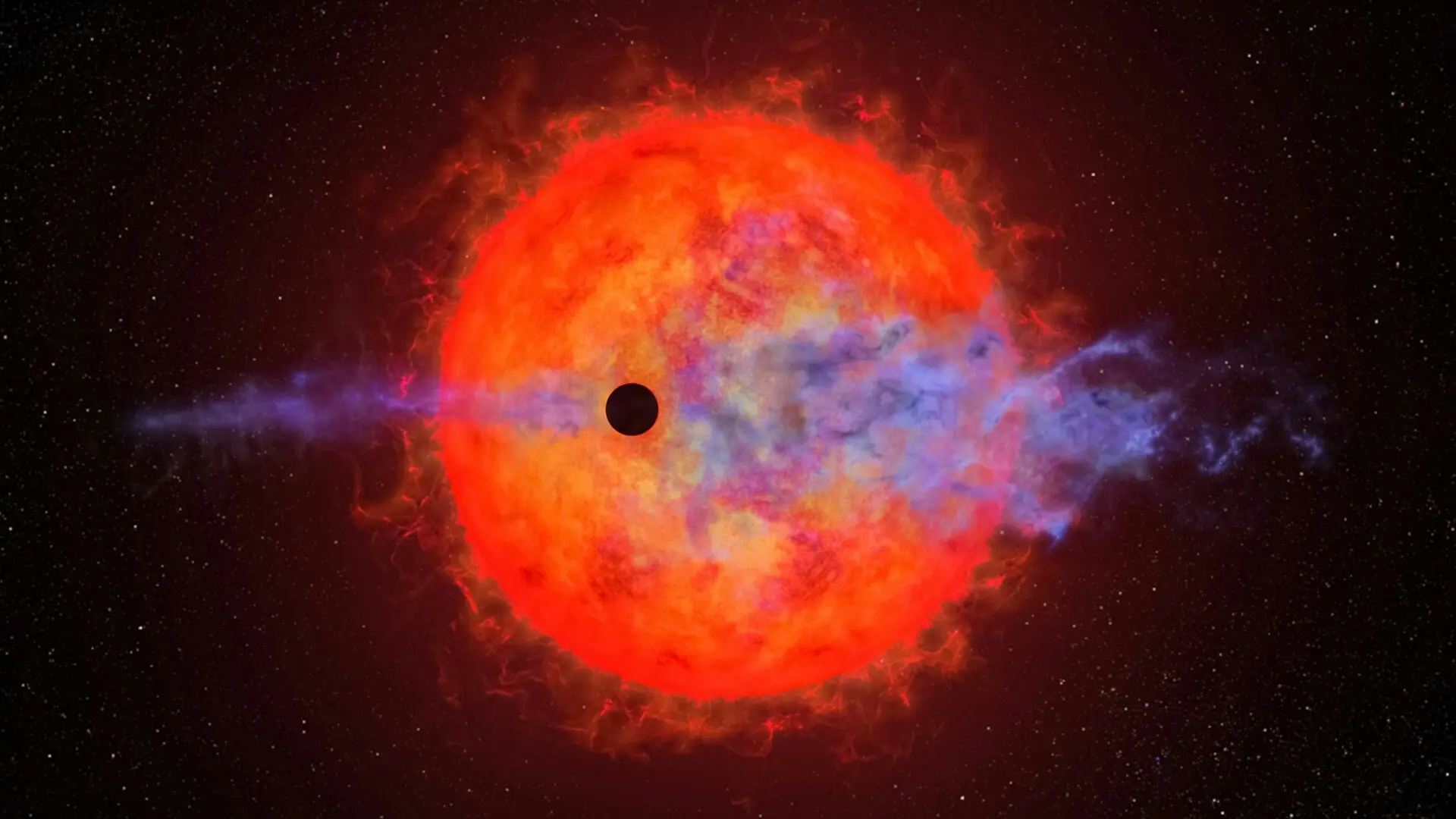
Astronomers have spotted two ancient, glowing supermassive black holes shining at about ten thousand kelvins, marking a missing evolutionary link between famously mysterious cosmic objects and standard bright quasars. The objects, named JADES1180 and GTO1215, sit roughly twelve billion light-years away at redshifts of 3.711 and 4.552, placing them in an era when the universe was just a fraction of its current age.
The discovery, available on the arXiv preprint server, centers on rare active galactic nuclei that challenge traditional models of early black hole growth. Led by Kristiphong Boonmee from Waseda University in Japan along with an international team of researchers, the study investigated archival data from the James Webb Space Telescope to find sources with an unusual lambda-shaped light profile.
In recent years, the space telescope has uncovered a bizarre population of compact active galactic nuclei nicknamed little red dots. These dense objects typically shine with a cool temperature of about five thousand kelvins and are heavily shrouded in thick gas envelopes that block X-ray and radio signals. Theorists have long predicted that as these baby quasars consume their surrounding fuel and the gas begins to clear, they should heat up significantly before evolving into standard, fully exposed quasars.
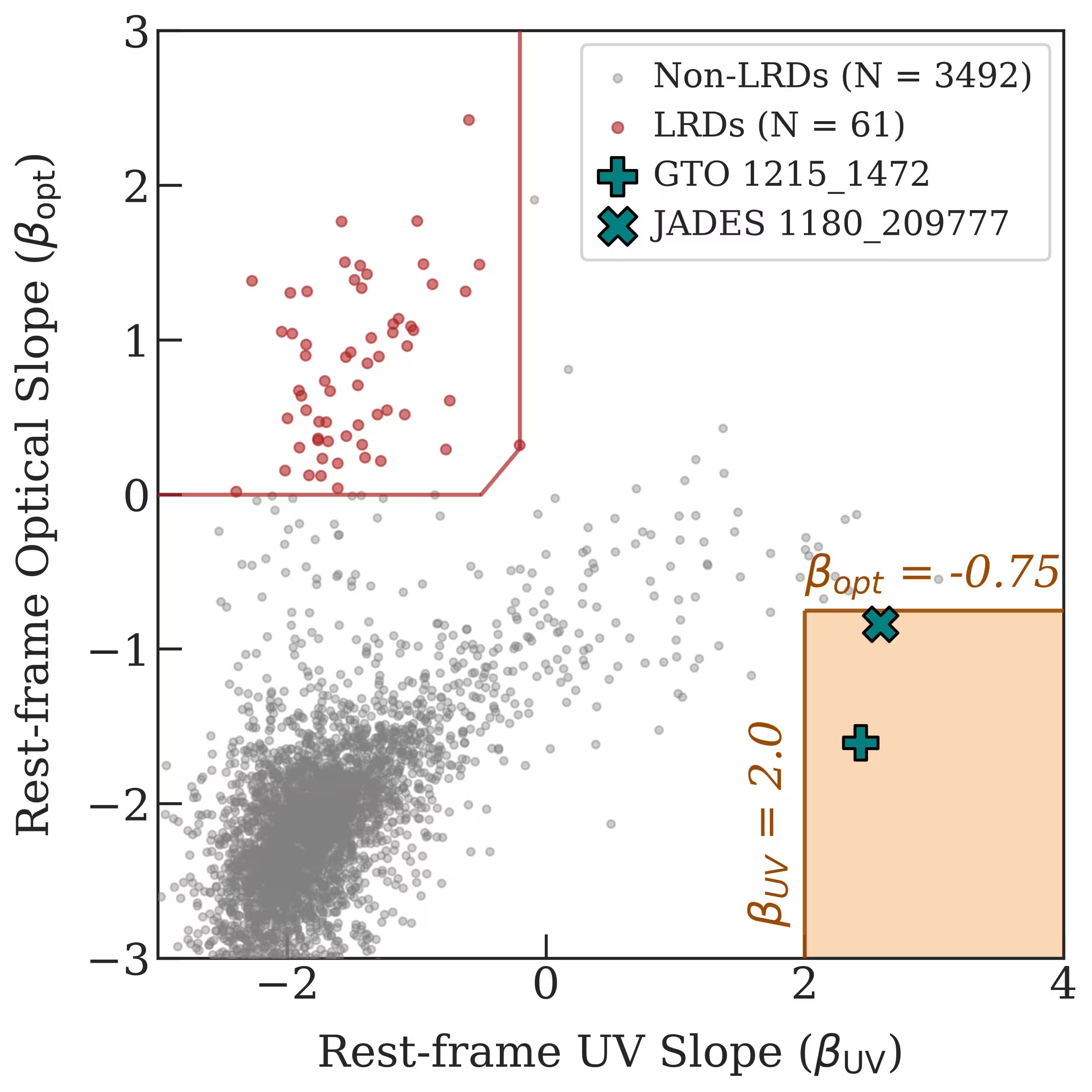
Until now, finding observational examples of this transitional phase has proven exceptionally difficult. The research team sifted through more than three thousand spectra from the Dawn JWST Archive to isolate objects showing extreme ultraviolet slopes paired with surprisingly blue optical continua. They identified JADES1180 and GTO1215 as prime candidates displaying blackbody-like temperatures roughly twice as hot as typical little red dots.
Spectral energy distribution modeling revealed that the gaseous envelopes surrounding these central engines reach temperatures between roughly seventy-six hundred and ten thousand three hundred kelvins. Despite this intense heat, their physical sizes remain remarkably compact, matching the tiny scales of their cooler precursors. The team calculated that JADES1180 houses a black hole with a mass of about eight hundred and ninety million solar masses, while GTO1215 holds roughly one billion five hundred million solar masses.
What Does X-Ray Detection Reveal About Obscured Growth?
Unlike their heavily hidden cousins, both newly identified objects show clear X-ray emissions detected by the Chandra X-ray Observatory. The measured X-ray signatures indicate that the surrounding gas is thin enough to allow radiation to escape, pointing to a clumpy or partially dispersed envelope rather than a total cosmic blanket. This transparency explains why high-energy photons can break free from the center.
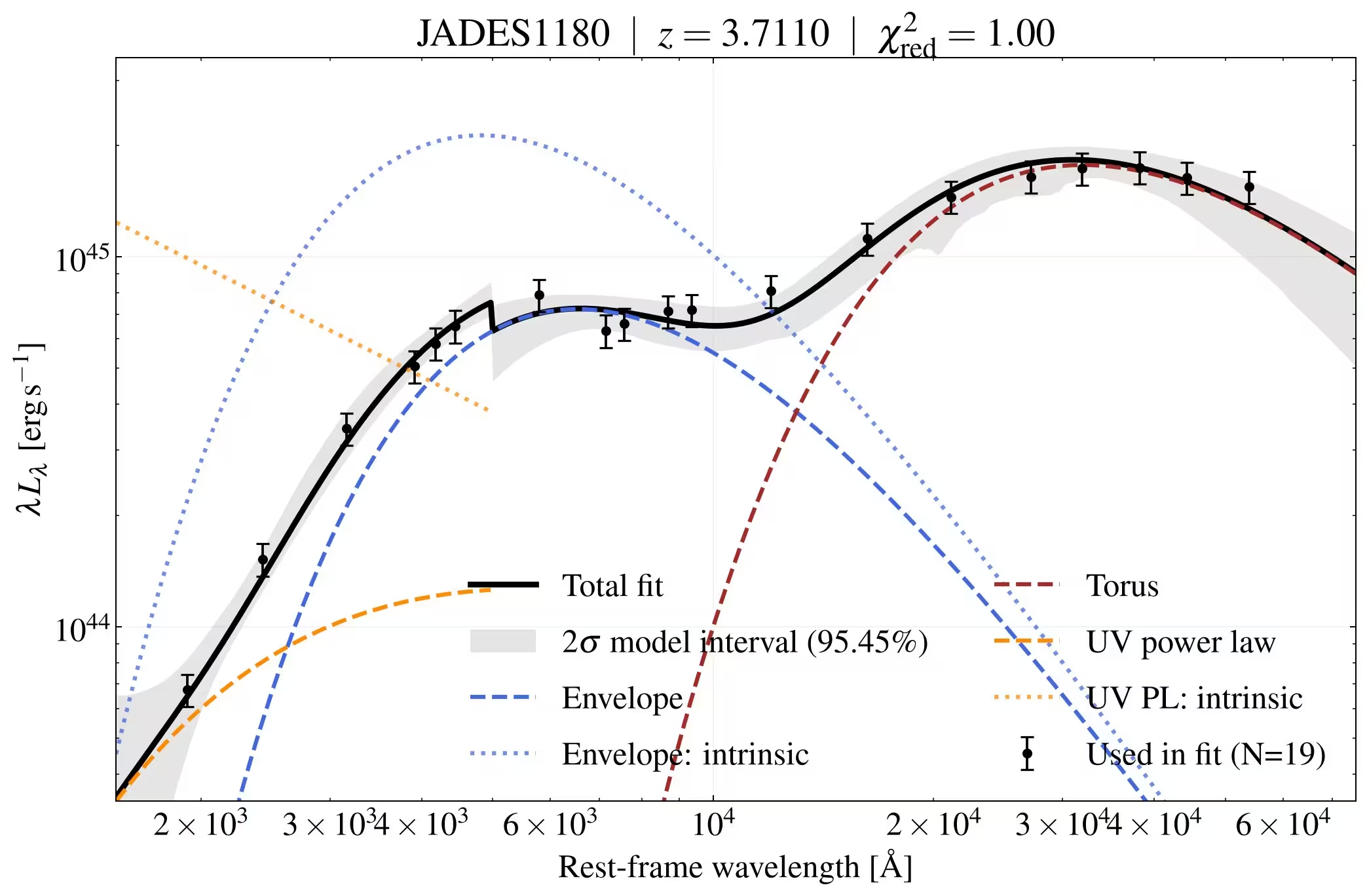
Furthermore, infrared observations reveal strong hot dust emissions with temperatures near fourteen hundred to fifteen hundred kelvins, sitting right at the threshold where cosmic dust typically melts. Far-infrared and millimeter data also suggest the presence of cooler dust originating from the host galaxies themselves, providing astronomers with a rare laboratory to study the environments surrounding these growing monsters.
How Long Does This Blazing Transition Last?
By comparing the relative population numbers of these hotter blackbody quasars with the much larger pool of little red dots, the authors calculated that this transitional phase lasts roughly one million years. Because little red dots have an estimated lifetime of about thirty million years, the brief transitional window suggests that the shedding of the gas envelope happens rapidly on a cosmic timescale.
The researchers note that while a gaseous envelope interpretation fits the data well, an alternative scenario involving an extremely steep dust extinction curve around a standard blue quasar cannot be entirely ruled out. Distinguishing between these possibilities will require further observations, but these two scorching objects provide crucial anchors for understanding how early supermassive black holes cast off their cocoons to light up the early universe.
The study was posted to the arXiv preprint server on November 20, 2026.
This article has been fact checked for accuracy, with information verified against reputable sources. Learn more about us and our editorial process.
Last reviewed on .
Article history
- Latest version
Reference(s)
- Boonmee, Kristiphong. “Hotter than Little Red Dots: Two Quasars with $T\sim10^4\,\mathrm{K}$ blackbody-like continua at $z\sim4$.” arXiv.org <http://arxiv.org/abs/2611.27856v1>.
Cite this page:
- Posted by Farah Siddiqui