Orion Star Nursery Reveals Surprising Elemental Secret In New Stellar Census
New infrared spectral data from 195 young stars across the Orion complex show consistent solar-like chemistry paired with an unexpected nitrogen shortage.

Astronomers mapping the chemical makeup of 195 young stars in the Orion star-forming complex have discovered that most core elements match solar values, while nitrogen shows a puzzling and unexpected deficit. Located about 1,300 light-years away from Earth, the Orion complex serves as a crucial cosmic laboratory for testing whether young stellar nurseries share a uniform chemical composition.
The research, published in arXiv by Ricardo López-Valdivia from the Universidad Nacional Autónoma de México and his international collaborators, analyzed high-resolution infrared spectra gathered by the Sloan Digital Sky Survey. The team focused on slow-rotating stars with speeds under 30 kilometers per second, spanning spectral types from G to M with surface temperatures between 3,500 and 5,900 Kelvin.
How Did Researchers Measure Stellar Chemistry in Orion?
To extract reliable abundances for carbon, nitrogen, oxygen, sulphur, and iron, the team employed MARCS model atmospheres alongside advanced spectral synthesis codes. Because young pre-main-sequence stars aged between 3 and 11 million years often display complex atmospheric phenomena like magnetic activity or starspots, the researchers implemented strict filtering criteria. They excluded objects with high rotation speeds and those showing signs of circumstellar dust disks or infrared excess.
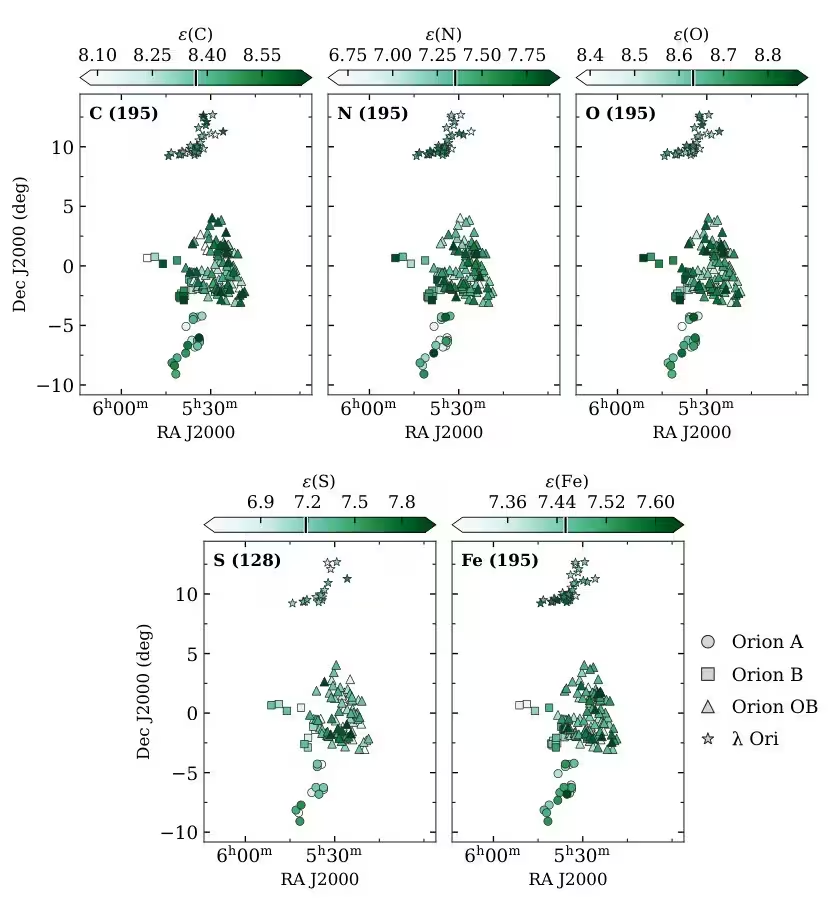
The analysis revealed median abundances of 8.37 for carbon, 7.35 for nitrogen, 8.63 for oxygen, 7.19 for sulphur, and 7.45 for iron on a logarithmic scale where hydrogen is set to 12. While carbon, oxygen, sulphur, and iron align closely with modern solar reference values within 0.1 dex, nitrogen stands out as significantly subsolar with a deficiency of nearly half a dex.
Why Is Orion Missing Nitrogen Across Its Subgroups?
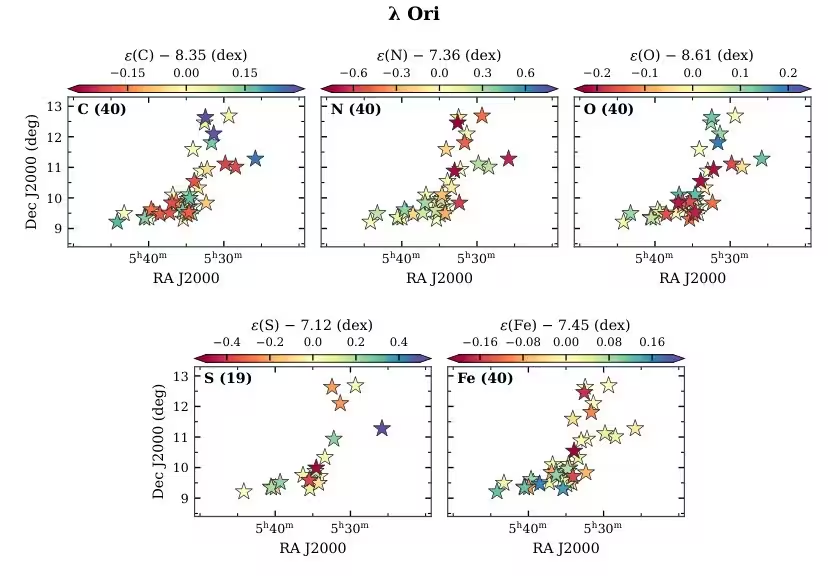
When comparing different subregions within the Orion complex, including Orion A, Orion B, Orion OB1, and Lambda Orionis, the authors found the region to be remarkably homogeneous. Statistical tests across the subgroups showed no major spatial gradients or abundance variations that would point to distinct historical enrichment events. However, Orion A exhibited a nitrogen abundance about 0.29 dex lower than Orion OB1, a difference that cannot be explained by variations in stellar temperature or surface gravity.
Because these stars are extremely young, internal nuclear reactions have not had enough time to alter their surface nitrogen levels. The authors suggest that this universal subsolar nitrogen measurement might stem from a systematic offset inherent to the molecular lines used in infrared analysis rather than a true nucleosynthetic anomaly.
How Do Young Stars Compare to the Solar Neighborhood and Nebula Gas?
The team extended their study by comparing the Orion sample with 430 nearby main-sequence field stars located within 300 light-years of the Sun. Main-sequence stars displayed slightly higher carbon, nitrogen, and oxygen levels by 0.1 to 0.2 dex, though the overall abundance patterns remained consistent given the different physical properties of contracting pre-main-sequence stars.
When contrasted against ionized gas measurements from external HII regions and star-forming galaxies found in the DEep Spectra of Ionized REgions Database, stellar iron and oxygen abundances appeared systematically higher than nebular gas readings. However, the researchers noted that agreement improves significantly when accounting for dust depletion, where metals lock onto solid grains, and temperature inhomogeneities within the gas clouds.
The findings emphasize the intricate challenges of comparing stellar photospheres directly with surrounding nebular gas. Future high-resolution observations of resolved nebulae in Orion will help clarify whether these lingering chemical offsets reflect true physical processing or remaining limitations in atmospheric modeling.
The study was posted to the arXiv preprint server on November 20, 2026.
This article has been fact checked for accuracy, with information verified against reputable sources. Learn more about us and our editorial process.
Last reviewed on .
Article history
- Latest version
Reference(s)
- López-Valdivia, Ricardo. “Atmospheric parameters and chemical abundances of young stars with APOGEE -- II. Carbon, Nitrogen, Oxygen, and Sulphur abundances in Orion.” arXiv.org <http://arxiv.org/abs/2611.27952v1>.
Cite this page:
- Posted by Aisha Ahmed