James Webb Telescope Detects Nearly Pristine Gas One Billion Years After Big Bang
Deep infrared spectroscopy reveals extreme ultraviolet radiation and remarkably low oxygen in a distant lensed galaxy, pointing toward primordial star conditions.
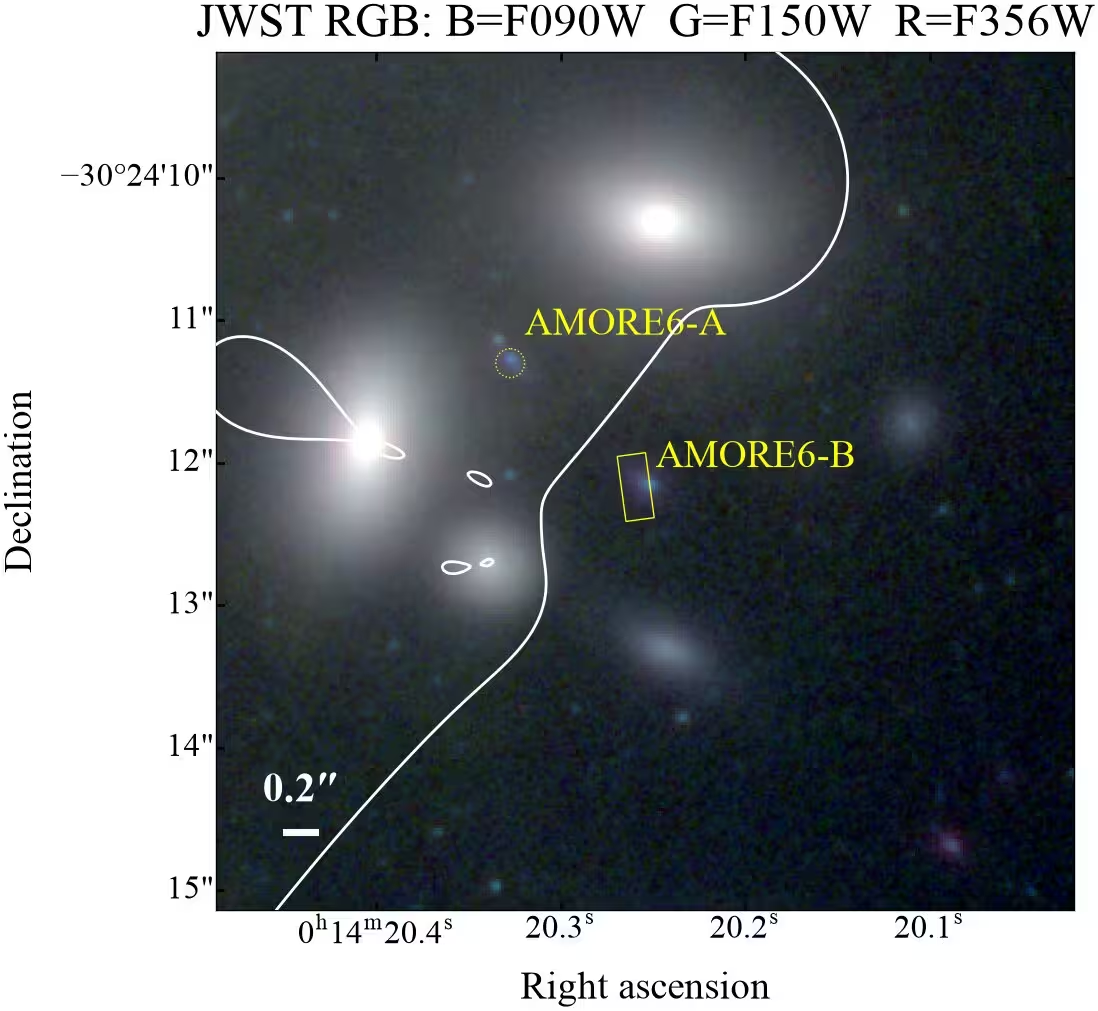
Astronomers have spotted a tiny, distant galaxy shining with nearly pristine gas and extreme ultraviolet radiation just one billion years after the Big Bang, offering a direct look at conditions reminiscent of the universe’s very first generation of stars. The object, known as AMORE6, sits behind a massive foreground galaxy cluster that magnifies its light and makes its faint signals visible to modern instruments.
Led by Takahiro Morishita of Tohoku University and an international team of researchers, the study is available on the arXiv preprint server. The team used deep spectroscopy to examine the chemical makeup of AMORE6 and found it possesses an oxygen abundance of roughly zero point zero seven six percent of the solar value, placing it far below typical galaxies of similar mass.
How Did the James Webb Space Telescope Reveal This Ancient Pocket?
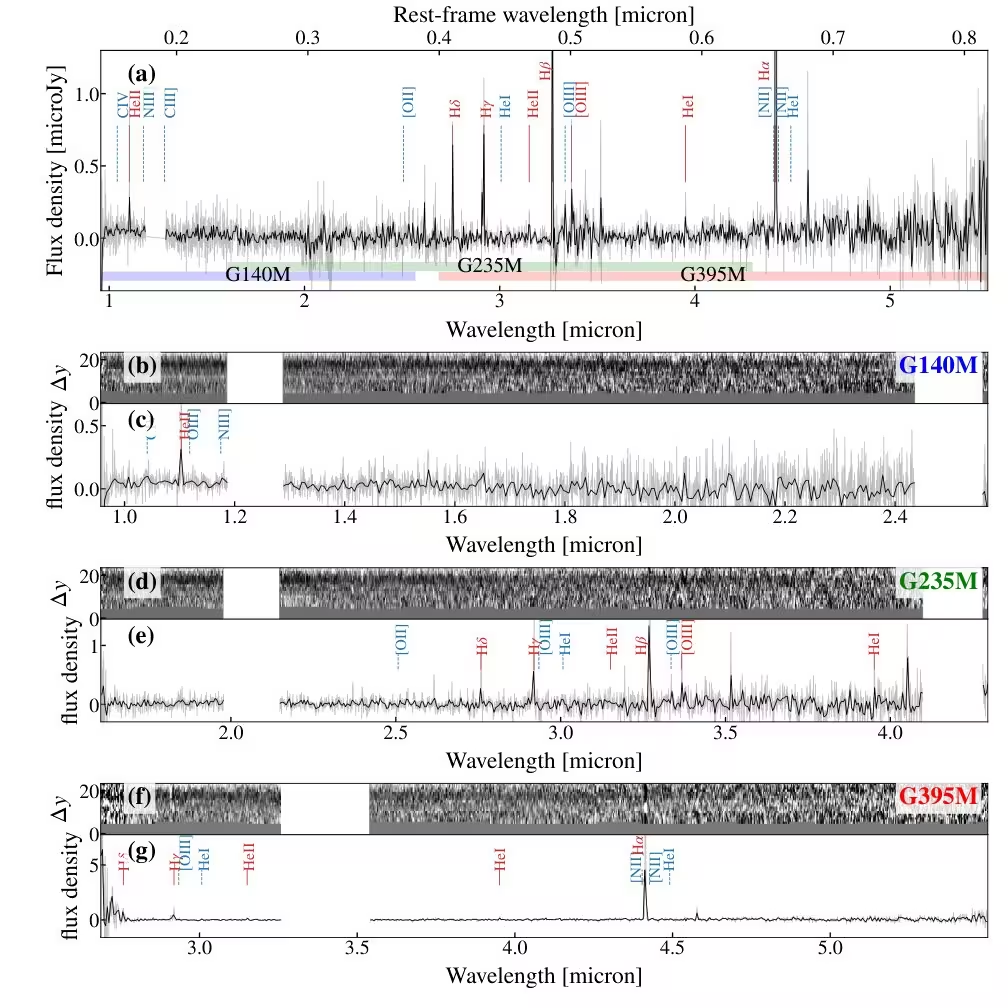
To peer into the distant system, the researchers utilized multi-object spectroscopy from the James Webb Space Telescope, capturing light across a wide wavelength range from roughly one to five and a half microns. This sensitive setup allowed the team to detect faint hydrogen recombination lines alongside rare helium emission lines that trace intense radiation fields. The strong detection of doubly ionized helium requires photons with energies exceeding fifty-four electron volts, a threshold very difficult for normal stellar populations to reach in such quantities.
The absence of heavy metal absorption lines in the spectra further confirms that the gas inside AMORE6 has experienced very little chemical enrichment over cosmic time. Such an environment is widely predicted to foster the creation of Population III stars, which are theoretical first-generation stars born entirely from hydrogen, helium, and trace lithium leftover from the Big Bang. These primordial stars are expected to grow extremely massive, reaching temperatures as high as one hundred thousand Kelvin.
Could an Accreting Black Hole Power the Radiation Field?
While the stellar explanation fits neatly with theoretical models of early star formation, the researchers note that alternative sources could contribute to the intense radiation. An intermediate-mass black hole with a mass between one thousand and ten thousand times that of our Sun could produce a similar power-law ionizing spectrum through matter accretion. However, high-resolution kinematic data from previous studies revealed a narrow hydrogen alpha profile without a dominant broad component, though complex radiative transfer effects mean an accreting black hole cannot be entirely ruled out.
The compact physical size of AMORE6, with an effective radius under thirty-six parsecs and an estimated stellar mass between one hundred thousand and five hundred thousand solar masses, strongly favors a galactic classification rather than a dense star cluster. Furthermore, the exceptionally low oxygen and carbon abundances suggest that either the galaxy has undergone very limited prior star formation or its gas has remained protected from earlier metal enrichment events.
What Does This Discovery Mean for Early Galaxy Evolution?
Finding a pocket of gas this pristine nearly one billion years after the formation of the universe demonstrates that isolated pockets of primordial material managed to survive long after cosmic dawn began. The combination of extreme ionization and extremely low metallicity points toward a top-heavy initial mass function, meaning the stars forming in this galaxy tend to be much larger than those seen in the modern universe.
Future observations will continue to test whether AMORE6 hosts genuine Population III stars or an early black hole engine. By studying such rare, magnified laboratories, astronomers hope to piece together how the earliest stars began the chemical enrichment that eventually led to rocky planets and life.
The study was posted to the arXiv preprint server on November 20, 2026.
This article has been fact checked for accuracy, with information verified against reputable sources. Learn more about us and our editorial process.
Last reviewed on .
Article history
- Latest version
Reference(s)
- Morishita, Takahiro. “Nearly pristine gas and hard ionizing radiation one billion years after the Big Bang.” arXiv.org <http://arxiv.org/abs/2611.27979v1>.
Cite this page:
- Posted by Karan Das