AI Reveals Deep Stellar Secrets by Predicting Hidden Interior Glitches in Aging Red Giant Stars
Machine learning models trained on stellar data recover internal acoustic glitches with high precision, shedding light on red giant interiors.

A new machine-learning approach can successfully predict internal structural properties of aging red giant stars using only their global observables, offering a shortcut to analyzing massive astronomical datasets. Researchers examined how well standard stellar metrics can reveal subtle acoustic disruptions hidden deep inside these aging stars, which span up to two solar masses.
Asteroseismology measures stellar oscillations to peer beneath a star’s luminous outer layers, much like geologists use seismic waves to map Earth’s interior. In red giants, specific acoustic signatures known as buoyancy glitches mark sharp compositional boundaries left behind as convective envelopes retreat inward. Traditionally, extracting these hidden markers requires intensive, model-dependent seismic analysis that is difficult to scale up to millions of targets observed by space telescopes.
How Well Can Algorithms Map Star Interiors?
To test whether artificial intelligence could bypass these complex calculations, researcher Chen Jiang from the Max Planck Institute for Solar System Research analyzed a grid of 12,580 synthetic stellar models representing low-luminosity red giants. The models covered masses ranging from 1.0 to 2.0 solar masses across three distinct chemical compositions during the evolutionary phase before the stellar luminosity bump.
Using gradient-boosted tree regressors—specifically implementing algorithms like XGBoost and LightGBM—the author trained machine learning models to predict three key glitch features: amplitude, location, and width. The input features fed into the algorithms consisted of five stellar properties, including mass, radius, luminosity, metallicity, and effective temperature, alongside two seismic properties known as the frequency of maximum oscillation power and the mean large frequency separation.
The study, available on the arXiv preprint server, reveals that the models can determine glitch location and width with exceptional precision, achieving test-set coefficient of determination values of 0.98 and 0.97, respectively. However, predicting the amplitude proved considerably more difficult, yielding a moderate coefficient of determination value of 0.68.
Why Do Some Interior Features Prove Harder to Predict?
Further analysis using Shapley Additive exPlanations, a method that breaks down how machine learning models arrive at specific predictions, clarified why certain features are easier to recover than others. The evaluation showed that effective temperature and the frequency of maximum oscillation power dominate the predictions, accounting for up to 75% of the total model importance. Stellar mass consistently ranked third, while metallicity, radius, and luminosity played minor roles.
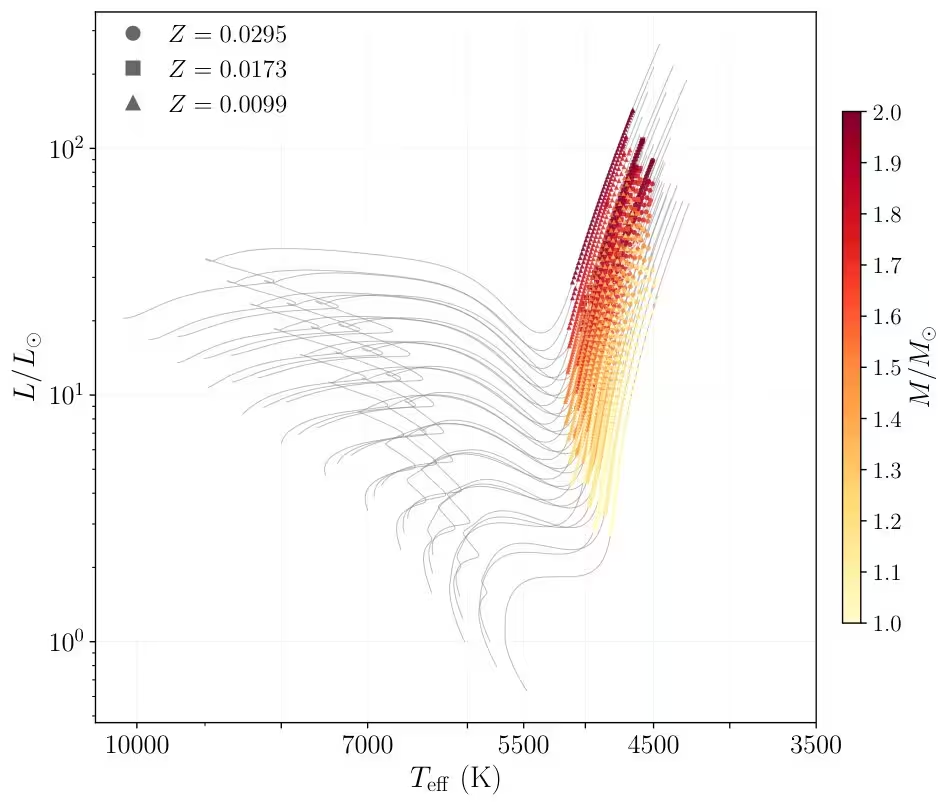
This hierarchy indicates that the regressors rely primarily on the overall evolutionary state of the star rather than direct sensitivities to the glitch itself. As a red giant evolves, its convective envelope retreats, causing the glitch location and width to change in a smooth, predictable manner that correlates strongly with global surface properties.
The lower predictability of the glitch amplitude stems from complex physical processes occurring during specific transition phases. Specifically, the drop in amplitude recovery is concentrated in an intermediate evolutionary window where the buoyancy glitch sits directly within the evanescent zone between the convective envelope and the gravity-mode cavity. In this region, mixed-mode coupling changes rapidly, introducing intrinsic physical scatter that standard evolutionary trends cannot easily smooth away.
What Limits This Machine Learning Approach?
While these findings suggest that global stellar properties can provide direct estimates of buoyancy glitches and help prioritize targets for future surveys like PLATO, several limitations remain. The models were trained exclusively on synthetic stars generated with simplified physics, omitting phenomena like magnetic fields, internal rotation, atomic diffusion, and convective overshooting.
Real observational data will also introduce measurement uncertainties in temperature and seismic frequencies, which can propagate into the predictions and increase error margins. Future refinements incorporating local seismic diagnostics, such as mixed-mode period spacings, could help improve amplitude recovery and bridge the gap between theoretical models and real stellar observations.
The study was posted to the arXiv preprint server on November 20, 2026.
This article has been fact checked for accuracy, with information verified against reputable sources. Learn more about us and our editorial process.
Last reviewed on .
Article history
- Latest version
Reference(s)
- Chen, Jiang. “Recovering buoyancy-glitch parameters in low-luminosity red giants from global stellar properties with machine learning.” arXiv.org <http://arxiv.org/abs/2611.27954v1>.
Cite this page:
- Posted by Nida Rehman