Ancient Dwarf Galaxy Flyby Left Permanent Scars In The Milky Way Disc
Computer simulations reveal that a single high-speed encounter from an ancient satellite permanently thickened older stars while leaving younger populations untouched.
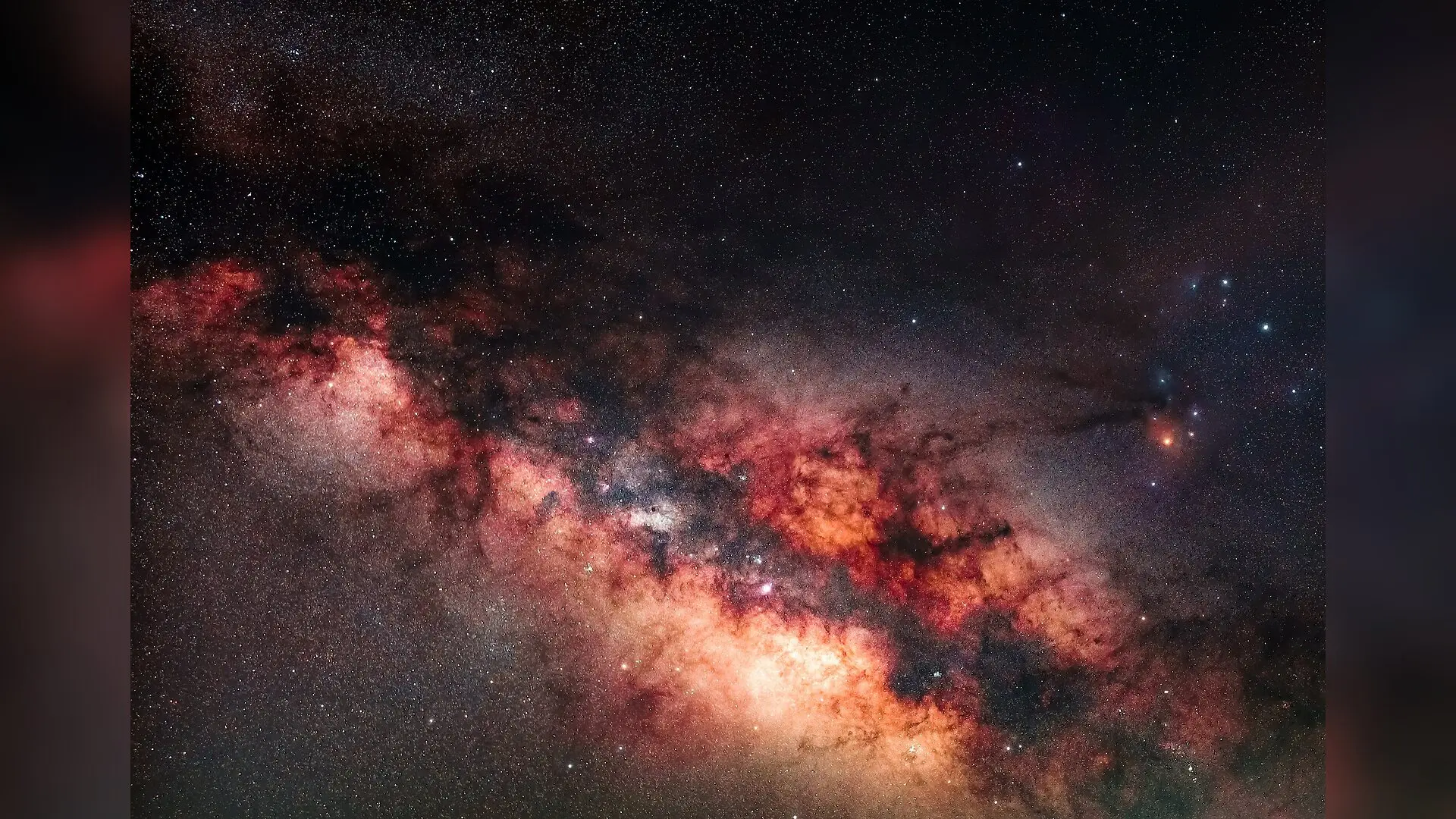
A single high-speed flyby from a massive dwarf galaxy can leave permanent, datable scars in the vertical structure of a host galaxy’s stellar disc, according to new galactic simulations. Researchers found that older stars present during an ancient satellite encounter remain permanently thickened and dynamically hotter today, while younger stars born afterward show no such disturbance.
Astronomers have long debated how ancient galactic encounters shape the architecture of galaxies like our own. While stellar streams in the outer halo are well documented, detecting the lasting impacts of a flyby on a disc has remained challenging. To investigate this, Payel Das and Jason A. S. Hunt from the University of Surrey constructed controlled computer models representing a Milky-Way-like host galaxy and a massive satellite resembling the Sagittarius dwarf galaxy. Their findings are available on the arXiv preprint server (arXiv:2611.27898).
How did the researchers simulate the ancient dwarf galaxy encounter?
The team designed four different numerical experiments to isolate how satellite mass and velocity affect a galactic disc over time. One model served as an isolated control with no satellite, while the other three simulated a Milky-Way-like host encountering a Sagittarius-like companion on an unbound polar orbit about seven billion years ago. In these interaction runs, the satellite crossed through the outer disc at speeds ranging from 466 to 634 kilometers per second, passing within roughly 15 to 18 kiloparsecs of the galactic center.
By tracking particle distributions across simulated stellar age bins, the authors analyzed how the disc responded to the rapid gravitational kick. Because the satellite crossed the disc in roughly 60 to 70 million years, which is much faster than the vertical oscillation period of the outer disc stars, the encounter acted as an impulsive shock. This sudden energy transfer permanently altered the kinematics of stars that already existed at the time of the passage.
What structural changes appeared in the simulated disc?
The simulations revealed that stars old enough to have experienced the passage were thickened by up to 37 per cent in mass-enclosed height compared to the isolated control host. Furthermore, these older populations exhibited an increase in vertical velocity dispersion of up to about 5 kilometers per second. In contrast, stars that formed after the interaction concluded remained completely unaffected by the flyby, preserving a sharp boundary in the disc’s fossil record.
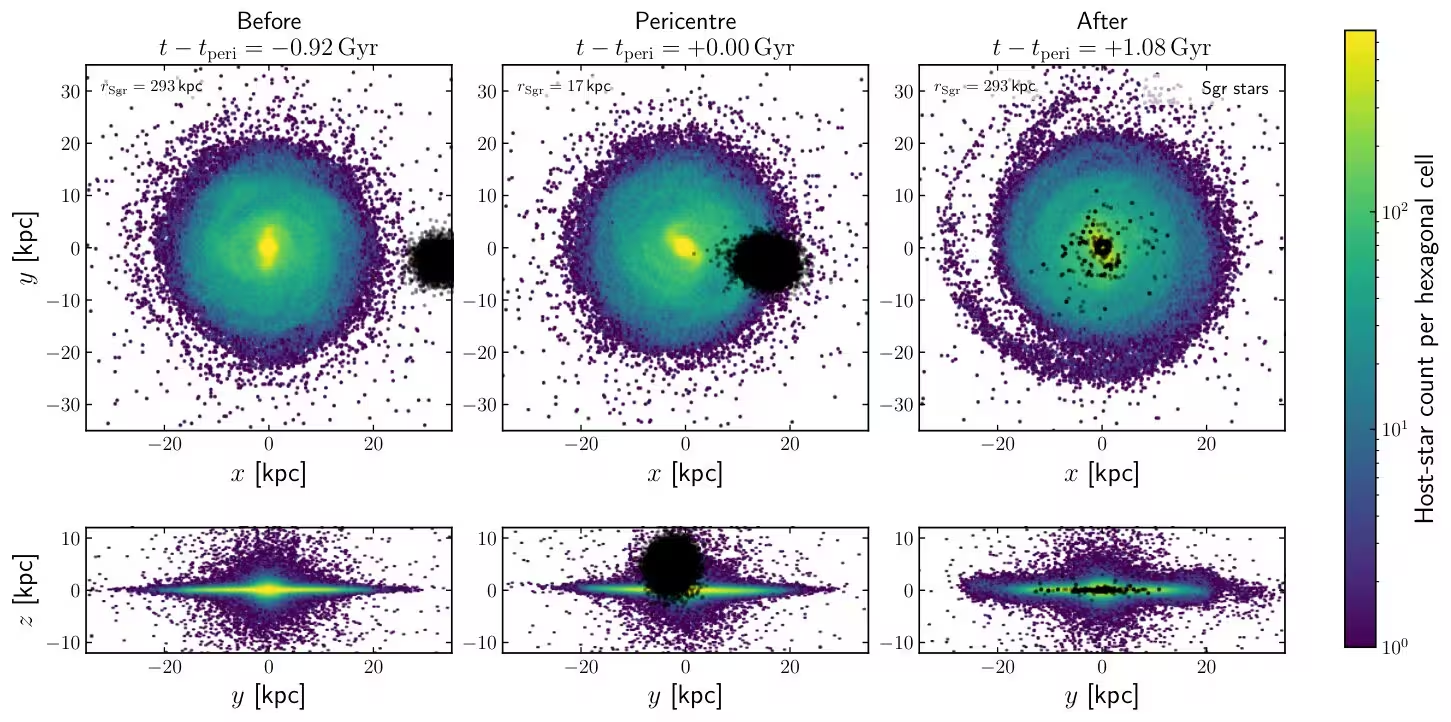
When the satellite was modeled with a 50 per cent larger mass, the vertical heating became even more pronounced and concentrated near the specific radius where the satellite crossed the disc. This localized peak reflects the physical reality that the inner regions of a galactic disc experience adiabatic shielding, meaning they are partially protected from outer gravitational shocks.
Could this explain the history of the Milky Way?
The simulated signatures closely mirror recent observational data from our own Galaxy. Previous studies of Gaia satellite data revealed a sharp jump in vertical velocity dispersion in the outer low-alpha disc of the Milky Way, pointing to an early encounter with the Sagittarius dwarf roughly 5 to 7 billion years ago. The new simulations demonstrate that a single, non-merging passage from a massive satellite can deposit the exact amount of energy needed to generate these observed anomalies.
However, the authors note several limitations in their idealized models. The simulated host disc was significantly colder than the real Milky Way before the encounter, and the model did not account for subsequent cosmological accretion events or additional satellites like the Large Magellanic Cloud. Future modeling with higher resolution and more complex galactic environments will help refine these mass estimates and clarify how ancient galactic collisions shape stellar populations.
The study was posted to the arXiv preprint server on November 20, 2026.
This article has been fact checked for accuracy, with information verified against reputable sources. Learn more about us and our editorial process.
Last reviewed on .
Article history
- Latest version
Reference(s)
- Das, Payel. “An early interaction between the Sagittarius dwarf and the Milky Way I: Fossil signatures in the phase-space structure of the disc.” arXiv.org <http://arxiv.org/abs/2611.27898v1>.
Cite this page:
- Posted by John Williams