Space Telescope Data Reveals Restless Flickering Hidden Inside Elusive Mid-Sized Black Holes
An eight-year analysis of space observations detects rapid brightness changes in twenty candidate intermediate-mass black holes, though limitations in telescope windows complicate mass estimates.
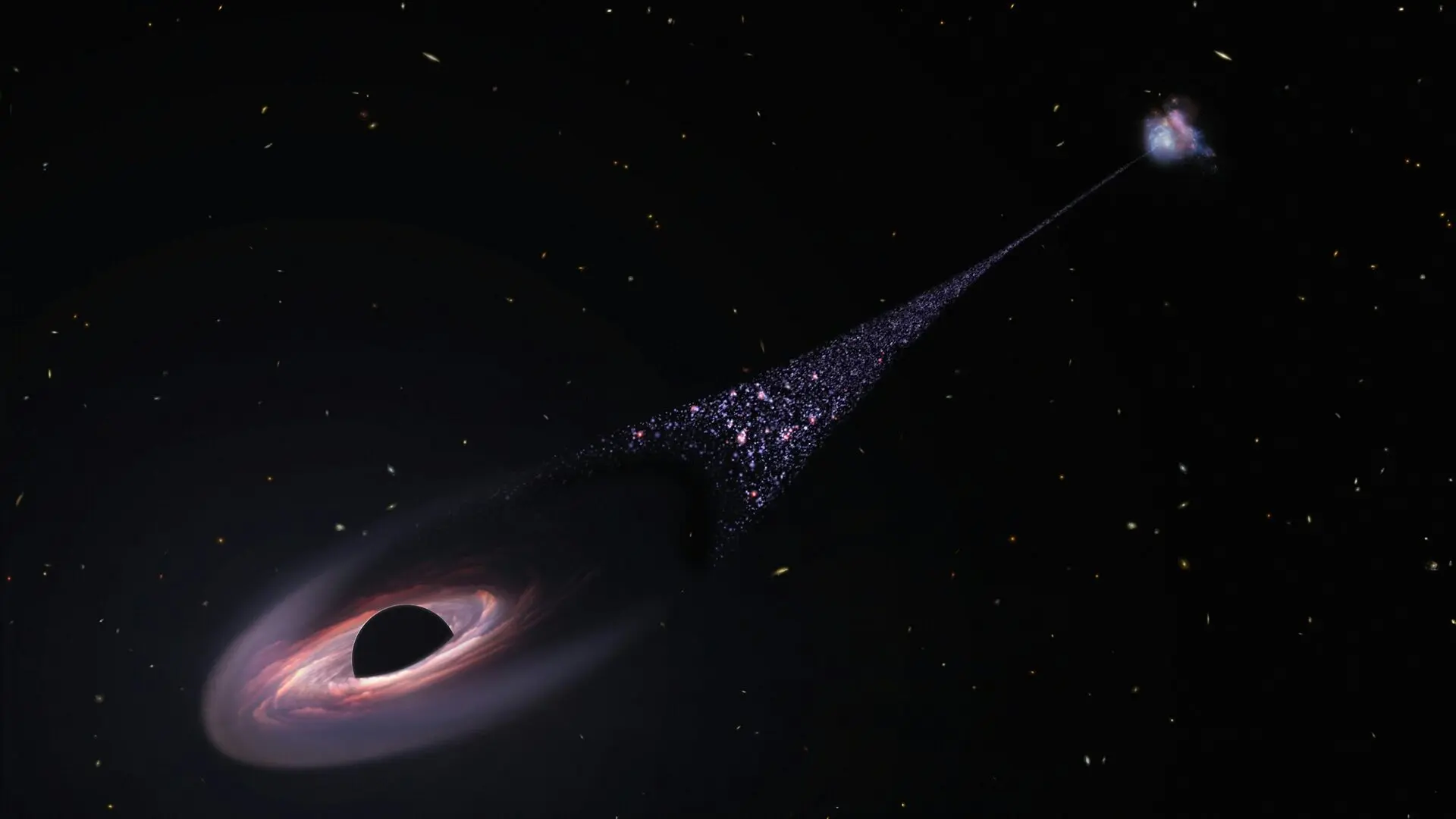
Astronomers tracking elusive black holes hidden inside the centers of small galaxies have found that space telescope data can reveal their restless feeding habits, though the method comes with unexpected limitations. By combing through eight years of observations, an international research team detected flickering light signals from twenty candidate intermediate-mass black holes, objects that weigh between one hundred and one million times the mass of our Sun.
Finding these mid-sized black holes has notoriously frustrated astronomers because their gravitational pull is too weak to create the dramatic swallowing acts seen around supermassive giants, while their host galaxies easily outshine them. To overcome this, the study, available on the arXiv preprint server, focused instead on how active galactic nuclei, regions where matter crashes violently into a central black hole, change in brightness over time.
How Do Space Telescopes Catch Elusive Black Holes in the Act?
Led by astronomer Jinghuai Yao from the University of Wisconsin-Madison, the research group turned to the Transiting Exoplanet Survey Satellite, a spacecraft originally built to spot alien worlds crossing in front of distant stars. Because the telescope stares continuously at patches of the sky for twenty-eight days at a time, it captures rapid changes in brightness that happen over hours or days, matching the theoretical flickering speed expected from mid-sized black holes.
The team analyzed four hundred ten potential targets by running the telescope’s full-frame images through an automated data reduction pipeline. They designed specific metrics to measure amplitude contrast, checking whether the central source flickered much brighter than its surrounding background, and correlation confidence, making sure the pixels belonging to the target varied together synchronously rather than picking up stray noise from nearby stars or instrumental glitches.
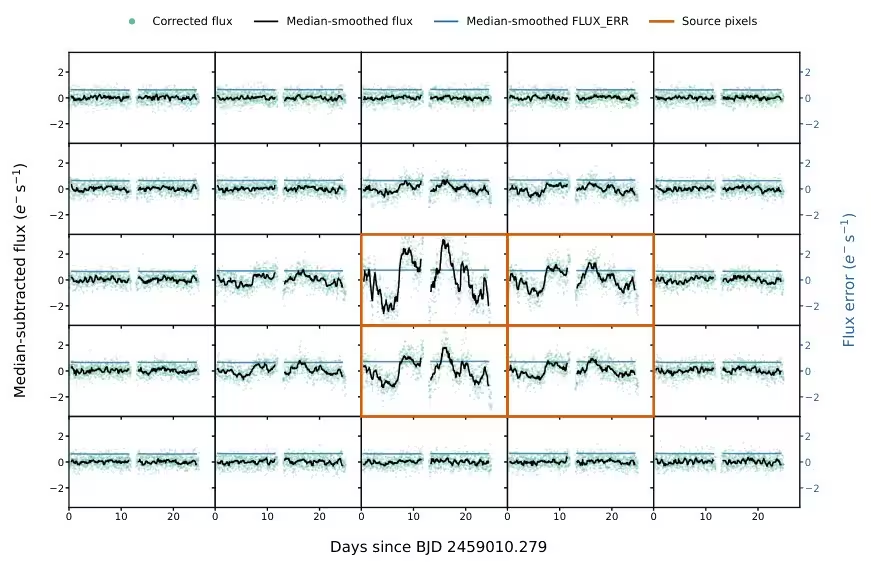
Out of the entire pool, the analysis flagged three sources with high-confidence optical variability and seventeen with medium confidence. All three high-confidence objects turned out to be well-documented nearby active galaxies with known historical flickering, validating the reliability of the automated screening process.
What Does the Flickering Reveal About Black Hole Mass?
When the researchers fitted the flickering patterns using a statistical model known as a damped random walk, which describes how long a system remembers its previous brightness state, they noticed a tentative mathematical link. The timescale over which the light curves lost their memory appeared to increase alongside the mass of the central black hole.
However, the data revealed a twist. The estimated timescales for these mid-sized objects generally fell below the established trends seen in heavier supermassive black holes. The team suggests that the twenty-eight-day viewing window of the telescope might cut off longer fluctuations, causing mathematical models to systematically underestimate how slowly the largest black holes in this sample actually vary.
Why Do Instrumental Artifacts Complicate the Search?
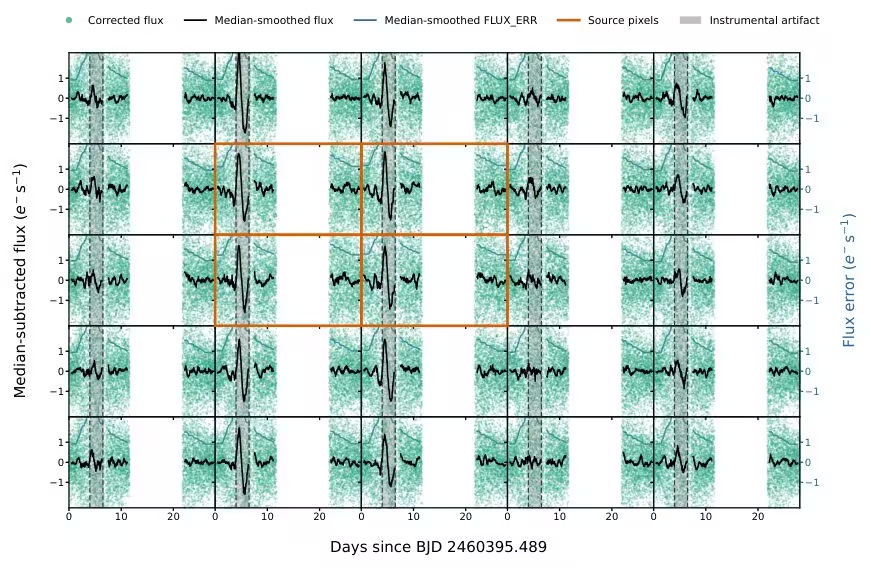
The space telescope’s design introduces unique hurdles for astronomers studying distant galactic nuclei. The instrument possesses a relatively broad pixel scale, meaning light from nearby variable stars or neighboring background sources can easily bleed into the target aperture and mimic true black hole flickering.
To test whether instrumental noise skewed their results, the authors conducted injection and recovery simulations, artificially feeding synthetic light curves into their software pipeline. The tests demonstrated that intrinsic fluctuations lasting longer than three days become increasingly difficult to recover accurately within a standard twenty-eight-day observation sector.
While the telescope provides unprecedented high-cadence coverage, its shallow limiting magnitude means that starlight from the host galaxy often washes out subtle variations in fainter targets. As a result, the authors caution that future observatories with longer monitoring baselines and sharper optics will be required to firmly establish the mass-timescale relationship for intermediate-mass black holes.
The study was posted to the arXiv preprint server on November 20, 2026.
This article has been fact checked for accuracy, with information verified against reputable sources. Learn more about us and our editorial process.
Last reviewed on .
Article history
- Latest version
Reference(s)
- Yao, Jinghuai. “A TESS Search for Optical Variability in Intermediate-mass Black Hole Candidates.” arXiv.org <http://arxiv.org/abs/2611.27890v1>.
Cite this page:
- Posted by Deepak Malhotra