New AI Framework Unlocks Hidden Gravitational Waves From Noisy Space Data
Researchers deploy a physics-aware transformer to rapidly separate faint cosmic signals from instrumental noise and mechanical glitches in simulated LISA observations.
A sophisticated new artificial intelligence framework successfully disentangles faint gravitational wave echoes from the roaring noise of space and millions of overlapping stars, offering a revolutionary shortcut for decoding data from Europe’s upcoming space observatory. Led by researcher Iuliu Cuceu at the Côte d’Azur Observatory, the team tested an advanced transformer architecture called the Simformer, capable of navigating complex data streams that have long plagued conventional astrophysical analysis.
The Laser Interferometer Space Observatory (LISA), scheduled to launch in the 2030s, will trail Earth in a triangular formation of three spacecraft separated by millions of kilometers. It aims to detect ripples in spacetime known as gravitational waves. However, the instrument will operate in an environment drowning in foreground signals, including roughly thirty million white dwarf binaries in our Milky Way galaxy alone, alongside instrumental noise fluctuations and sudden mechanical glitches. Traditionally, separating these interwoven noise components requires immensely heavy computational pipelines that evaluate complex mathematical likelihoods one data set at a time.
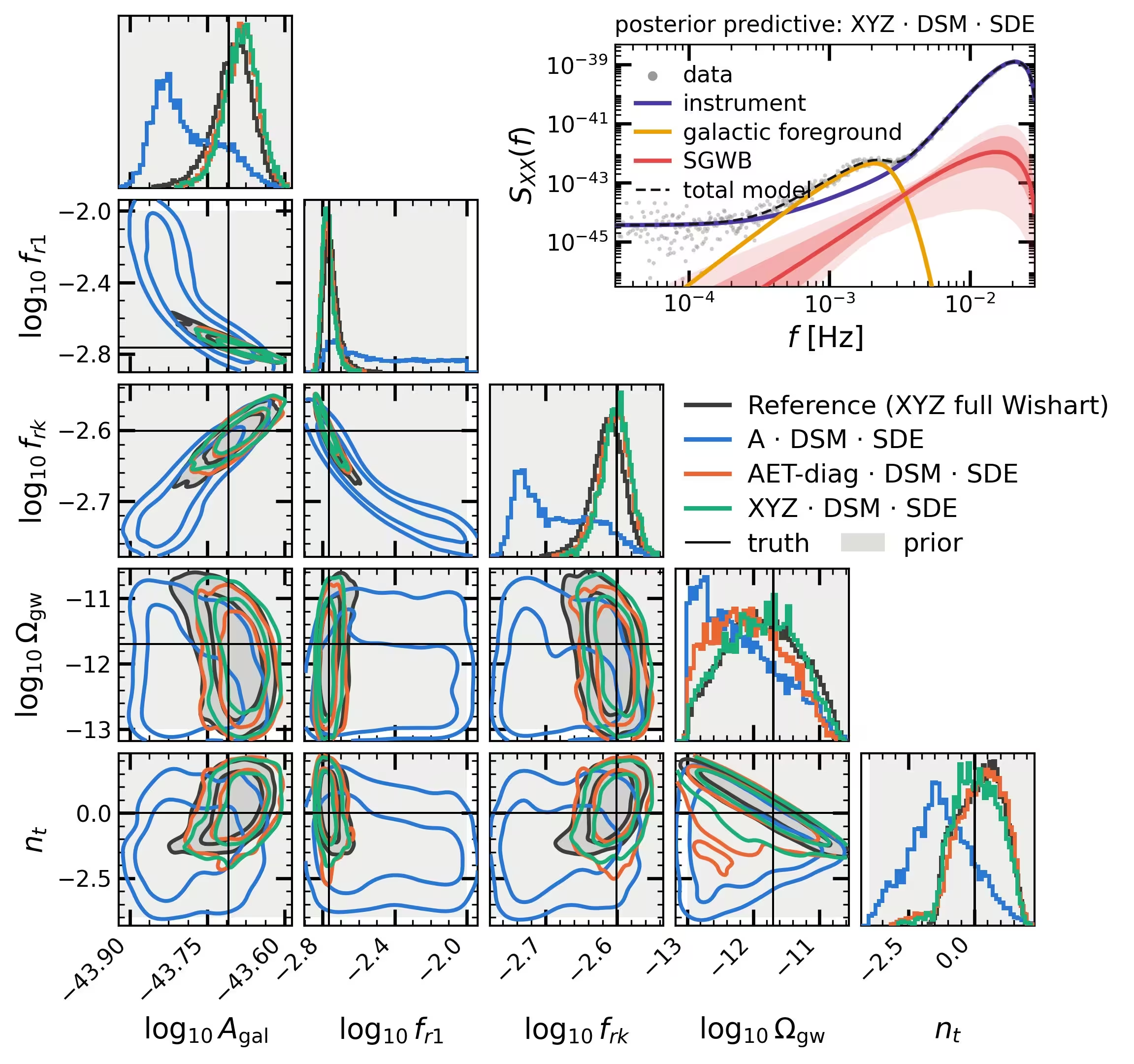
To overcome this computational bottleneck, the researchers turned to simulation-based inference, a machine learning paradigm that trains neural networks on millions of simulated observations rather than computing explicit mathematical likelihoods. As detailed in a study published on the arXiv preprint server, the Simformer ingests the full spectral matrix of the detector using a physics-aware embedding scheme, allowing it to rapidly estimate probability distributions for instrumental noise, the Galactic foreground, and a faint cosmological stochastic gravitational wave background.
How Does The AI Handle Imperfect Space Data?
Real space missions rarely deliver clean, uninterrupted streams of data. Spacecraft orbits stretch unevenly, thermal shifts alter instrumental noise levels across different links, and tiny mechanical impacts from cosmic dust create sharp instrumental glitches roughly two or three times a day. Furthermore, routine antenna maintenance creates multi-hour data gaps that disrupt continuous observation.
Instead of discarding corrupted data or assuming ideal conditions, the team fed their network data segments containing realistic glitch rates, time-varying noise profiles, and missing chunks. The Simformer treats time as a sequence of tokens, allowing it to process gapped data seamlessly by representing missing periods as zeros while maintaining proper contextual dependencies through specialized attention masks.
Can Neural Networks Match Traditional Statistical Precision?
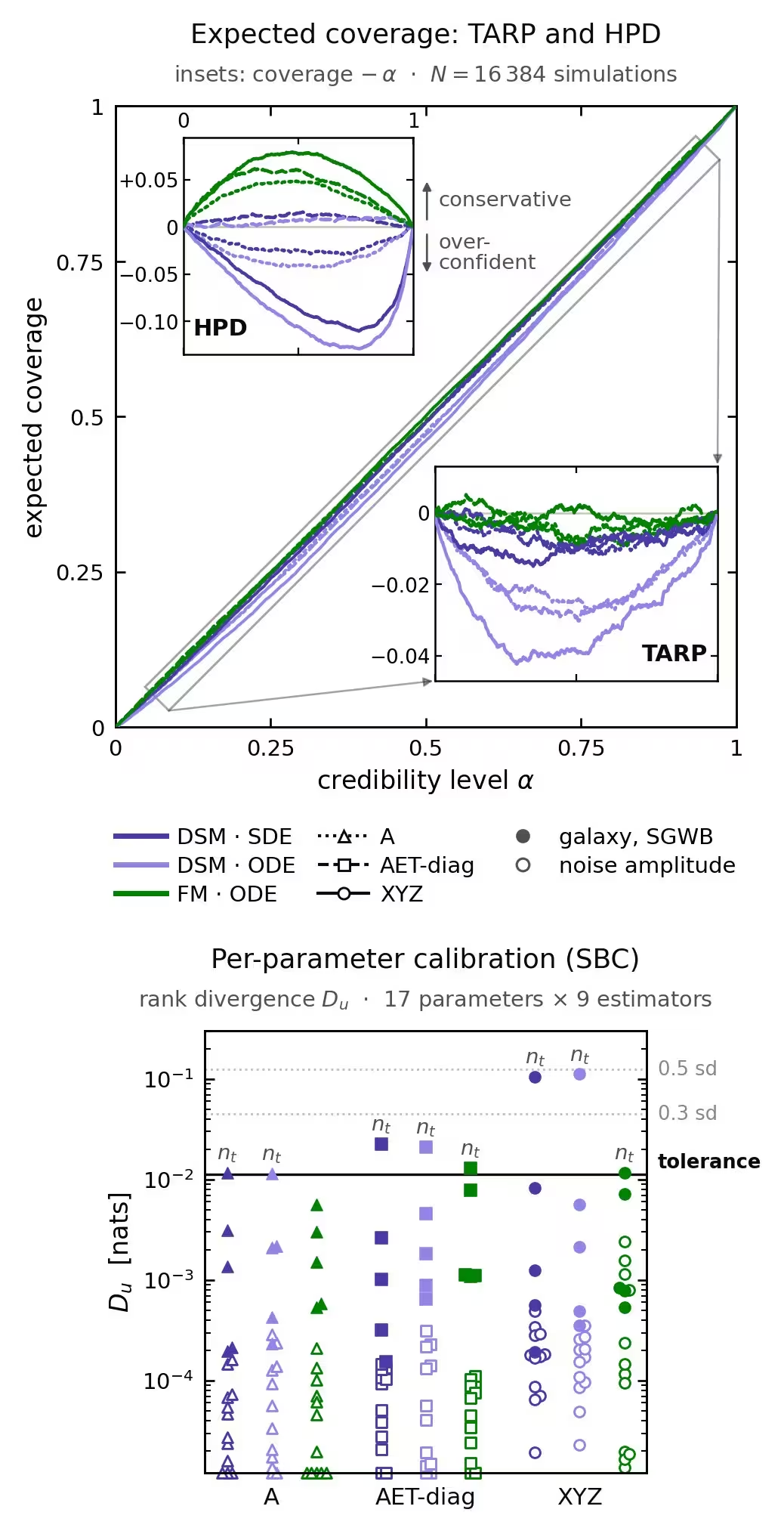
To ensure the artificial intelligence was not hallucinating physical features, the team subjected their network outputs to rigorous statistical validation. Using population-level calibration tests and a novel localized simulation-based calibration technique, they verified that the network’s uncertainty estimates remained accurate even when handling high-dimensional parameter spaces involving up to thirty-seven distinct variables.
The results indicate that full spectral matrix data is vital for constraining optical metrology system noise parameters on individual detector links, whereas traditional diagonal channel approximations fail to capture these crucial details. Furthermore, the network demonstrated an ability to marginalize over unexpected transients like instrumental glitches and massive black hole binary signals without biasing the underlying cosmological background measurements.
What Happens Next For Space-Based Gravitational Wave Astronomy?
While the current study utilized simulated data spanning less than twelve days, the successful deployment of amortized simulation-based inference opens exciting avenues for future mission operations. The framework could serve as an automated instrument monitor, providing real-time assessments of detector health, or act as an initial search engine to generate starting points for intensive global fits.
As researchers continue to refine the underlying simulators to include more intricate astrophysical sources and complex spacecraft dynamics, machine learning approaches like the Simformer may become indispensable tools. By bridging the gap between raw instrumental readouts and high-precision Bayesian inference, these methods ensure that scientists can extract every possible whisper of the early universe from the noisy expanse of space.
The study was posted to the arXiv preprint server on November 20, 2026.
This article has been fact checked for accuracy, with information verified against reputable sources. Learn more about us and our editorial process.
Last reviewed on .
Article history
- Latest version
Reference(s)
- Cuceu, Iuliu. “Diffusing the assumptions: towards realistic LISA stochastic component separation with physics-aware simulation-based inference.” arXiv.org <http://arxiv.org/abs/2611.27848v1>.
Cite this page:
- Posted by Karan Das