Warming Climate Threatens to Eradicate Colombia’s Last Tropical Glaciers by Mid-Century
New modeling reveals that lower-elevation ice masses in the Colombian Andes could lose all suitable habitat as early as 2040.

Rising temperatures are threatening to wipe out nearly all suitable habitat for Colombia’s remaining tropical glaciers by the middle of the century, according to new research mapping the future of these fragile high-altitude ice masses.
Only six glacier areas survive near the equator in Colombia today, spanning a fraction of their historical size after decades of continuous recession. Researchers combined computer models of environmental suitability with decades of field measurements to understand what is driving the rapid disappearance of these icy landmarks.
How close are Colombian glaciers to complete vanishing point?
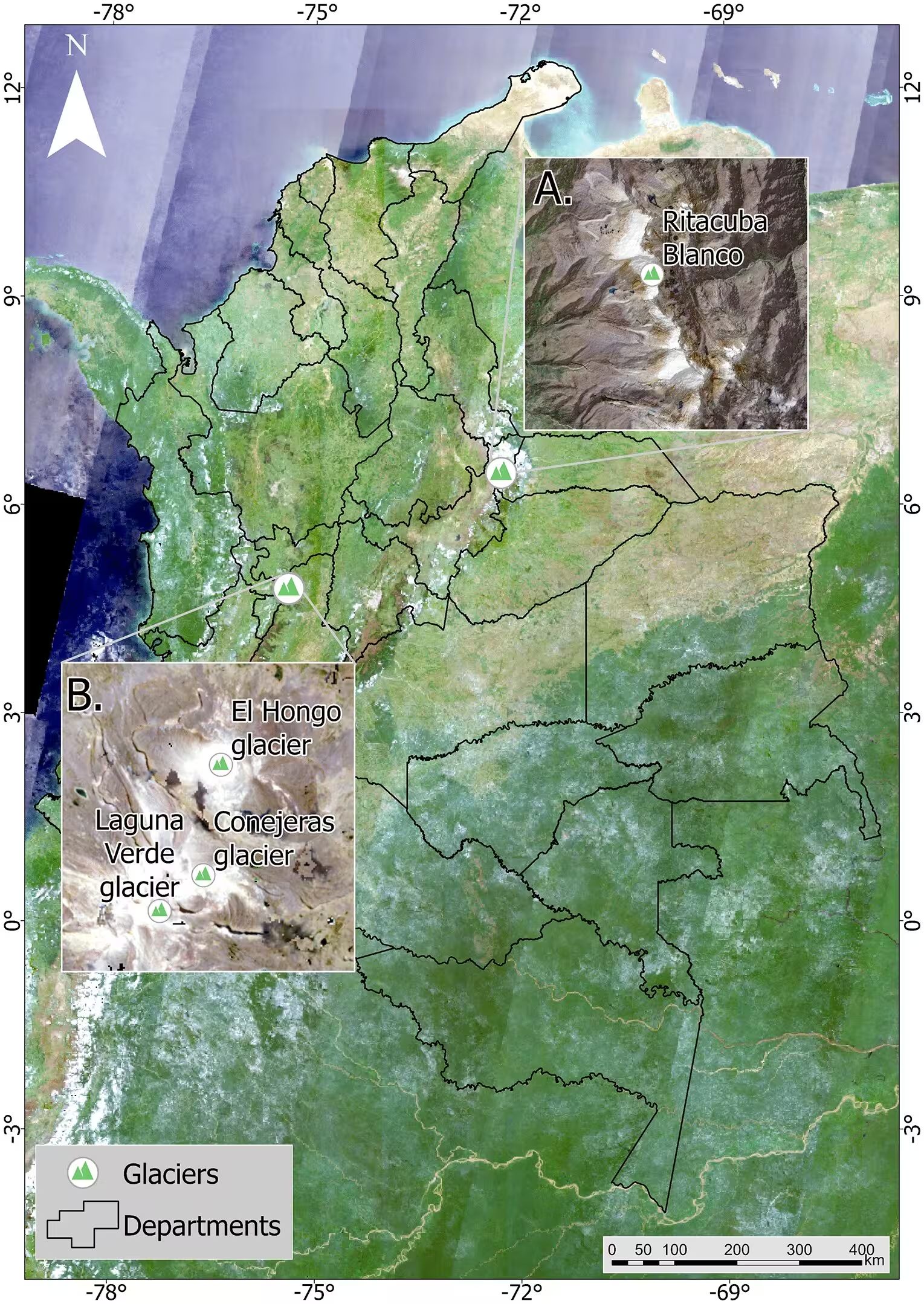
The study, published in PLOS Climate, focused on two contrasting glacier systems in the Colombian Andes to evaluate their vulnerability under various greenhouse gas emission pathways. Led by Maria Paula Rivera Reyes from Universidad del Rosario alongside colleagues from several institutions, the team analyzed the Sierra Nevada del Cocuy in the Eastern Cordillera and the smaller Santa Isabel volcano in the Central Cordillera.
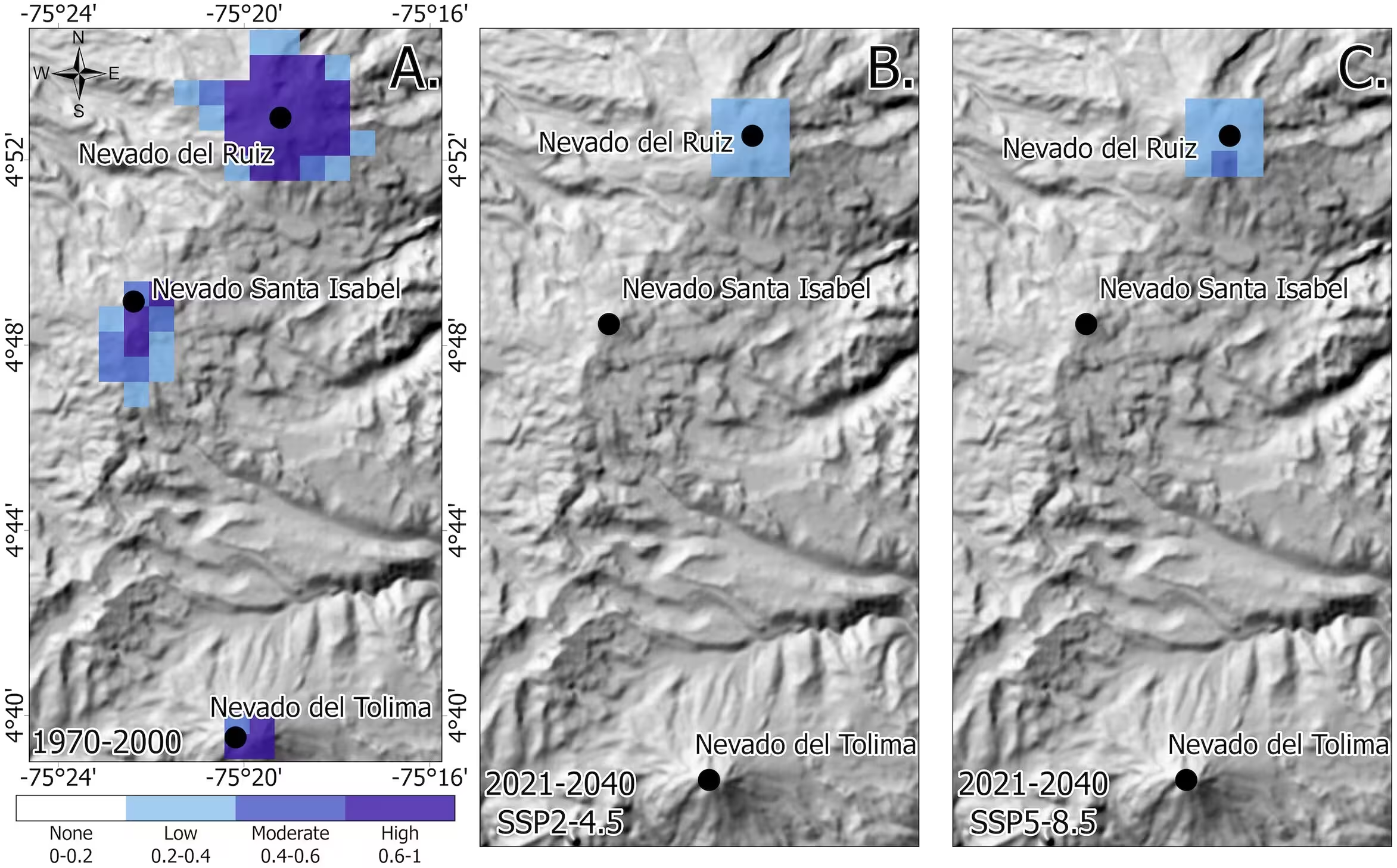
Using a software approach called Maximum Entropy, which estimates environmental niches based on historical occurrences and future climate simulations from 13 global circulation models, the team found a drastic contraction of suitable habitat. For the Santa Isabel glacier, which sits at lower elevations and covers less than two-tenths of a square kilometer, high-suitability climatic conditions are projected to disappear entirely as early as 2040 under intermediate warming scenarios.
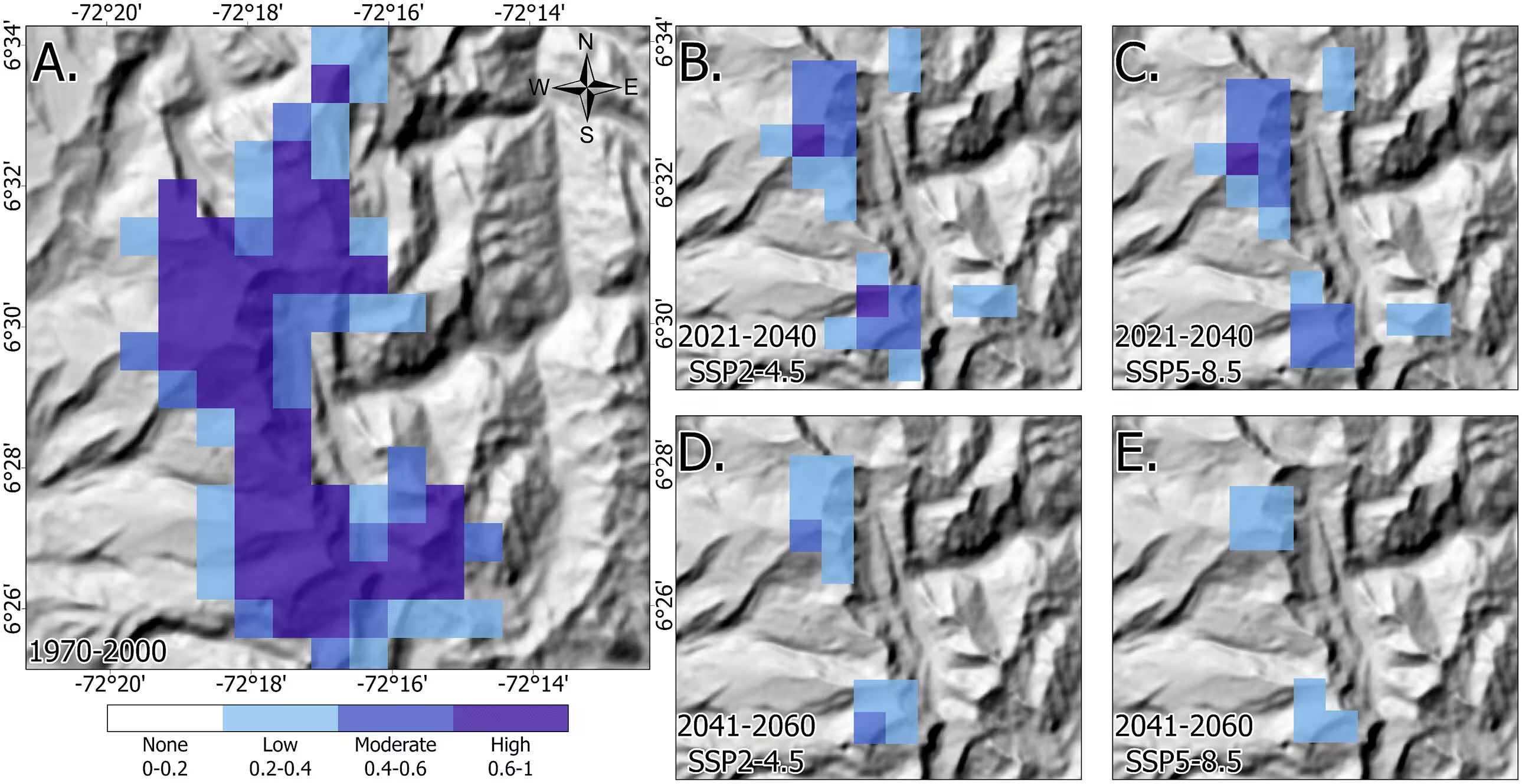
The much larger Sierra Nevada del Cocuy, which reaches heights over 5,300 meters, fares slightly better in the near term but still loses up to 98 percent of its high-suitability habitat by 2040 under high-emissions scenarios. By the period spanning 2041 to 2060, climatically favorable zones for both glaciers are projected to shrink by nearly 100 percent.
Why does temperature hit these equatorial ice masses harder than other factors?
To cross-check the computer distribution models against real-world changes, the researchers analyzed bimonthly and trimonthly mass-balance data collected directly from monitoring stakes on the glaciers between 2006 and 2025. Multiple linear regression models revealed that air temperature is the primary driver of glacier mass loss across both sites, accounting for roughly 45 to 65 percent of the explained variability.
When temperatures climb, freezing levels move higher up the mountain, exposing the margins of the ice to direct rainfall and accelerating melting. Furthermore, darker bare ice absorbs more solar radiation than fresh snow, creating a feedback loop that speeds up the retreat.
However, secondary climatic drivers differ significantly between the two mountains due to their distinct physical settings. Santa Isabel showed strong sensitivity to temperature fluctuations during its wet seasons, whereas Cocuy displayed greater vulnerability to variations in dry-season precipitation and net solar radiation.
What do these environmental shifts mean for local water supplies?
The steady loss of tropical glaciers carries serious implications for regional water security, agriculture, and hydroelectric power generation, which supplies about 80 percent of Colombia’s electricity. As these ice bodies shrink, high-mountain ecosystems experience altered soil moisture dynamics and changing streamflows that threaten native species dependent on saturated ground.
The authors note that while their predictive models offer vital insights into local vulnerabilities, uncertainties remain due to the coarse resolution of regional climate datasets and the sparse network of weather stations in high-altitude South America. Expanding on-the-ground monitoring and improving climate downscaling will be essential for anticipating how remaining mountain habitats will respond as the century progresses.
The research was published in PLOS Climate on November 24, 2026.
This article has been fact checked for accuracy, with information verified against reputable sources. Learn more about us and our editorial process.
Last reviewed on .
Article history
- Latest version
Reference(s)
- Rivera Reyes, Maria Paula., et al. “Historical and future climate niche of Colombian glaciers: A multi-statistical analysis.” PLOS Climate, vol. 5, no. 11, November 24, 2026, pp. e0001019 Public Library of Science (PLoS), doi: 10.1371/journal.pclm.0001019. <https://doi.org/10.1371/journal.pclm.0001019>.
Cite this page:
- Posted by Michael Ellison