Stratospheric Balloons Could Hunt Dark Matter Using High-Altitude Lasers
By bouncing laser beams between high-altitude balloons, physicists hope to detect elusive dark matter particles with unprecedented sensitivity.

High-altitude stratospheric balloons floating at an altitude of 30 to 40 kilometers could soon hunt for elusive dark matter particles by shooting laser beams across distances spanning hundreds of kilometers. The novel proposal, known as the Kilometric Enhanced Balloon-Baseline for Axion Birefringence Search (KEBBABS), aims to spot theoretical particles called axions by measuring subtle twists in light polarization.
Axions are hypothetical elementary particles proposed to solve major puzzles in particle physics while also serving as a leading candidate for dark matter. If they exist, axions should interact weakly with electromagnetism, causing the two circular polarizations of light to travel at slightly different speeds when passing through an axion background field. This phenomenon, known as axion birefringence, twists the polarization axis of a linearly polarized laser beam by an amount proportional to the axion field values at the start and end of the light journey.
Traditional laboratory searches rely on compact resonant optical cavities, bouncing light back and forth thousands of times to build up a measurable signal. While effective at saving space, those cavities also amplify technical noise and optical imperfections. Tommaso Feri of the University of Trieste and the National Institute for Nuclear Physics in Italy, alongside Silvia Gasparotto of CERN, outlined their alternative approach in a study published on the arXiv preprint server, suggesting that long, open-air baselines between high-altitude platforms could bypass the noise bottlenecks of closed cavities.
How Do Stratospheric Balloons Track Invisible Dark Matter?
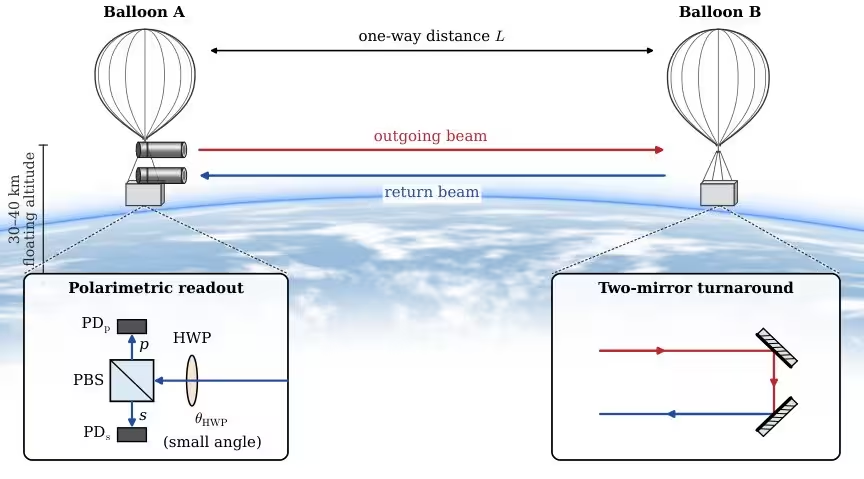
The proposed setup utilizes two stratospheric balloons forming a free-space optical link above ninety-nine percent of Earth’s atmosphere. In the basic Pathfinder configuration, one balloon hosts a laser and a sensitive polarimeter, transmitting a linearly polarized laser beam to a second balloon equipped with a two-mirror turnaround system. This roof-mirror arrangement reflects the light precisely back to the first balloon with an even number of reflections, preventing unwanted signal cancellation while keeping the hardware shared on a common reference frame.
For more advanced setups dubbed Feasible Today and Futuristic, the architecture is duplicated in both directions, allowing simultaneous bidirectional measurements. The coherent average of these reciprocal paths acts as the primary science channel, while their difference provides an internal null channel to diagnose and subtract local instrumental disturbances. By operating at float altitudes between 30 and 40 kilometers, the laser beams travel through thin air where molecular scattering and atmospheric turbulence remain extremely weak, keeping disruptions to a minimum.
What Sensitivities Can These Balloon Links Achieve?
The researchers evaluated three benchmark configurations scaling from near-term technology to projected future capabilities. The low-cost Pathfinder uses a zero point one watt laser, a twenty-seven and a half kilometer baseline, and thirty days of integration time to target axion masses around one in one hundred trillion electronvolts. This initial setup could probe axion-photon couplings as small as about two point eight times ten to the negative eleven inverse gigaelectronvolts, pushing past existing bounds set by the CERN Axion Solar Telescope.
Moving further, the Feasible Today configuration incorporates a two watt laser across a two hundred and twenty-six kilometer baseline with fifty days of integration, dropping sensitivity thresholds down to about two point seven times ten to the negative thirteen inverse gigaelectronvolts. The most ambitious Futuristic setup imagines a one hundred watt laser, a massive six hundred and sixty-seven kilometer baseline, and a full year of cumulative integration time. That high-end design could reach coupling strengths roughly eighty times weaker than current astrophysical observations permit, rivaling theoretical limits derived from black hole superradiance.
What Are the Main Technical Hurdles Ahead?
Despite the high projected sensitivity, several engineering challenges remain before stratospheric dark matter searches can take flight. Pointing stability between balloons separated by hundreds of kilometers demands extreme precision, as residual angular jitter can broaden the laser beam and starve the receiver of photons. Furthermore, slow pendulation and roll motions of the balloon gondolas around the line of sight can mimic polarization signals at low frequencies, prompting the authors to restrict their analysis to frequencies above one hertz.
Ground-based demonstrations of the optical link and polarimetric readout will serve as the necessary first step to characterize noise floors under controlled conditions. If successful, subsequent balloon flights could establish a powerful new observational window, exploiting the flexibility and vast distances available in the stratosphere to probe dark matter sectors that remain entirely out of reach for conventional laboratory instruments.
The study was posted to the arXiv preprint server on November 25, 2026.
This article has been fact checked for accuracy, with information verified against reputable sources. Learn more about us and our editorial process.
Last reviewed on .
Article history
- Latest version
Reference(s)
- Feri, Tommaso. “KEBBABS: Kilometric Enhanced Balloon-Baseline for Axion Birefringence Search.” arXiv.org <http://arxiv.org/abs/2611.34927v1>.
Cite this page:
- Posted by Karan Das