Physicists Finally Solve 28-Year-Old Quantum Paradox Involving Entangled States
A newly analyzed sixty-four-dimensional matrix proves that certain quantum links cannot be purified, settling a major theoretical debate.
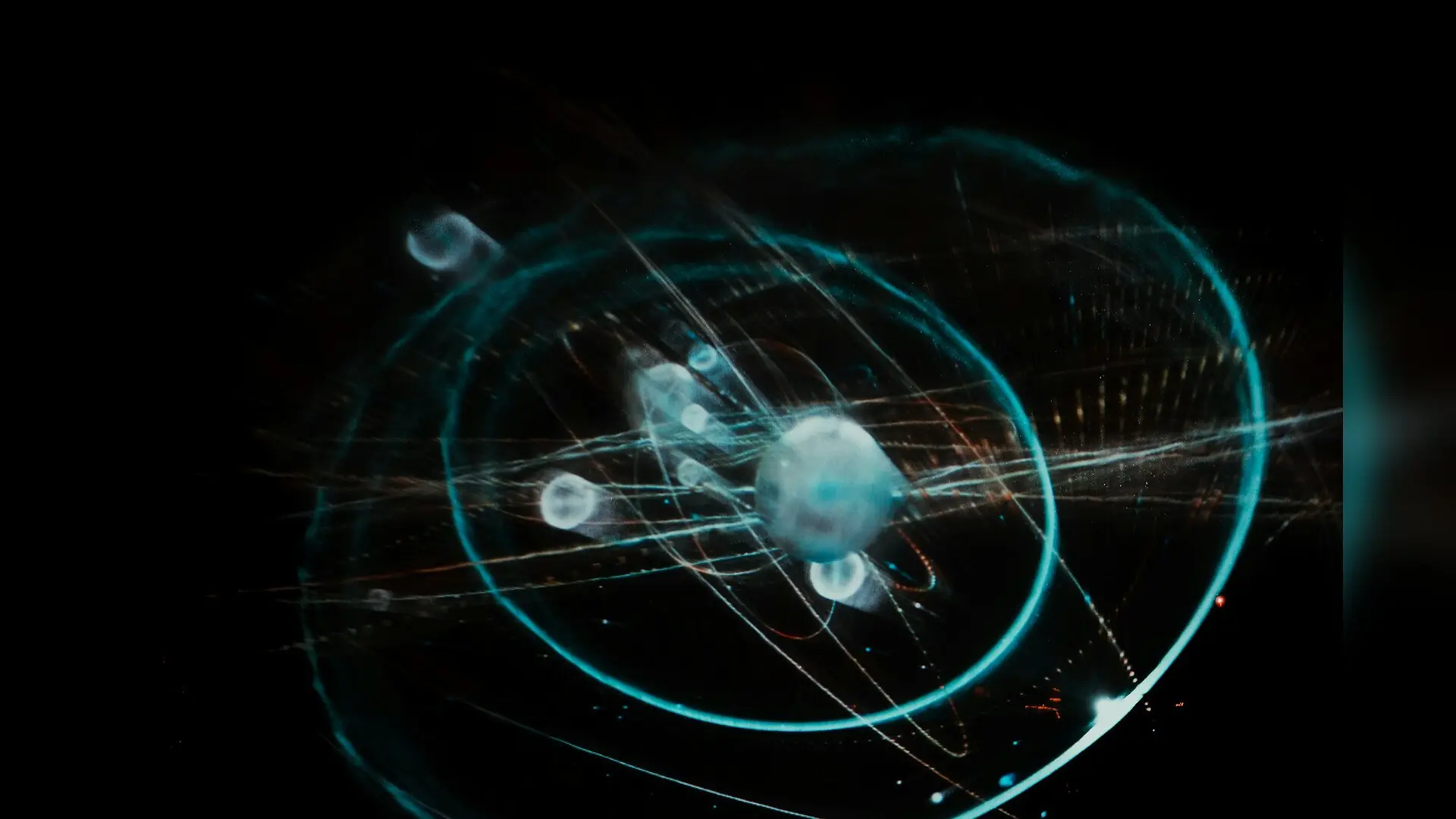
Physicists have finally resolved a 28-year-old quantum paradox by proving that a specific type of entangled state, known as a Werner state, can possess a negative partial transpose while remaining entirely bound, meaning its quantum link cannot be extracted or purified into usable bits.
The long-standing puzzle originated in 1998, when researchers asked whether every quantum state with a negative partial transpose could be successfully distilled into pure entanglement using local operations and classical communication. Over the following decades, multiple attempts to prove the existence of such bound entangled states collapsed due to mathematical errors or oversight, leaving the problem listed as a major open question in quantum information theory.
How Can a Quantum State Be Entangled Yet Undistillable?
To understand the paradox, imagine two distant parties sharing pairs of linked quantum particles that cannot be directly transformed into clean, usable communication channels. In a study available on the arXiv preprint server, Islam Faisal from Boston University demonstrated that a particular sixty-four dimensional quantum matrix exhibits this exact stubborn behavior.
The author identified a specific mathematical configuration, written as rho equals twenty-three identity minus three times the swap operator divided by one thousand four hundred forty-eight, operating across two eight-dimensional spaces. By analyzing this system, the author showed that its distillable entanglement under two-way local operations and classical communication is exactly zero.
What Does This Mean for the Foundations of Quantum Mechanics?
The core of the proof relies on constructing an explicit linear map and a corresponding Hermitian matrix satisfying four strict boundary conditions across four-copy systems. Through a series of six lemmas, the author established that any two-qubit output produced by a separable operation from multiple copies of this state achieves a fidelity of at most about zero point six hundred four when compared to a pristine Bell state.
This strict ceiling on fidelity proves that the entanglement trapped within the system cannot be unlocked. More broadly, the findings confirm that distillable entanglement fails to be either additive or convex, validating historical speculations about superactivation where two individually useless quantum states become unexpectedly potent when combined.
Why Do These Theoretical Limits Matter for the Future?
While the work is purely theoretical, it places rigorous mathematical boundaries on how quantum information can be manipulated, transmitted, and cleaned. The discovery settles a foundational debate about the limits of quantum distillation, confirming that certain complex configurations of matter hold onto their internal correlations in a way that standard quantum protocols can never harvest.
The study was posted to the arXiv preprint server on November 25, 2026.
This article has been fact checked for accuracy, with information verified against reputable sources. Learn more about us and our editorial process.
Last reviewed on .
Article history
- Latest version
Reference(s)
- Faisal, Islam. “Bound Entanglement with Negative Partial Transpose Exists.” arXiv.org <http://arxiv.org/abs/2611.34921v1>.
Cite this page:
- Posted by John Williams