New Brain Model Outperforms Traditional Forecasts By Tracking Ongoing Neural States
By tracking ongoing neural history alongside visual stimuli, a recurrent world model captures how internal brain states shape individual reactions.
When watching a fast-moving video clip, your brain is never a blank slate, as its internal rhythms and ongoing attention states strongly shape how you react to every frame. Traditional brain-scanning models focus entirely on what is happening on screen while treating your internal mental state as random noise. A new artificial intelligence architecture changes this perspective by demonstrating that forecasting how an individual mind evolves over time requires tracking both the external stimulus and the brain’s own ongoing neural history.
How Can Nonlinear Models Predict Unfolding Brain Dynamics?
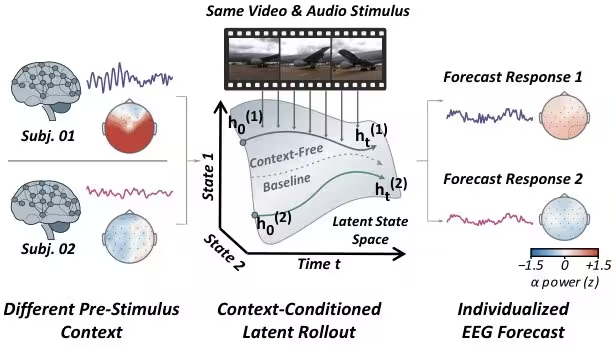
To capture how brain activity shifts from one moment to the next, a research team led by scientists at the Southern University of Science and Technology introduced a recurrent world model called EEG-World. The system infers a latent brain state from six seconds of preceding electroencephalography recordings and rolls that state forward under audiovisual conditioning to forecast ten seconds of neural band-power dynamics. As published in a preprint on arXiv, the authors evaluated this approach using a massive new dataset containing two thousand five hundred eighty-four hours of electroencephalography recordings collected from seventy-eight participants watching naturalistic video clips.
While standard linear forecasters assume brain responses react passively to a stimulus at a fixed rate, the new nonlinear model recognizes that the brain possesses persistent internal dynamics. The team discovered that when training on small amounts of data, traditional linear models perform well because complex neural patterns remain hidden. However, once researchers pooled hundreds of hours of recordings across dozens of participants, the nonlinear recurrent model surpassed strong linear baselines and continued improving as more data became available.
What Happens When Brain States Are Far From Equilibrium?
The predictive advantage of the recurrent model becomes most pronounced when a viewer starts watching a clip in a mental state far removed from their personal average. Linear models tend to pull forecasts straight back toward a general baseline, whereas the world model successfully calculates how unusual starting states will naturally drift and fluctuate over time. The team observed that for the fifth of trials starting farthest from equilibrium, the nonlinear model achieved a forecasting correlation boost nearly double that of trials starting near standard resting states.
Furthermore, when testing the framework on twenty-four individuals who were entirely new to the model, attaching a lightweight subject-specific linear head allowed the system to outperform conventional linear models in twenty-three out of twenty-four participants. Merely thirty-three minutes of calibration data from a new subject enabled the transferred model to match the predictive accuracy of a traditional linear model trained on over five hours of data from that same person.
Why Does Video Feature Encoding Matter for Neural Predictions?
By separating the brain’s internal momentum from stimulus-driven events, the researchers could test which computer vision models align most closely with human neural processing. When swapping out visual encoders in the video pathway, the team found that V-JEPA 2, a video model trained to predict masked representations in a latent space, improved clip-locked neural prediction by thirty-five percent compared to standard image features alone. The results suggest that objectives focused on predicting dynamic video features in a latent space capture human visual processing more effectively than simpler image recognition frameworks or pixel-reconstruction baselines.
The study was posted to the arXiv preprint server on November 24, 2026.
This article has been fact checked for accuracy, with information verified against reputable sources. Learn more about us and our editorial process.
Last reviewed on .
Article history
- Latest version
Reference(s)
- Zhang, Junxiang. “EEG-World: Context-Conditioned Dynamics of the Watching Brain.” arXiv.org <http://arxiv.org/abs/2611.32825v1>.
Cite this page:
- Posted by Jessica Martin