Why People Asking About History And Art On ChatGPT Rarely Want Factual Answers
A large-scale analysis of AI conversation logs reveals that unconstrained platforms invert the social and factual profiles seen in museums, with users overwhelmingly driving content production and creative writing instead.
When everyday users turn to open-ended artificial intelligence platforms like ChatGPT, their cultural heritage inquiries rarely resemble the guided gallery tours or social chatbot exchanges documented in museum settings. Instead of asking factual questions about history, users overwhelmingly employ general-purpose language models to produce and creatively transform heritage material into essays, stories, and educational notes, completely bypassing the institutional framing of traditional museum displays.
To understand whether the non-heritage interaction profile observed in earlier museum-deployed AI studies is a property of the technology itself or of the institutional setting, a team of researchers conducted a secondary analysis of large-scale public conversation corpora. Led by Pengbo Chen at an institution not specified in the study details, the authors examined how people engage with cultural heritage outside of purpose-built museum systems, with their findings published in PLOS One.
Previous research on museum-deployed android robots and art exhibition chatbots consistently reported that personal questions and casual conversation outweighed heritage-related questions by a factor of four. However, because those observations occurred entirely within institutional settings, it remained unclear whether that social-exchange-dominant profile reflected the technology or the physical museum environment. General-purpose browser tabs carry none of the physical co-presence, curatorial framing, or social signals that a museum floor provides.
How Do General-Purpose Platforms Shape Heritage Engagement?
To investigate this question outside the museum frame, the investigators extracted candidate heritage conversations from three public conversational datasets, namely WildChat containing over three million ChatGPT conversations, LMArena containing paired model battle logs, and ShareChat containing publicly shared URLs. After rigorous keyword filtering and four rounds of cleaning to remove commercial spam, image generation prompt syntax, and standardized test items, the team established a candidate set of 1,146 conversations.
Through a deductive coding scheme and relevance screening that assessed user communicative purpose rather than mere keyword presence, the authors identified 396 relevant conversations containing 1,454 user turns. The low overall hit rate of below zero point two percent across the source datasets confirms that cultural heritage remains a niche topic when users have unconstrained access to general-purpose conversational agents.
What Happens When Users Ask About Art and History on ChatGPT?
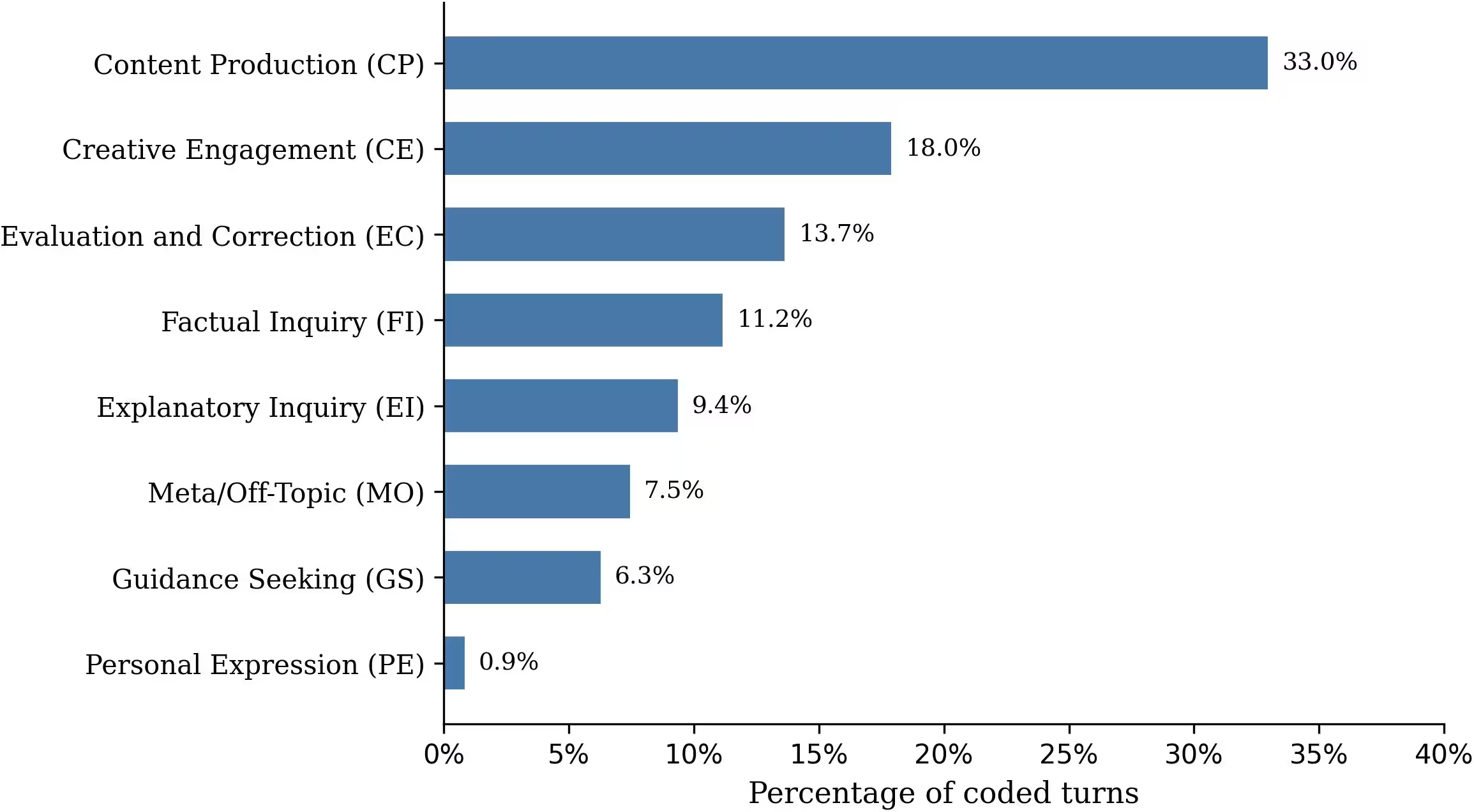
The behavioral analysis revealed a stark inversion of the profile typically seen in purpose-built museum systems. Content Production accounted for thirty-three percent of all coded turns, while Creative Engagement represented eighteen percent. Together, production-oriented behaviors made up over half of all heritage-related interactions.
In contrast, inquiry-oriented behaviors such as factual and explanatory questions accounted for only twenty percent of turns. Personal expression, which often dominates museum robot interactions, dropped to less than one percent on unconstrained platforms. Users approached the conversational interface as a production tool, instructing the model to generate historical descriptions, translate ancient texts, or compose imaginative narratives.
Why Do Users Cycle Between Producing and Evaluating AI Output?
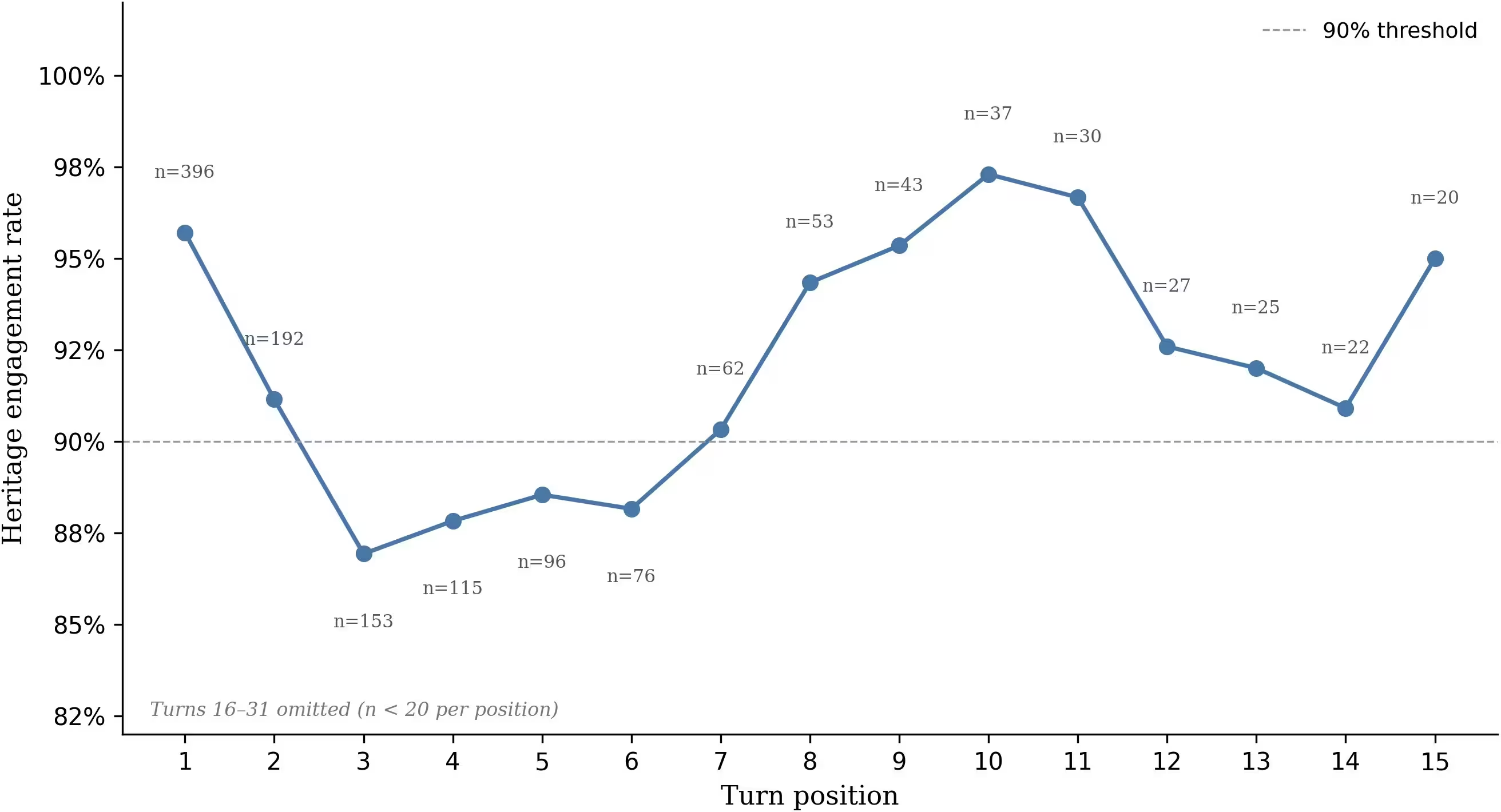
Examining the multi-turn evolution of these conversations revealed that over half consisted of a single user turn, while multi-turn sessions averaged six and a half user turns. The engagement rate dipped during the middle turns of multi-topic sessions as peripheral heritage mentions gave way to other tasks, before recovering in longer, more committed exchanges.
Code transition analysis uncovered strong behavioral inertia and a prominent production-evaluation loop. Users frequently cycled between directing content production and evaluating the resulting text without an intervening information-seeking phase, compressing traditional information-gathering steps into a single iterative workflow. Creative engagement proved to be the most reliably coded category, highlighting how unconstrained platforms invite imaginative transformation of historical material.
The authors note limitations in their work, including the predominance of ChatGPT data from the WildChat corpus, which restricts cross-platform generalization, and the small sample size of dropout conversations that rendered exploratory persistence predictors inconclusive. Despite these constraints, the study demonstrates that the behavioral profile of heritage interaction shifts dramatically when moving from institutional museum exhibits to open-ended digital platforms.
The research was published in PLOS One on November 24, 2026.
This article has been fact checked for accuracy, with information verified against reputable sources. Learn more about us and our editorial process.
Last reviewed on .
Article history
- Latest version
Reference(s)
- Chen, Pengbo., et al. “Behavioral patterns in cultural heritage engagement with general-purpose conversational AI.” PLOS One, vol. 21, no. 11, November 24, 2026, pp. e0362130 Public Library of Science (PLoS), doi: 10.1371/journal.pone.0362130. <https://doi.org/10.1371/journal.pone.0362130>.
Cite this page:
- Posted by Zubair Ali