Why Do Our Brains Merge Sights and Sounds So Effortlessly
A comprehensive scientific review contrasts simple mathematical formulas with artificial neural networks to reveal how the brain weaves together multiple senses.
When humans and animals navigate the world, their brains constantly merge sights, sounds, and scents into a single unified perception. Scientists have long debated how brain circuits achieve this feat, building a vast spectrum of mathematical equations and computer models to explain the process. A comprehensive review available on the arXiv preprint server outlines how researchers are bridging the gap between classical theoretical formulas and massive artificial neural networks to decode the human mind.
How Do Traditional Equations Stack Up Against Artificial Brains?
For decades, cognitive scientists and neurophysiologists have approached multisensory integration from opposite directions. Marcus Ghosh from Imperial College London and John S. Butler from Technological University Dublin examined the two dominant modeling philosophies in the field. Traditional normative models use a top-down approach, starting with a core hypothesis about how senses ought to be combined statistically. These models typically rely on only a handful of parameters, making them exceptionally clear to interpret and analyze.
On the other side of the spectrum lie artificial neural network models, which take a bottom-up approach. These computer simulations emulate how interconnected layers of artificial neurons might process information together. While normative equations can predict optimal behavioral outcomes, artificial networks excel at learning complex, time-varying tasks that mirror real-world survival scenarios.
What Happens When Brains Must Decide Which Senses Belong Together?
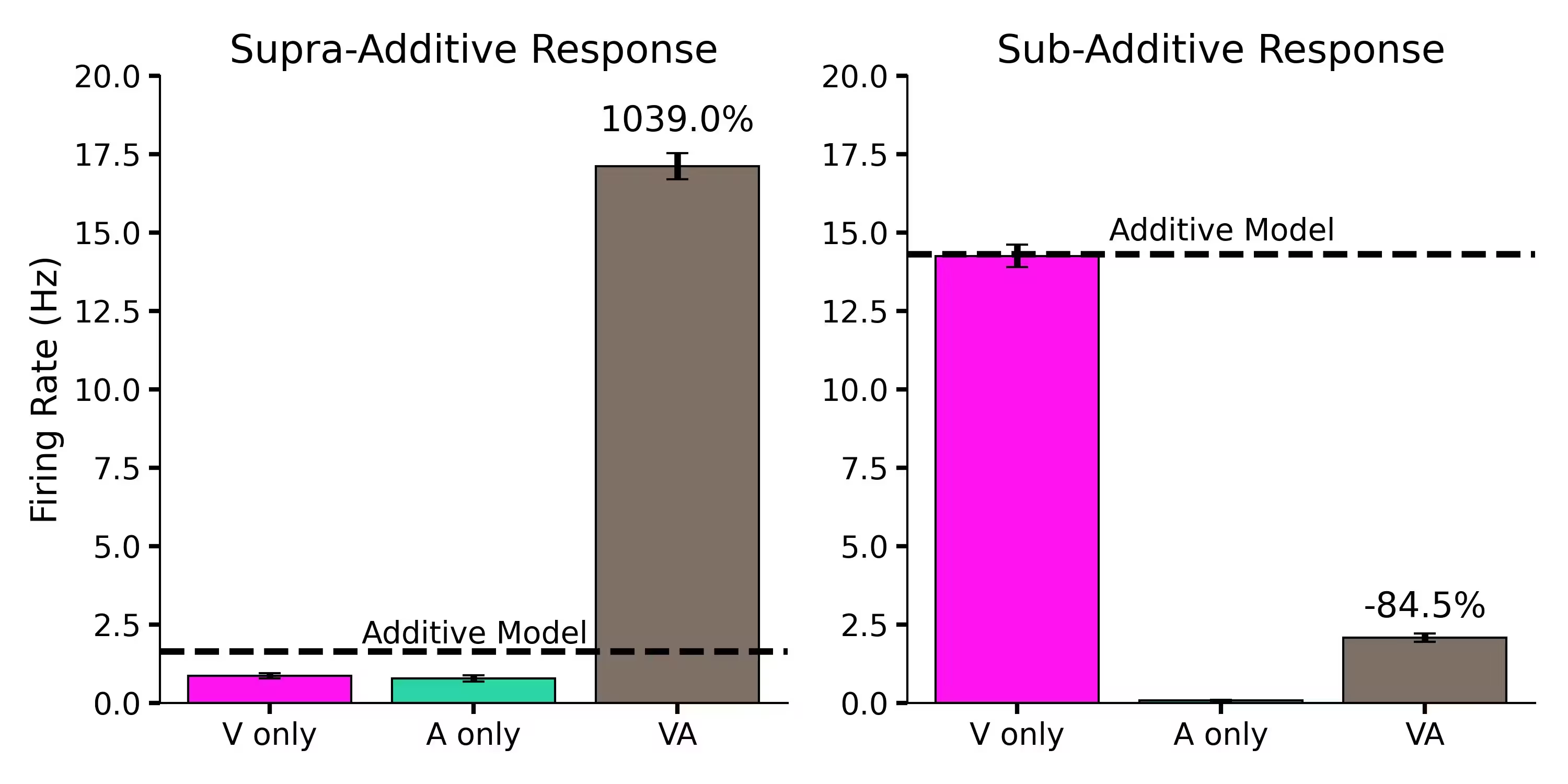
A major challenge in sensory processing involves figuring out whether two incoming signals originate from the same physical event. If a flash of lightning and a clap of thunder happen simultaneously, the brain integrates them. If they are separated by too much time or distance, the brain treats them as independent events.
Classical probabilistic frameworks, such as maximum-likelihood estimation, successfully predict how healthy adults combine cues to minimize perceptual uncertainty. However, these traditional equations often struggle when faced with spatial and temporal discrepancies. To solve this, researchers turned to causal inference models, which calculate the mathematical probability that two sensory inputs share a common source.
Why Do Advanced Neural Networks Outperform Simple Equations in Complex Tasks?
While elegant mathematical formulas work well for static laboratory tests, natural environments present fluid, unpredictable challenges. Recent studies highlighted in the review demonstrate that recurrent neural networks equipped with internal memory can track dynamic scenarios, such as predicting a prey animal darting between hiding places. Such tasks quickly become computationally intractable for standard Bayesian formulas.

Furthermore, researchers have begun developing hybrid architectures that merge the interpretability of normative rules with the flexibility of machine learning. These emerging frameworks allow scientists to test thousands of variations to see which circuit designs best replicate human behavioral data.
Where Is the Future of Cognitive Modeling Heading?
The authors conclude that the future of neuroscience relies on dissolving the boundary between classical equations and deep learning. By building models that generate testable neural predictions rather than mere curve fitting, researchers hope to uncover how biological circuits seamlessly blend sensory streams.
The study was posted to the arXiv preprint server on November 24, 2026.
This article has been fact checked for accuracy, with information verified against reputable sources. Learn more about us and our editorial process.
Last reviewed on .
Article history
- Latest version
Reference(s)
- Ghosh, Marcus. “Normative and neural network models of multisensory integration.” arXiv.org <http://arxiv.org/abs/2611.32829v1>.
Cite this page:
- Posted by Zubair Ali