Chinese Study Reveals Why Resident Doctors Affiliated With Institutions Score Lowest in Medical Leadership
A newly adapted 29-item assessment tool uncovers leadership gaps among medical trainees with different identity sources in clinical settings.

Resident physicians in China have lower leadership scores when they are affiliated with an institution compared to their peers pursuing professional master’s degrees, a new study reveals. Because modern healthcare requires doctors to coordinate complex teams and manage resources alongside clinical care, researchers are looking for reliable ways to measure these essential skills.
The study, published in PLOS One, details the successful translation, cultural adaptation, and psychometric testing of a specialized evaluation tool for medical staff. A team led by researchers from Yichang Central People’s Hospital localized the Medical Leadership Competence Scale (MeLeCoS), which was originally developed by Professor Sigrid Harendza’s team at the University of Hamburg in 2024 to assess leadership traits among medical students.
How Can Leadership Be Measured in Trainee Doctors?
Leadership in healthcare involves guiding others toward shared goals, shaping positive interpersonal relationships, and demonstrating strong moral cultivation alongside governance capacity. In China, standardized residency training acts as a critical three-year bridge where medical students transition into fully qualified clinicians. To determine whether the original 37-item MeLeCoS tool worked for Chinese resident physicians, the researchers conducted a two-phase survey process.
During the first phase between March and April 2025, the team used cluster sampling to survey 242 resident physicians at a national-level training base in the Yichang area. After removing invalid responses, 237 questionnaires were analyzed using exploratory factor analysis. This initial step reduced the scale structure into five distinct domains: organizational leadership and promotion, personal and team development, professional ethics and responsibility, communication and coordination, and autonomous learning and planning.
Why Did Researchers Need to Revise the Original Survey Tool?
When the team tested the five-factor model on a second independent sample of 210 resident physicians between July and September 2026, the statistical fit was initially unsatisfactory. Cultural differences between Western educational environments and China’s national clinical training context meant certain original items caused semantic overlap and redundancy. For example, questions regarding financial planning in student clubs or specific undergraduate committee tasks did not fit the daily realities of hospital resident doctors.
To solve this, the research team deleted five problematic items and merged several others to better reflect clinical rotations, medical insurance policies, and patient treatment tracking. The revised Chinese version of MeLeCoS was shortened to 29 items. A second confirmatory factor analysis on the same participant group showed that the revised model achieved an acceptable statistical fit, alongside a high Cronbach’s alpha internal consistency coefficient of 0.941.
What Do the Competency Scores Reveal About Different Trainee Groups?
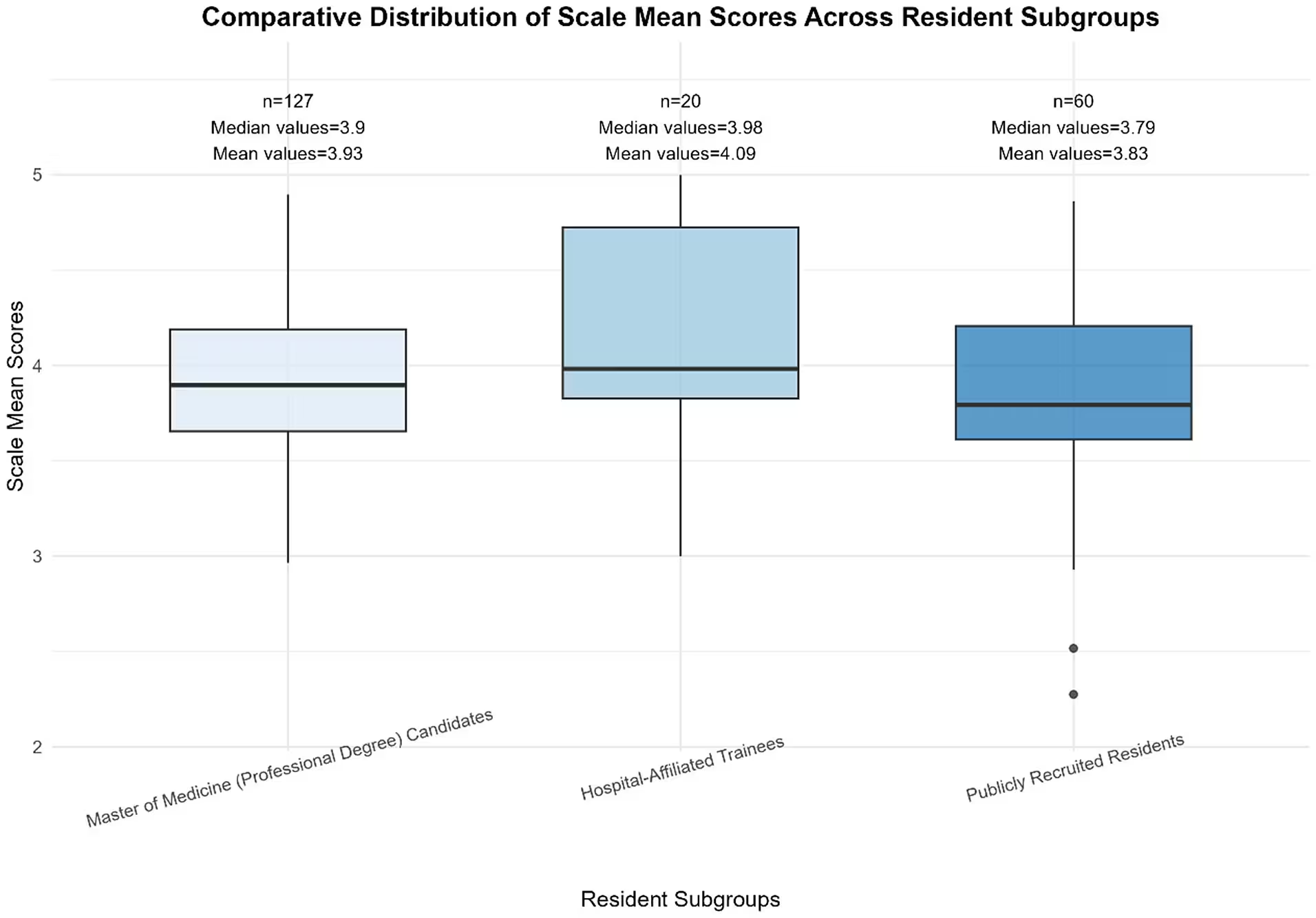
The final 29-item scale yielded an overall mean score of 3.92 out of 5 among the surveyed resident physicians. Further statistical analysis uncovered statistically significant differences in leadership competence based on the identity source of the trainees. Medical master’s professional degree students scored significantly higher than their peers, which the authors attribute to their dual identity. These graduate students balance academic research, group meetings, and thesis requirements alongside their clinical hospital duties, giving them more opportunities to hone their self-directed learning and communication skills.
In contrast, resident physicians affiliated directly with an institution recorded the lowest scores, while socially recruited resident physicians scored at an intermediate level. The authors suggest that teaching hospitals should recognize these identity-based disparities and provide targeted educational interventions. Tailored leadership training could help close the gap and support all trainees in becoming well-rounded clinicians.
What Are the Limitations of This Competency Assessment?
The authors noted several important limitations to their findings. The study relied on convenience sampling at a single national-level training base in the Yichang area, which restricts how broadly the results can be generalized to doctors across other regions of China. Furthermore, the study did not evaluate test-retest reliability over time, meaning the long-term stability and repeatability of the scale remain untested. The lack of longitudinal tracking data also prevented the researchers from measuring the predictive validity of the tool. Future investigations will require multicenter, multi-region sampling with larger and more diverse cohorts to verify the practical utility of the revised scale.
The research was published in PLOS One on November 24, 2026.
This article has been fact checked for accuracy, with information verified against reputable sources. Learn more about us and our editorial process.
Last reviewed on .
Article history
- Latest version
Reference(s)
- Xue, Di., et al. “Cross-cultural adaptation and validation of the Medical Leadership Competence Scale among residents.” PLOS One, vol. 21, no. 11, November 24, 2026, pp. e0363082 Public Library of Science (PLoS), doi: 10.1371/journal.pone.0363082. <https://doi.org/10.1371/journal.pone.0363082>.
Cite this page:
- Posted by Susan White