Study Links Mysterious Global Hum to Low‑Frequency Tinnitus Inside Our Ears
New research links the mysterious ’Hum’ to internal human mechanisms rather than environmental sources, shedding light on this puzzling phenomenon.

For more than fifty years, people around the globe have spoken of an odd, low‑pitch rumble that often becomes noticeable in quiet, indoor settings. A new analysis published in PLOS One proposes that many of these reports may stem from processes inside the human auditory system rather than from external sources.
The first wave of attention arrived in the 1970s in Bristol, United Kingdom, where residents complained of a persistent low drone that was especially evident after dark. Despite numerous complaints, investigators were unable to pinpoint a tangible external origin at the time.
The Guardian notes that hundreds of similar incidents have been recorded in international databases, even though the phenomenon—commonly called the “Hum”—remains difficult to capture reliably in laboratory settings.
Global Pattern of Reports
Following the initial Bristol cases, comparable descriptions emerged in other UK towns such as Hythe, Plymouth, Southampton and Swansea. The accounts consistently describe a continuous, low‑frequency tone that appears without warning and lacks an identifiable source.
The narrative later extended across the Atlantic, with reports from places like Taos, New Mexico, and Kokomo, Indiana. This geographic spread turned a localized curiosity into a broader scientific puzzle, because the occurrences appeared in environments with no obvious shared physical cause.

The World Hum Database Project, which has been compiling testimonies since 2012, continues to receive submissions that describe a deep, monotonous drone that is hard to locate and often more pronounced in quiet interiors.
Environmental Theories Remain Unconfirmed
Researchers have long explored possible external mechanisms. An early hypothesis from the 1970s suggested that interactions between fast jet streams and slower air masses might generate low‑frequency vibrations. More recent work in 2015 from French scientists linked the phenomenon to continuous ocean wave activity.
The Guardian points out that such ideas share a common obstacle: very low‑frequency sound has a long wavelength that easily merges with background noise, making precise localisation extremely challenging. (See also the discussion of long‑wavelength phenomena.)
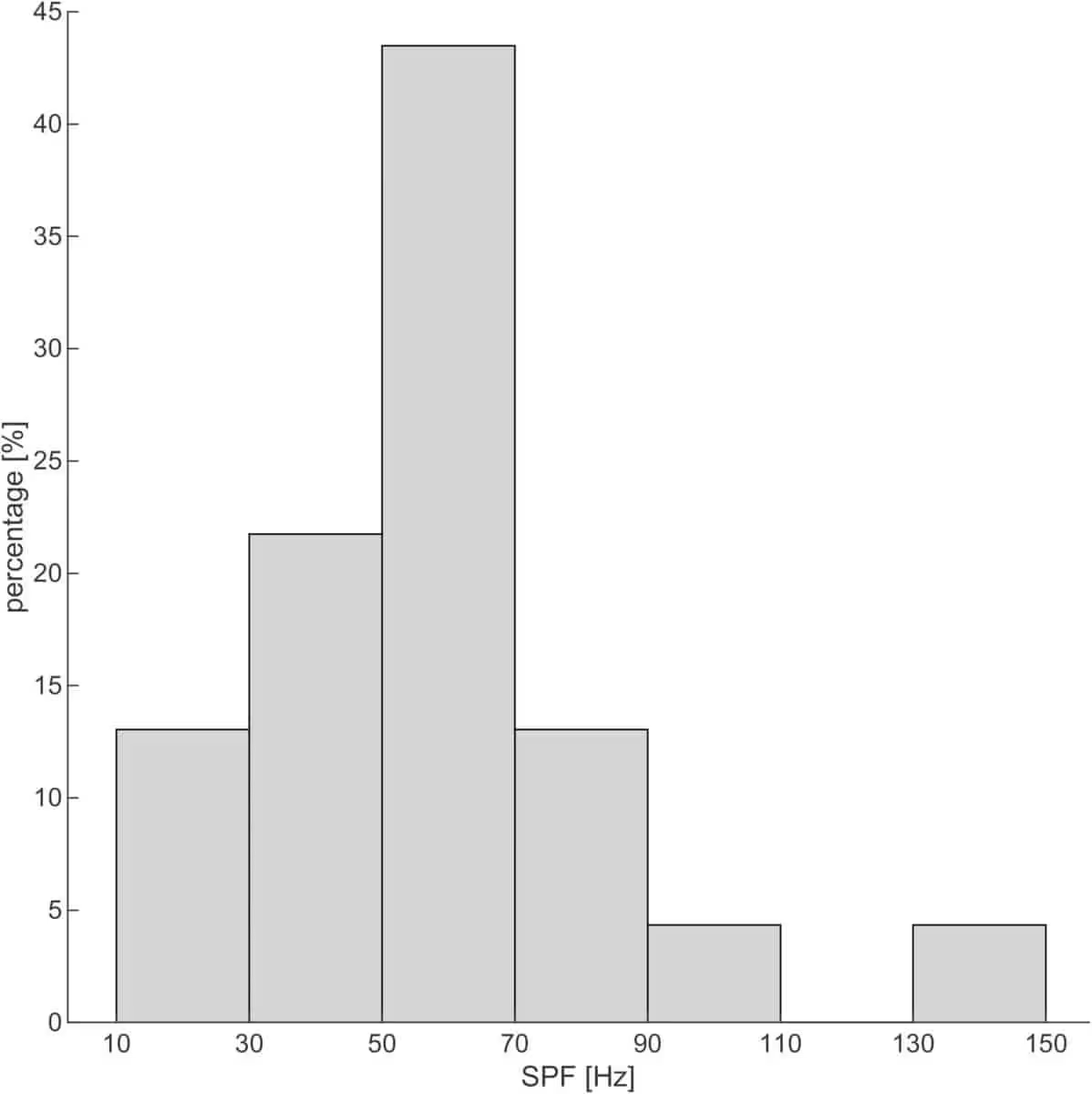
Despite these investigative avenues, no single external explanation has consistently accounted for the full range of reported incidents, and the phenomenon continues to appear sporadically in both intensity and location.
Internal Auditory Mechanisms Under Investigation
A recent article in PLOS One shifts focus to the listeners themselves. Led by Markus Drexl at the Norwegian University of Science and Technology, the study examined twenty‑eight German participants who reported low‑frequency sound percepts (LFSPs).
Only two volunteers displayed markedly heightened sensitivity to low‑frequency tones during controlled testing, suggesting that an unusually acute external hearing ability does not explain the majority of cases.
The team also evaluated otoacoustic emissions—subtle sounds produced by the inner ear itself—but found no reliable association between these emissions and the participants’ subjective experiences.
In remarks accompanying the publication, Drexl explained:
“We know that there are people who hear low‑frequency sounds that can actually be measured, even if other people don’t hear them,” he said in a release for the Norwegian SciTech News. “It’s not so easy to find the source of these sound waves, because it’s a struggle to localize low‑frequency sounds.”
Low‑Frequency Tinnitus as a Plausible Explanation
With external origins and otoacoustic emissions largely excluded for the studied cohort, the researchers propose low‑frequency tinnitus as a likely driver for many reports. Unlike the more familiar high‑pitched tinnitus, this variant can manifest as a deep hum or vibration‑like sensation that feels external even though it originates inside the ear.
“What we know about the hearing system is mainly based on how we capture and process sound with higher frequencies,” he noted. “We know less about how the auditory system handles and processes low‑frequency sound, or infrasound.”
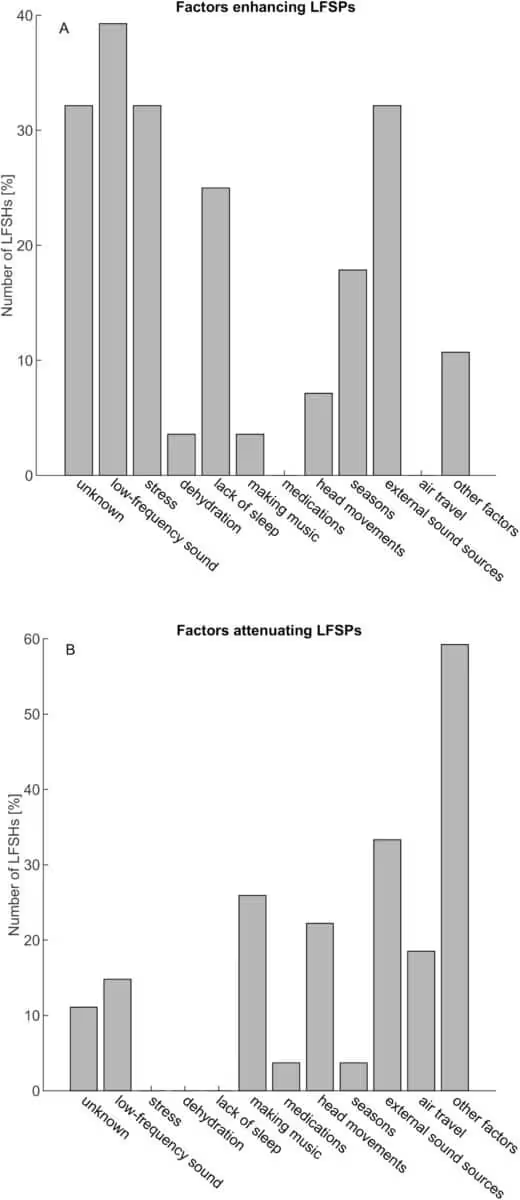
The authors caution that the issue is not yet fully resolved. While internal auditory factors may explain a substantial portion of the Hum, the extensive history and worldwide distribution of the phenomenon suggest that multiple mechanisms could still be at play.
This article has been fact checked for accuracy, with information verified against reputable sources. Learn more about us and our editorial process.
Last reviewed on .
Article history
- Latest version
Reference(s)
- “The World Hum Map and Database Project - Dr Glen MacPherson.” <https://www.thehum.info/>.
- Tannahill, Jordan. “Can you hear the Hum? The mystery noise that says a lot about modern life.”, July 7, 2021 The Guardian <https://www.theguardian.com/books/2021/jul/07/the-hum-mystery-noise-says-a-lot-about-modern-life>.
- Baumann, Bonifaz. “On the potential sources of a low-frequency sound percept that only a few can perceive.”, vol. 21, no. 3, pp. e0326818, doi: 10.1371/journal.pone.0326818. <https://journals.plos.org/plosone/article?id=10.1371/journal.pone.0326818>.
- “Markus Rudolf Drexl - NTNU.” <https://www.ntnu.edu/employees/markus.drexl>.
- Haugan, Idun. “A strange humming phenomenon.”, June 2, 2026 Norwegian SciTech News <https://norwegianscitechnews.com/2026/06/a-strange-humming-phenomenon/>.
Cite this page:
- Posted by David Anderson