Standard Body Mass Index Screening Misses Hidden Fat in One Third of Women
A large population study in Mexico shows that standard weight-to-height measures hide dangerous abdominal fat, especially in women.

Body mass index (BMI) alone leaves out hidden body fat and misses over a third of clinically significant obesity cases among Mexican adults, according to a population-based study. The research highlights a major gap in standard health checks where weight and height measurements fail to spot dangerous fat accumulation around organs.
Researchers examined health data from 13,160 adults across Mexico, representing a total population of over eighty-two million people, to see how different definitions of obesity change national statistics. While standard BMI calculations flagged thirty-four percent of adults with obesity, a comprehensive clinical framework that accounts for waist measurements and metabolic health found a similar overall rate of thirty-two percent. However, the numbers shifted dramatically when looking at individual groups, revealing that standard screening heavily overlooks women.
How Do Waist Measurements and Blood Markers Reveal Hidden Health Risks?
Standard BMI categories do not separate muscle mass from fat tissue or show where fat is stored on the body. To capture true health risk, the Lancet Diabetes and Endocrinology Commission proposed a clinical definition that requires confirmed excess body fat alongside signs of organ dysfunction, such as high blood sugar, elevated triglycerides, low HDL cholesterol, or high blood pressure.
In this analysis of data from the Mexican National Health and Nutrition Survey, the study authors, led by Mario Cesar Torres-Chavez and colleagues at the National Institute of Public Health, applied these stricter criteria. The findings were published in PLOS Global Public Health, mapping out how body fat distribution alters public health estimates.
The study found that among adults with a normal BMI below thirty, half still displayed increased central adiposity, meaning excess fat stored around the abdomen. This hidden fat accumulation creates significant cardiometabolic strain even when overall body weight appears normal.
Why Are Women More Likely to Be Misdiagnosed by Standard BMI Screening?
The most striking discovery involved a profound sex disparity in how obesity manifests. Men showed a higher prevalence of obesity when measured by BMI alone, at thirty-eight percent compared to twenty-nine percent for women. Yet when evaluated using the clinical obesity definition that includes waist size and blood markers, the trend reversed entirely.
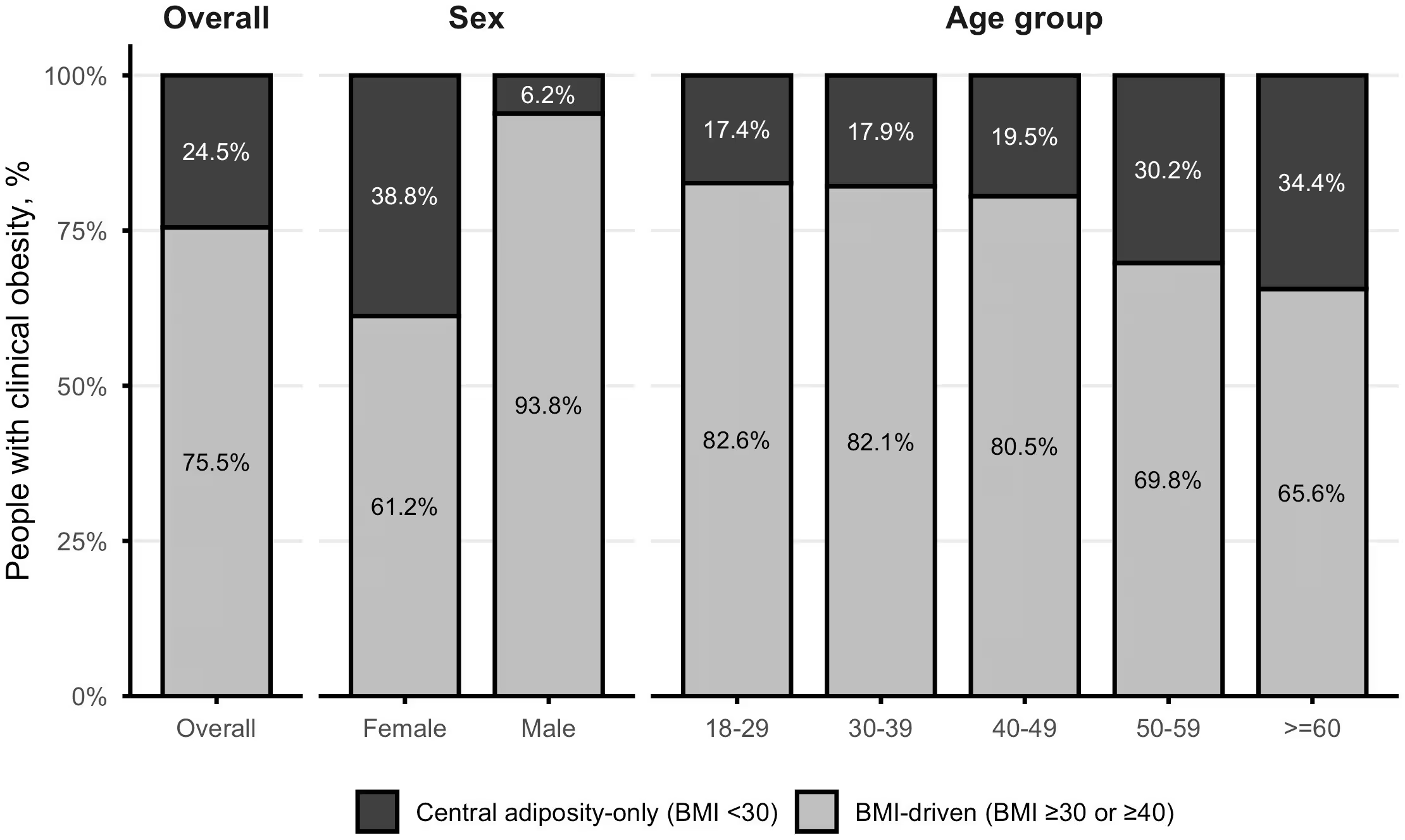
Women suffered from clinical obesity at a rate of forty percent, compared to twenty-six percent for men. This reversal happened because thirty-eight percent of women with clinical obesity had a normal BMI but high abdominal fat, whereas only six percent of men fell into that same category. This indicates that relying solely on weight-to-height ratios leaves millions of women undiagnosed while they may already experience early metabolic dysfunction.
What Does This Mean for Future Health Policies and Clinical Practice?
The study also tracked how clinical obesity shifts across age brackets and socioeconomic groups. Prevalence rose steadily with age, climbing from eighteen percent among young adults aged eighteen to twenty-nine up to forty-two percent for those aged fifty to fifty-nine. Furthermore, clinical obesity increased with household income, moving from thirty percent in the lowest income quartile to forty-one percent in the highest.
The authors noted several limitations in their work, including its cross-sectional design, which prevents researchers from proving cause and effect regarding long-term health outcomes. The team also relied on body measurements rather than direct imaging scans to gauge fat distribution, and a small fraction of participants had incomplete blood panels.
Despite these caveats, the findings demonstrate that adding waist-based measurements to routine checkups can drastically improve health risk identification. Updating screening guidelines to account for fat distribution rather than total body mass alone could help catch hidden disease risks much earlier.
The research was published in PLOS Global Public Health on November 24, 2026.
This article has been fact checked for accuracy, with information verified against reputable sources. Learn more about us and our editorial process.
Last reviewed on .
Article history
- Latest version
Reference(s)
- Torres-Chavez, Mario Cesar., et al. “Prevalence of excess adiposity and clinical obesity in a Mexican nationally representative survey.” PLOS Global Public Health, vol. 6, no. 11, November 24, 2026, pp. e0007232 Public Library of Science (PLoS), doi: 10.1371/journal.pgph.0007232. <https://doi.org/10.1371/journal.pgph.0007232>.
Cite this page:
- Posted by Sana Malik