Artificial Intelligence Controls Major National Telescope For First Time In Live Test
An artificial intelligence trained on six years of historical sky surveys successfully directed the four-meter Blanco Telescope in real time.
An artificial intelligence scheduler has successfully directed a major national telescope in real time, marking a significant milestone for astronomical automation. Researchers trained the artificial intelligence model using six years of historical observation logs rather than pre-programmed rules. When tested on the four-meter Victor M. Blanco Telescope in Chile, the autonomous system matched expert human performance with minimal deviation.
Deciding which patches of the night sky a telescope should observe, and in what order, is a famously difficult puzzle. Telescopes must balance changing weather, shifting moon positions, urgent requests to observe unexpected cosmic events, and long-term scientific goals. Traditionally, observatories rely on complex human-written heuristics and physical models to schedule every exposure. In a new study available in the arXiv preprint server, led by Rachel Hur and colleagues at the University of Chicago and Fermi National Accelerator Laboratory, the team tested whether an algorithm could learn these expert choices simply by imitating past observations.
The research team employed a machine learning technique known as behavior cloning to train their neural network. Instead of rewarding the system for optimal science outcomes or giving it explicit scheduling rules, the model was fed more than sixty thousand state-action pairs extracted from six years of observations by the Dark Energy Survey using the Dark Energy Camera on the Blanco telescope. The network learned to predict the telescope pointing and filter choices that human experts would select under identical environmental conditions.
To evaluate how well the trained scheduler performed, the authors put the system through three increasingly rigorous tests. First, they evaluated single-step predictions against held-out expert states, finding that the artificial intelligence matched the expert filter choice about sixty-one percent of the time, which is roughly three times better than random selection across five broadband filters. Second, they ran closed-loop simulations across sixty-eight test nights, where each decision made by the model determined the starting state for the next step. During these extended simulations, the team noticed that the model suffered from compounding errors, slowly drifting toward targets at higher airmass as it preferred shorter telescope slews than human planners typically use.
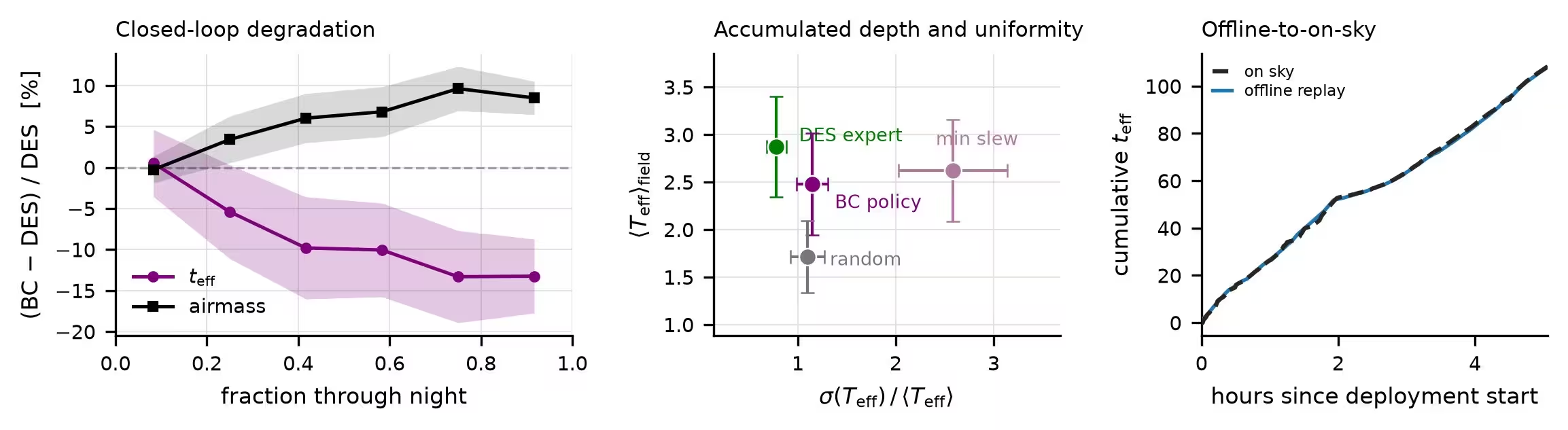
The crucial test happened on the night of June 24, 2026, when the learned policy took direct autonomous control of the Blanco telescope for a five-hour observing window. During this on-sky deployment, the system executed one hundred forty-nine exposures across various filters, achieving an average effective exposure time scale factor of zero point seventy-five. This metric measures data quality and sensitivity relative to pristine conditions. Crucially, the on-sky results closely matched offline computer replays of the exact same night, showing no unexpected degradation when transitioning from simulation to real-world telescope hardware.
While the initial deployment lasted only a single half-night under unusually favorable weather, the findings suggest that imitation learning can bridge the gap between archival human decisions and live telescope operations. The authors note that future improvements will incorporate neighborhood awareness using graph neural networks to help the scheduler cover the sky more uniformly. The team ultimately plans to combine this historical baseline with reinforcement learning to train schedulers that explore alternative observation strategies without requiring manual rule tuning.
The study was posted to the arXiv preprint server on November 24, 2026.
This article has been fact checked for accuracy, with information verified against reputable sources. Learn more about us and our editorial process.
Last reviewed on .
Article history
- Latest version
Reference(s)
- Hur, Rachel. “From Historical Schedules to On-Sky Control: Autonomous Scheduling on the 4-m Blanco Telescope.” arXiv.org <http://arxiv.org/abs/2611.32963v1>.
Cite this page:
- Posted by Karan Das