Massive Binary Star Systems Reveal Hidden Shells and Mass Transfer Secrets Across Galaxies
Archival data from space telescopes uncovers the complex evolutionary states of three rare, long period eclipsing binaries with hundreds of days in their orbits.
Three exceptionally bright binary star systems with orbital periods lasting hundreds of days have revealed surprising clues about how massive stars interact and evolve. T. J. Davidge from the Dominion Astrophysical Observatory analyzed archival photometric and spectroscopic datasets for these rare long period eclipsing binaries, including two located in the Small Magellanic Cloud and one in our own Milky Way galaxy. The research sheds light on complex mass transfer processes that challenge traditional models of stellar evolution.
Why Do Long Period Eclipsing Binaries Matter for Stellar Physics?
Most interacting binary systems studied in our solar neighborhood have short orbital periods lasting less than one hundred days. Systems with periods exceeding one hundred days are much rarer and typically begin their active phase when at least one component is significantly more evolved. These extended systems often grow to become some of the most luminous objects within a galaxy, exhibiting evolutionary pathways that deviate sharply from single stars.
To better understand these exotic systems, Davidge examined archival observations from digital surveys including OGLE, MACHO, and WISE. The study focused on three specific targets: the Small Magellanic Cloud systems SMC004701 and SMC005609, and the Galactic system PW Pup. All three feature orbital periods spanning hundreds of days, with SMC005609 holding a period of about four hundred fifty-five days, SMC004701 lasting about three hundred forty-six days, and PW Pup taking about one hundred fifty-eight days to complete an orbit.
What Do Infrared Observations Reveal About Mass Transfer and Shells?
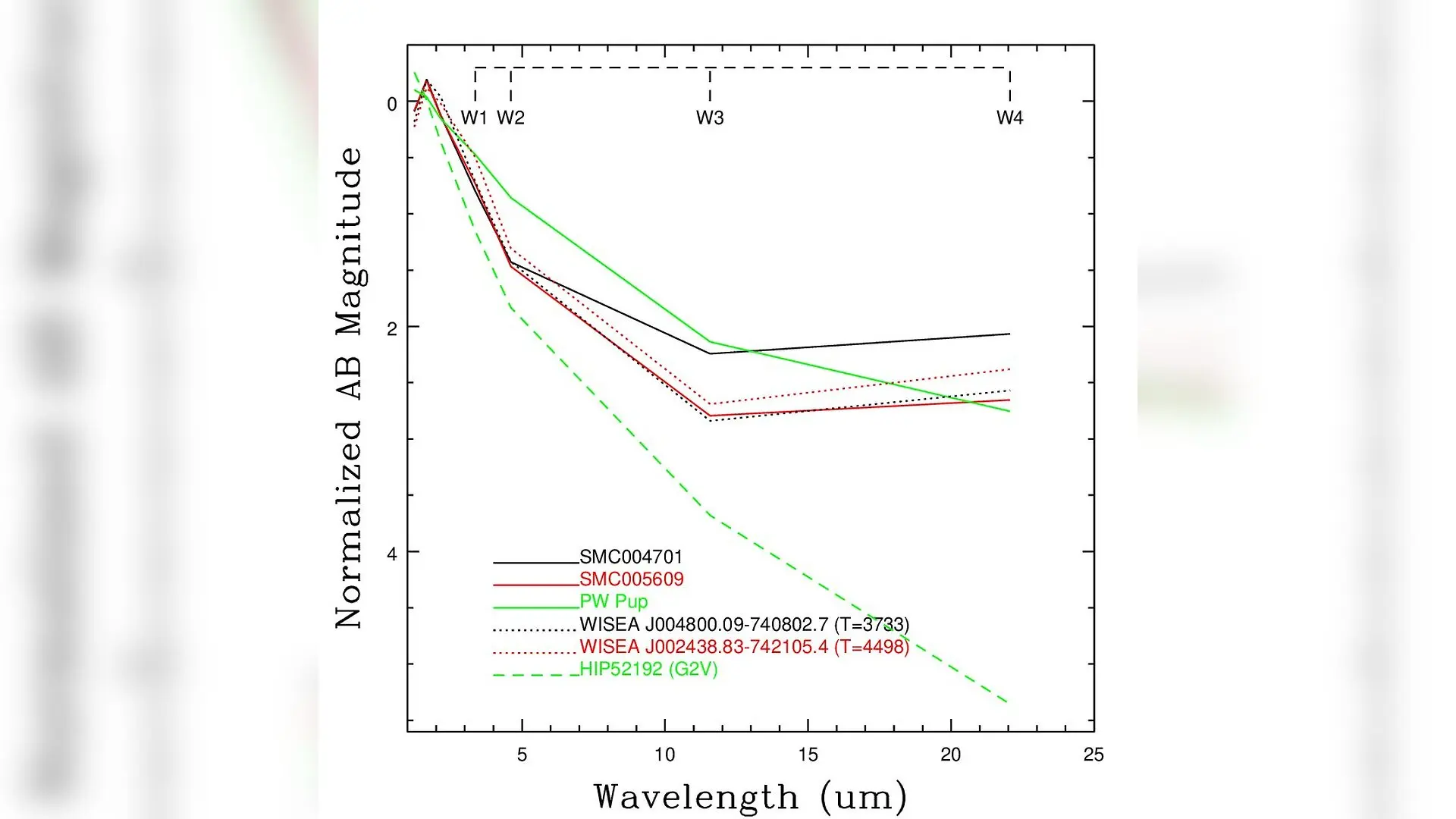
Infrared photometry extending out to twenty-four micrometers provided critical insights into the cooler components and surrounding material within each system. The findings were published in the arXiv preprint server, detailing how the two Small Magellanic Cloud binaries display pronounced excess thermal emission at wavelengths longer than eleven micrometers. This infrared behavior closely mirrors that of isolated late-type giant stars in the same galaxy.
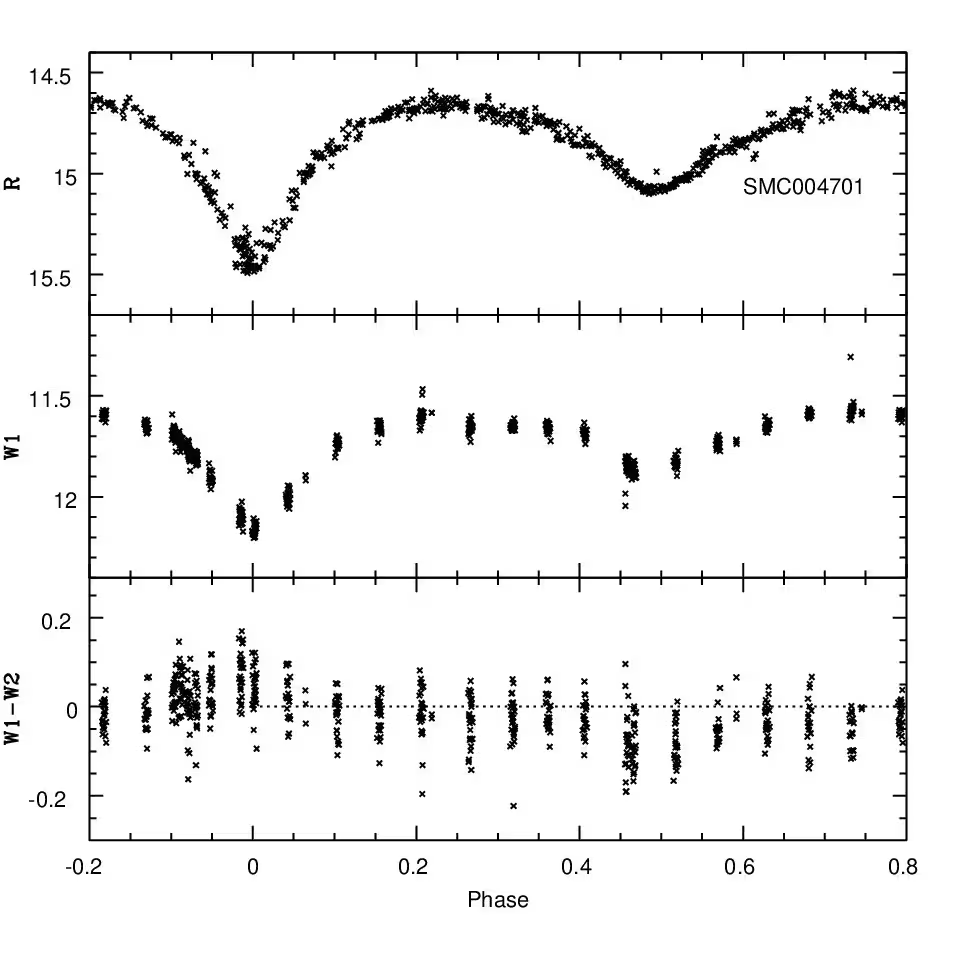
However, the analysis suggests that this excess emission does not necessarily stem from an opaque accretion disk formed by mass transfer. Instead, it likely originates from circumstellar shells or diffuse material distributed along the orbital plane. The system SMC004701 showed phase-dependent color variations in its infrared data, pointing toward a non-uniform distribution of warm material. In contrast, the Galactic system PW Pup lacked the sharp upward break in its infrared spectral energy distribution seen in the Small Magellanic Cloud counterparts, indicating different physical characteristics for its emitting sources.
What Are the Mass Limits and Orbital Geometry of These Binaries?
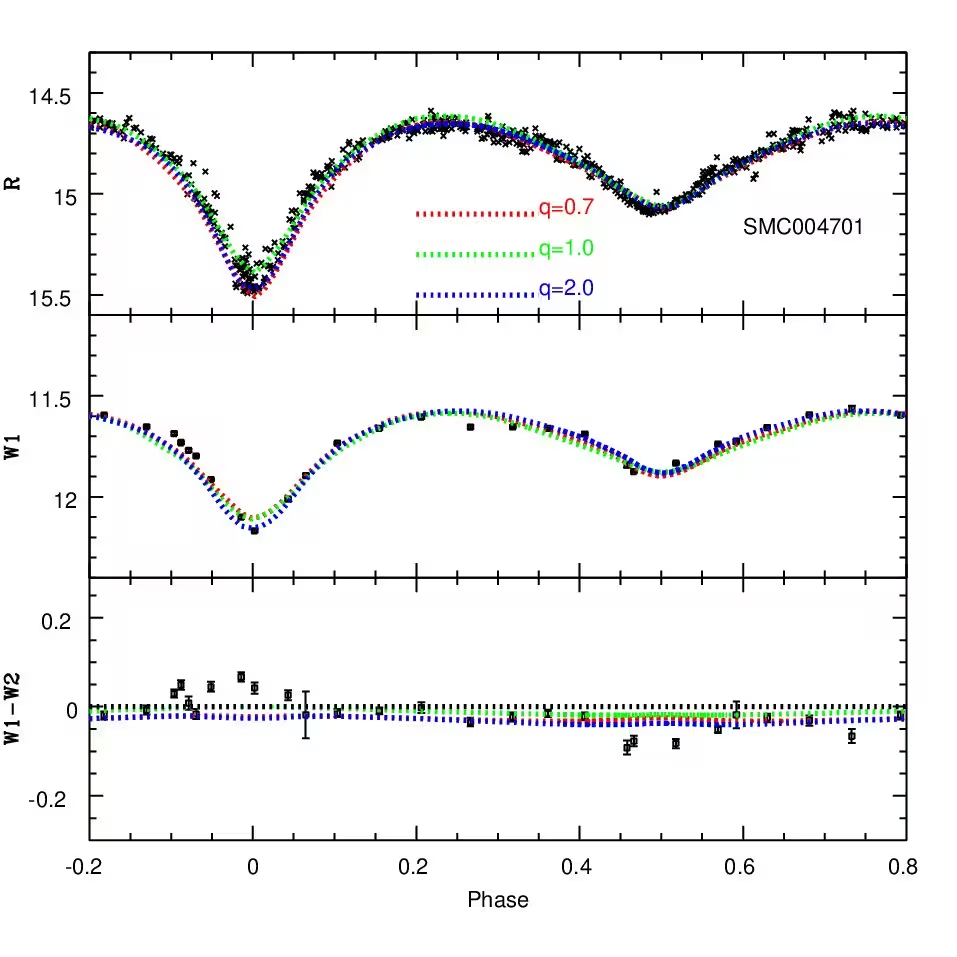
Using radial velocity measurements and light curve modeling packages like PHOEBE, the author constrained the physical parameters and mass functions of the systems. For SMC004701, archival velocity data suggests a minimum mass for the secondary companion of 3.8 solar masses, while PW Pup yields a minimum secondary mass of 3.2 solar masses. The models indicate that the primary stars in these binaries are yellow giants or supergiants that have likely filled or come very close to filling their Roche lobes, which are the gravitational boundaries dictating stellar shapes in a binary system.
The research also addressed potential third bodies in these systems. High astrometric error values in Gaia data for PW Pup point toward the possible presence of an unresolved companion, though a faint B-type star previously spotted in optical spectra cannot serve as the primary component of the eclipsing binary itself without breaking the light curve models. The study emphasizes that while definitive mass ratios remain difficult to pin down from photometry alone, future spectroscopic observations at infrared wavelengths will be vital to detect the hidden spectra of the secondary stars and directly monitor their orbital motions.
The study was posted to the arXiv preprint server on November 24, 2026.
This article has been fact checked for accuracy, with information verified against reputable sources. Learn more about us and our editorial process.
Last reviewed on .
Article history
- Latest version
Reference(s)
- Davidge, T.. “A Study of Three Intrinsically Luminous Long Period Interacting Eclipsing Binaries in the Galaxy and the Small Magellanic Cloud.” arXiv.org <http://arxiv.org/abs/2611.33002v1>.
Cite this page:
- Posted by Nida Rehman