Could The Secret To Dark Energy Be Hidden Inside The Strong Nuclear Force
Researchers have developed a new dark energy model linking cosmic acceleration to the strong nuclear force, offering a fresh perspective on our universe.
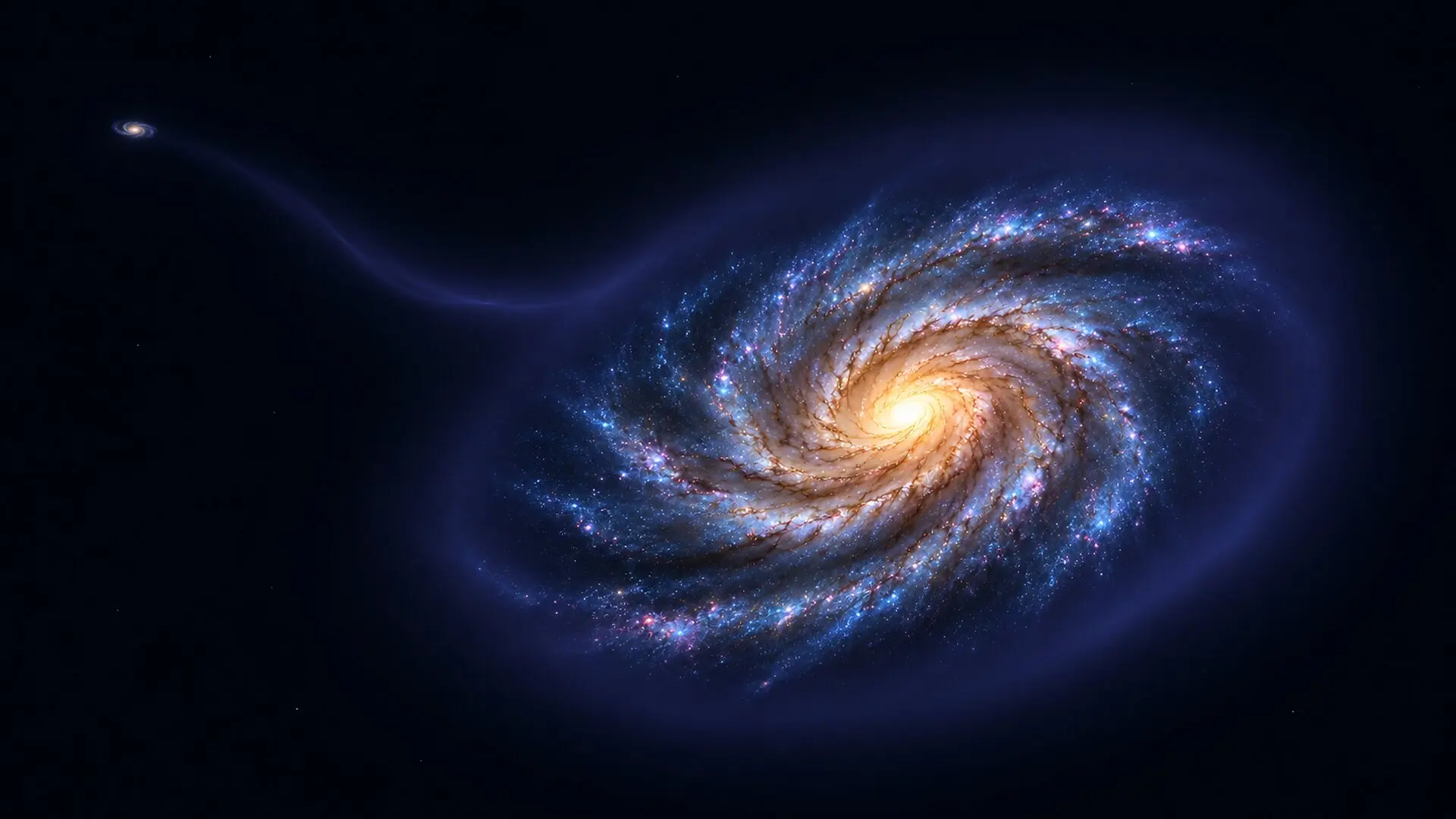
Could the mysterious force driving the universe’s runaway expansion be hiding within the same physics that holds atomic nuclei together? A new theoretical model suggests that the quantum vacuum of the strong nuclear force might be the engine behind dark energy, offering a bridge between the subatomic world and the largest scales of the cosmos.
The proposal, detailed in The Astrophysical Journal, stems from a collaboration between researchers at the University of British Columbia and the University of Sheffield. By applying the principles of quantum chromodynamics (QCD)—the established theory governing quarks and gluons—to the geometry of an expanding universe, the team has formulated a way to explain cosmic acceleration without invoking entirely new, exotic particles.
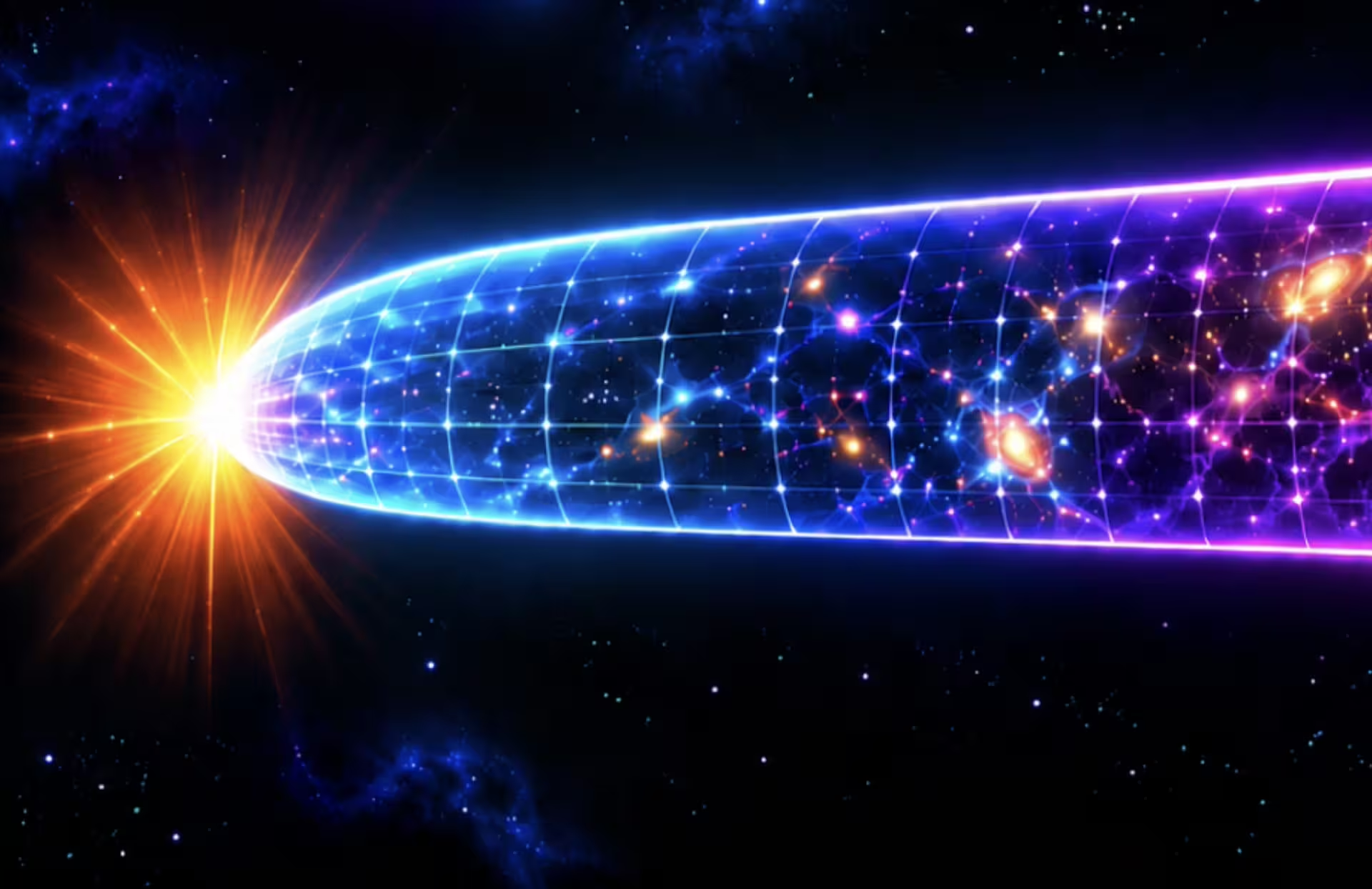
Bridging Subatomic Physics and Cosmic Expansion
Dark energy constitutes roughly 70% of the universe’s total energy, yet its true nature remains one of physics’ most stubborn puzzles. Standard cosmological models typically treat dark energy as a static “cosmological constant.” However, recent evidence suggesting that dark energy might evolve over time has spurred scientists to look for dynamic alternatives.
The research team focused on the QCD vacuum, which is the lowest-energy state of quantum fields. Even in the absence of matter, this vacuum possesses a complex structure defined by mathematical “topological sectors.” The authors propose that quantum tunneling between these configurations generates vacuum energy that is sensitive to the global geometry of spacetime. As the universe expands, this vacuum energy shifts, potentially providing the push behind current cosmic acceleration.
“Our theoretical framework suggests no new particles may be required at all,” said co-author Ariel Zhitnitsky. The model aligns the energy scale of the strong force with the observed energy density of dark energy, providing a compelling theoretical link, though the team emphasizes that this does not yet constitute final proof that this mechanism is driving the universe.
Putting the Theory to the Test
To evaluate the model, the researchers compared it against high-precision cosmological data. This included measurements from the Cosmic Microwave Background—the oldest light in the universe—and data from the Dark Energy Spectroscopic Instrument (DESI), which tracks the history of cosmic expansion through baryon acoustic oscillations. They also incorporated distance measurements from Type Ia supernovae, often referred to as “standard candles” for mapping the cosmos.
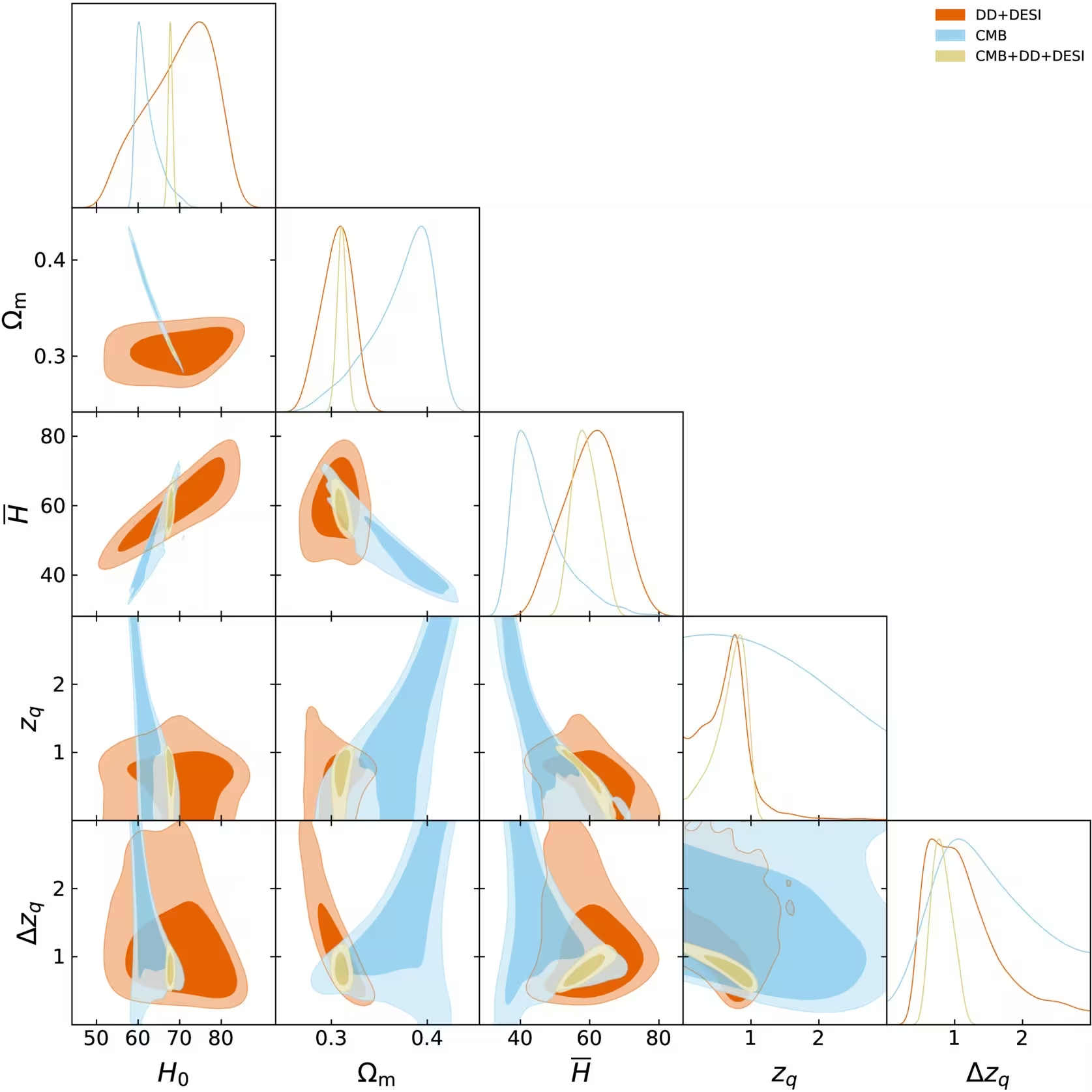
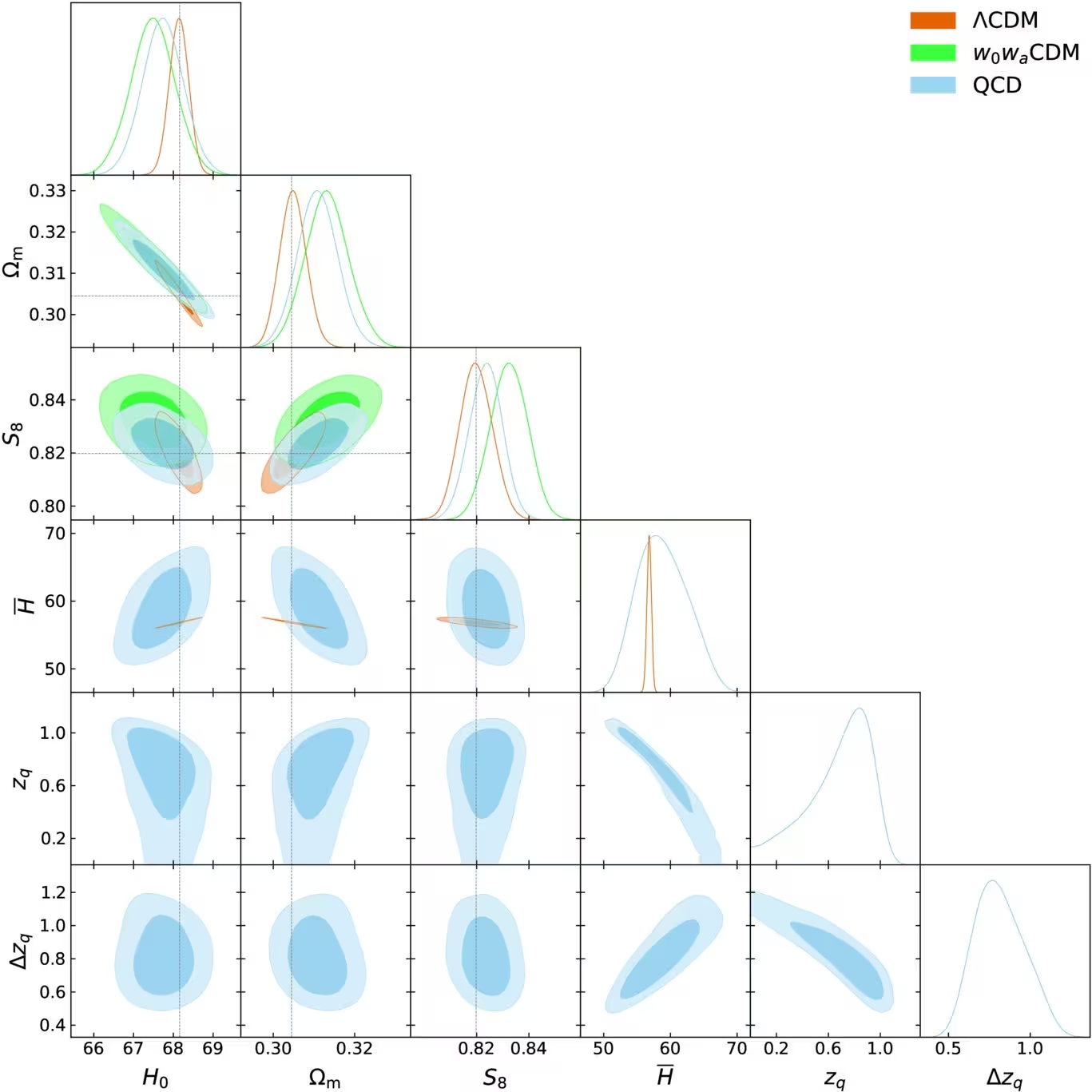
In their analysis, the QCD-based model performed competitively against the standard ΛCDM (Lambda Cold Dark Matter) model. While the standard model relies on a fixed constant, the researchers’ version introduces two additional parameters to account for the transition in vacuum energy over cosmic time. These parameters act as a “switching function,” allowing the effect to remain dormant in the early universe while becoming significant in later epochs.
A New Path Forward
While the results are encouraging, the authors acknowledge that directly calculating how the QCD vacuum behaves in a dynamic, expanding geometry is technically daunting. The current model relies on certain theoretical assumptions to bridge the gap between microscopic particle behavior and macroscopic cosmic expansion.
Future observations, such as those expected from upcoming space telescopes, will be crucial in determining whether this model holds up under closer scrutiny. By tightening measurements of cosmic distances, researchers hope to see if the predicted signatures of this evolving vacuum energy actually manifest in the sky. For now, the proposal stands as a provocative reminder that the answers to our greatest cosmic mysteries may be written in the fundamental rules governing the smallest particles in existence.
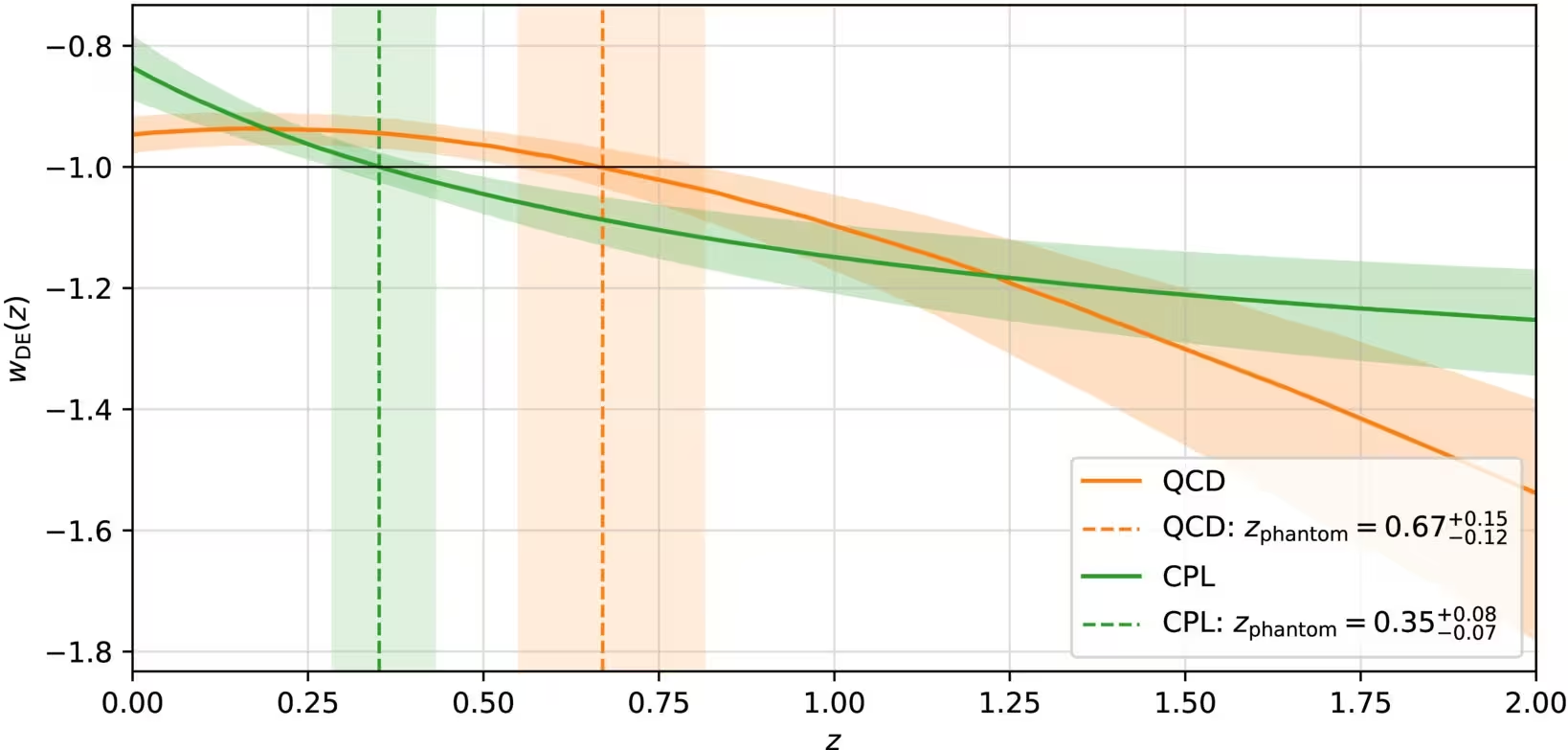
Further reading on the team’s methodology and the broader context of dark energy research can be found in the original publications in Physical Review D and The Astrophysical Journal.
This article has been fact checked for accuracy, with information verified against reputable sources. Learn more about us and our editorial process.
Last reviewed on .
Article history
- Latest version
Reference(s)
- Lee, Dong Ha., et al. “Evolving Dark Energy Is Vacuum Energy After All.” The Astrophysical Journal, vol. 1012, no. 2, November 20, 2026, pp. 172 American Astronomical Society, doi: 10.3847/1538-4357/aeb9cc. <https://doi.org/10.3847/1538-4357/aeb9cc>.
- “The University of British Columbia.” <https://www.ubc.ca/>.
- “Independent thinking. Shared ambition..”, November 17, 2026 <https://www.sheffield.ac.uk/>.
- van Waerbeke, Ludovic., et al. “DESI results and dark energy from QCD topological sectors.” Physical Review D, vol. 114, no. 10, November 4, 2026 American Physical Society (APS), doi: 10.1103/16mj-vjg9. <https://journals.aps.org/prd/abstract/10.1103/16mj-vjg9>.
- Lee, Dong Ha., et al. “Evolving Dark Energy Is Vacuum Energy After All.” The Astrophysical Journal, vol. 1012, no. 2, November 20, 2026, pp. 172 American Astronomical Society, doi: 10.3847/1538-4357/aeb9cc. <https://iopscience.iop.org/article/10.3847/1538-4357/aeb9cc>.
Cite this page:
- Posted by John Williams