Topical Vancomycin Powder Linked to Lower Infection Rates in 600 Neurosurgery Patients
A prospective study of six hundred brain and spine operations suggests an affordable antibiotic powder could slash postoperative infection risks in high-burden settings.

A simple pinch of antibiotic powder placed directly into surgical wounds during brain and spine operations is linked to a substantially lower risk of dangerous postoperative infections, according to a new prospective observational study of six hundred adult patients. The findings suggest that applying topical vancomycin powder could help protect vulnerable patients undergoing high-risk neurosurgeries in resource-limited healthcare settings.
Surgical site infections represent one of the most feared complications in neurosurgery, often leading to extended hospital stays, expensive reoperations, and severe long-term disability. These complications are particularly prevalent in low- and middle-income countries due to delayed patient presentation, underlying health conditions, and stretched infection-control resources. Although high-income hospitals have explored topical antibiotic powders to deliver localized protection against stubborn gram-positive bacteria like Staphylococcus aureus without flooding the bloodstream, real-world data from developing nations remain scarce.
How did researchers evaluate topical vancomycin in six hundred neurosurgery patients?
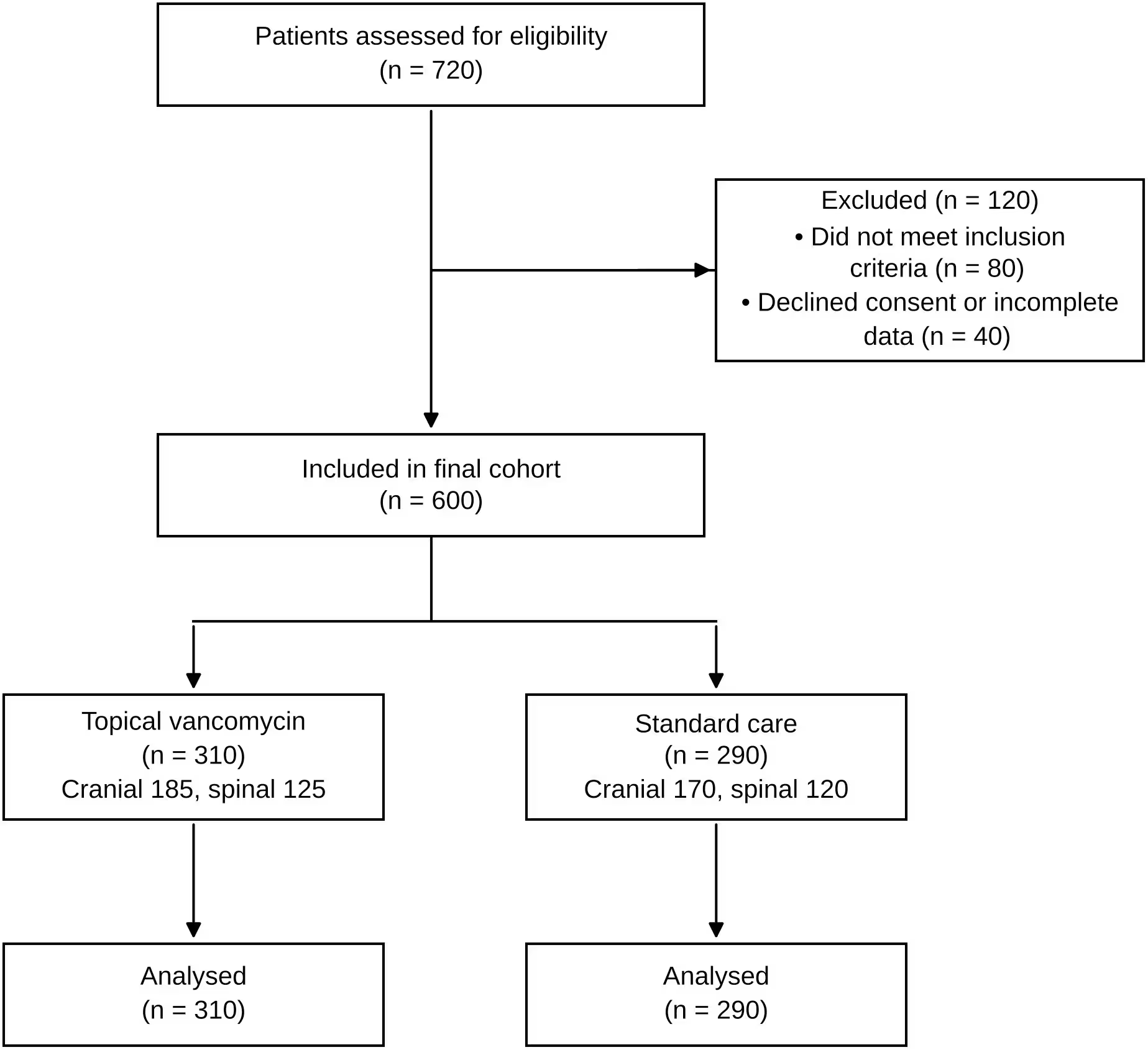
To address this clinical knowledge gap, Ihsan Ullah and colleagues from the Department of Neurosurgery at Lady Reading Hospital in Peshawar, Pakistan, conducted a prospective observational cohort study between January 2021 and December 2024. The investigation, published in PLOS One, tracked six hundred adult patients who underwent elective cranial or spinal neurosurgical procedures after a rigorous screening process excluded active infections, vancomycin allergies, or contaminated wounds.
Out of the total cohort, three hundred ten patients received the intervention, which involved placing one gram of sterile vancomycin powder directly onto the surgical wound bed or subgaleal space prior to layered closure. The remaining two hundred ninety patients received standard perioperative care, which included intravenous cefoperazone plus sulbactam as prophylaxis but no topical antibiotics. Treatment allocation was non-randomized and based on surgeon preference as the clinic gradually adopted the technique to combat rising infection rates, though both groups were managed concurrently by the same surgical team.
What were the infection rates and key outcomes for treated patients?
The overall incidence of surgical site infections was significantly lower in the vancomycin group at one point six percent, compared to six point six percent in the control group. This corresponded to an absolute risk reduction of four point nine percentage points and meant that doctors needed to treat twenty patients with the powder to prevent one infection. Further analysis revealed that topical vancomycin was also associated with notable drops in severe complications, including deep or organ-space infections falling to zero point six percent versus three point one percent, and reoperations due to infection dropping to one percent compared to three point eight percent.
When breaking down the procedures, the protective association was statistically significant in cranial operations and non-instrumented procedures, whereas spinal and instrumented surgeries did not show a statistically significant benefit when analyzed in isolation. Importantly, no systemic toxicity, kidney impairment, or adverse drug events were recorded in either group during the monitoring window.
Does diabetes and operative time change the risk of infection?
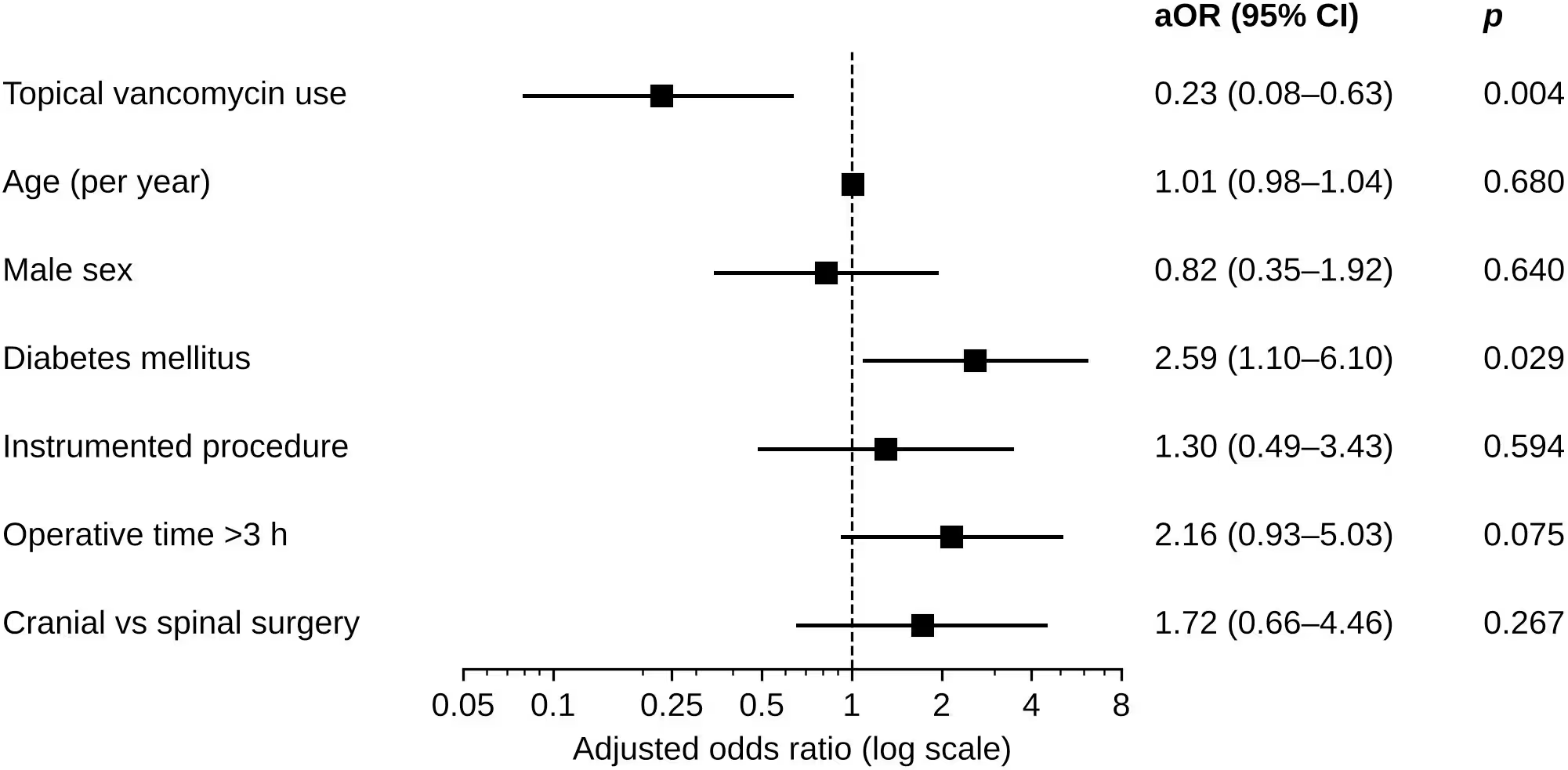
Multivariable logistic regression analysis confirmed that topical vancomycin remained independently associated with a slashed risk of infection, yielding an adjusted odds ratio of zero point twenty-three after controlling for age, sex, and operative details. However, the data also highlighted diabetes mellitus as a major independent risk factor, increasing the odds of developing a postoperative infection by nearly two and a half times.
The researchers performed several sensitivity checks, including Firth penalized regression, propensity score weighting, and adjustments for the year of surgery, to confirm that the protective signal was not an artifact of changing hospital practices over time. An E-value of eight point two indicated that an unmeasured confounding factor would need an exceptionally strong association with both the treatment and the infection outcome to fully explain away the observed protective effect.
What are the limitations and future steps for neurosurgical infection control?
The study authors emphasize several important limitations, primarily that the non-randomized, single-center design leaves room for residual confounding and selection bias. Furthermore, the relatively small total number of infection events restricted detailed subgroup evaluations, and the follow-up period of thirty to ninety days could not capture long-term bacterial resistance patterns or delayed complications. Consequently, while the results point to a promising and affordable safety measure for high-risk neurosurgical environments, the authors stress that large multicenter randomized controlled trials are essential before routine use can be universally recommended.
The research was published in PLOS One on November 24, 2026.
This article has been fact checked for accuracy, with information verified against reputable sources. Learn more about us and our editorial process.
Last reviewed on .
Article history
- Latest version
Reference(s)
- Ullah, Ihsan., et al. “Topical vancomycin powder and surgical site infection in cranial and spinal surgery: A prospective cohort study from Pakistan.” PLOS One, vol. 21, no. 11, November 24, 2026, pp. e0363427 Public Library of Science (PLoS), doi: 10.1371/journal.pone.0363427. <https://doi.org/10.1371/journal.pone.0363427>.
Cite this page:
- Posted by Susan White