New Mathematical Framework Resolves Longstanding Debate Over Bacterial Cell Division Control
By analyzing single-cell dynamics across seventeen datasets, a new mathematical model proves that bacteria coordinate DNA replication and division using two concurrent adders.
Bacterial cells coordinate DNA replication and cell division through two concurrent regulatory processes rather than a single standalone mechanism, according to a mathematical analysis of Escherichia coli growth dynamics. The study resolves a long-standing debate in quantitative microbiology by showing that combining a size-adder rule at birth with a replication-dependent adder successfully explains cell cycle coordination across diverse growth conditions.
How do bacteria balance chromosome replication and division events?
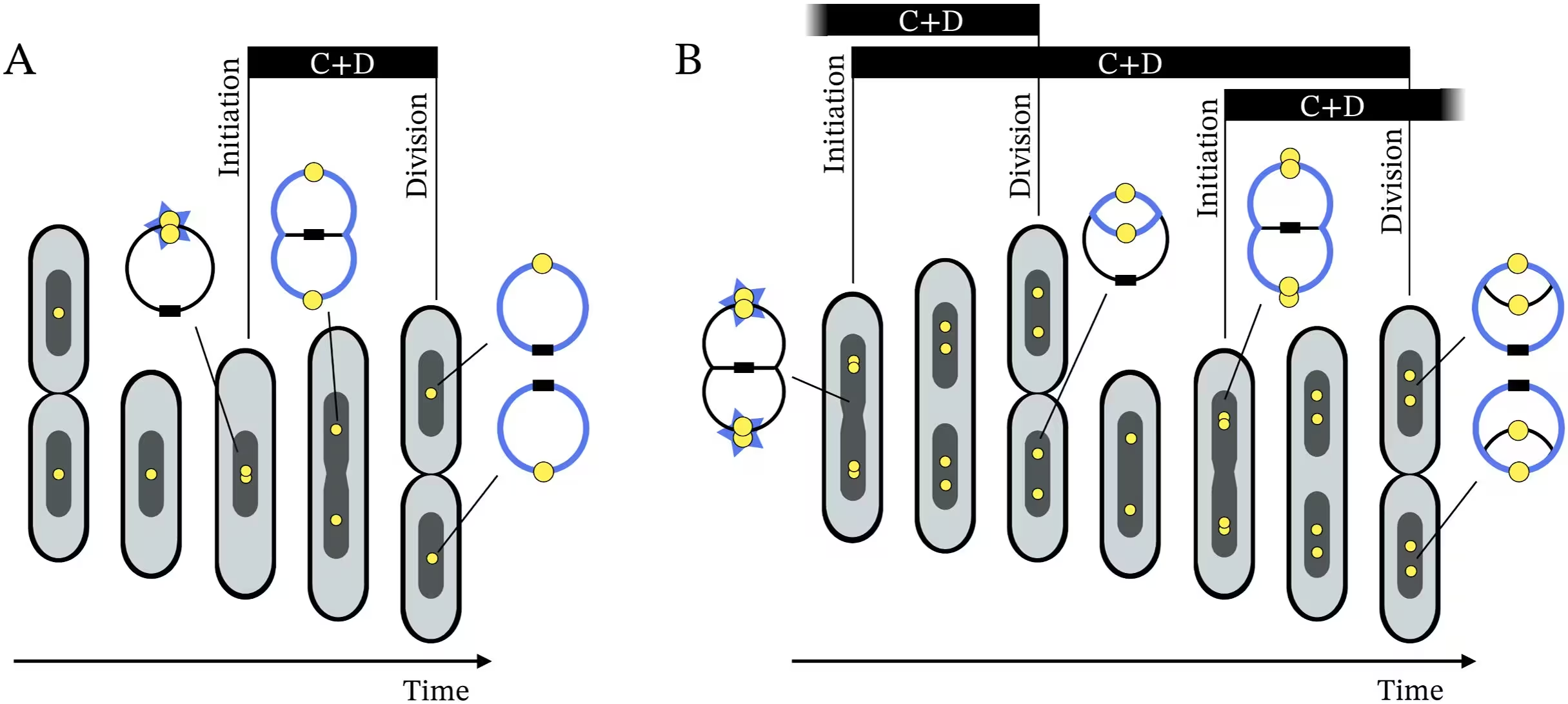
For more than half a century, researchers have investigated how single-celled organisms maintain homeostasis by timing their physical divisions to match the duplication of their genetic material. While earlier deterministic models assumed uniform behavior, advanced microfluidic observations reveal considerable variability among individual cells. This stochastic nature prompted the development of probabilistic models, such as the division adder model where cells divide after adding a fixed volume regardless of their birth size, and the initiation adder model which controls chromosome replication.
A central challenge in the field has been understanding how these two cycles synchronize, especially during fast growth conditions where multiple replication rounds overlap. Previous single-process models argued either that division is entirely independent of replication or that replication alone dictates when a cell divides. To evaluate these competing ideas rigorously, Alexandre Perrin from the Pasteur Institute and their colleagues developed a unifying mathematical framework published in PLOS Computational Biology that removes previous statistical limitations, such as the assumption that cell variables are normally distributed.
Why do single-process models fail logical consistency checks?
The research team demonstrated that single-process models can lead to unphysiological outcomes unless strict mathematical conditions are met. For instance, if division and replication are completely independent as proposed by the Double Independent Adders Model, calculations reveal a non-zero probability of roughly one in a thousand that a cell will divide without possessing any functional chromosome copies, producing anucleated descendants that lack genetic material.
Similarly, models that assume division is solely governed by replication permit theoretical scenarios where a daughter cell divides before its mother. By establishing exact mathematical boundaries, the authors proved that single-process frameworks require specific restrictions on their underlying probability distributions to prevent these biological inconsistencies. These findings suggest that relying on a single isolated control mechanism is insufficient to explain robust cellular regulation across all environmental conditions.
Does a new double-process model outperform previous theories?
To overcome the limitations of single-process rules, the researchers formulated a novel double-process framework named the Concurrent Adders Model. This new approach combines a standard birth-size adder with an initiation-division adder that ties division timing directly to the completion of chromosomal replication steps. Using maximum likelihood estimation across 17 distinct experimental datasets spanning multiple laboratory strains and growth media, the team compared the new model against existing single-process and concurrent timer models using the Bayesian Information Criterion.
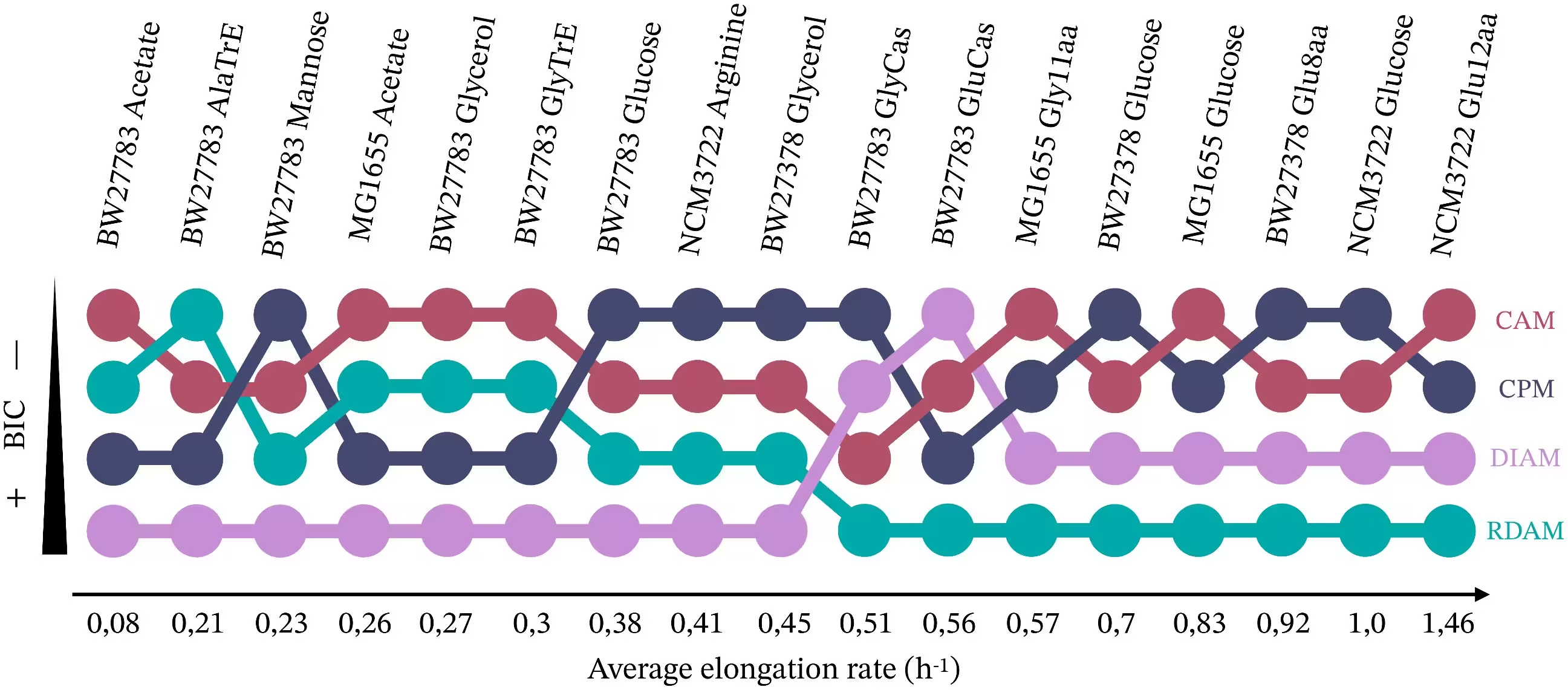
The statistical comparison indicates that double-process models provide superior predictions of division size across nearly all tested conditions. Furthermore, when evaluating how accurately each model reconstructs the joint distributions of birth, initiation, and division sizes using Wasserstein distance metrics, the Concurrent Adders Model outperformed earlier alternatives in 16 out of 17 datasets. This demonstrates that a replication-based adder mechanism is more accurate than timer-based counterparts in describing how bacteria couple their division cycles to DNA replication.
What do artificial perturbations reveal about cellular control?
When scientists artificially perturb replication initiation proteins such as DnaA, cellular birth size remains largely unaffected, a phenomenon that previously led researchers to argue for complete independence between replication and division. However, when the authors simulated DnaA oscillations within their new concurrent adders framework, the model successfully reproduced this exact experimental buffering effect. This confirms that dual-process regulation can absorb minor internal fluctuations without destabilizing overall cell size homeostasis, reconciling conflicting evidence from earlier experimental studies.
The research was published in PLOS Computational Biology on November 24, 2026.
This article has been fact checked for accuracy, with information verified against reputable sources. Learn more about us and our editorial process.
Last reviewed on .
Article history
- Latest version
Reference(s)
- Perrin, Alexandre., et al. “Deciphering the replication-division coordination in E. coli: A unified mathematical framework for systematic model comparison.” PLOS Computational Biology, vol. 22, no. 11, November 24, 2026, pp. e1014907 Public Library of Science (PLoS), doi: 10.1371/journal.pcbi.1014907. <https://doi.org/10.1371/journal.pcbi.1014907>.
Cite this page:
- Posted by Faisal Qureshi