AI-Guided Optimisation Algorithm Cuts Green Hydrogen Production Costs in New Study
Researchers developed an adaptive reinforcement learning approach to balance equipment sizing, conversion efficiency, and lifecycle costs in solar-hydrogen systems.

A new artificial intelligence-guided optimisation approach helps engineers design solar-powered hydrogen production systems that balance low generation costs with real-world energy demands, according to a recent study. Converting surplus solar power into storable green hydrogen is considered a promising route for decarbonising electricity grids and industrial applications, but the physical and economic variables involved make system design exceptionally complex. To tackle this challenge, Lei Liu and co-workers from Henan Polytechnic University developed an adaptive algorithm that coordinates photovoltaic generation, water electrolysis, power conversion, and equipment economics.
The research, published in PLOS One, addresses a fundamental hurdle in green hydrogen engineering. Designing a photovoltaic and proton exchange membrane electrolyser system involves tightly coupled interactions among solar panel sizing, electrical matching, electrolyser operation, thermal regulation, hydrogen storage, and lifecycle costs. Oversizing generation capacity increases capital expenditures without guaranteeing a proportional return in hydrogen output, whereas undersizing restricts annual production and drives up the per-kilogram cost.
How Does Reinforcement Learning Guide the Optimisation Search?
The authors developed a reinforcement learning-guided Dandelion Optimizer, abbreviated as RL_DO, to navigate these complex trade-offs. The original Dandelion Optimizer is a nature-inspired swarm algorithm that models how dandelion seeds disperse across rising, descending, and landing phases. While effective, traditional metaheuristics rely on fixed mathematical rules that cannot adapt when an optimisation search becomes trapped in local traps or needs to shift between broad exploration and local fine-tuning.
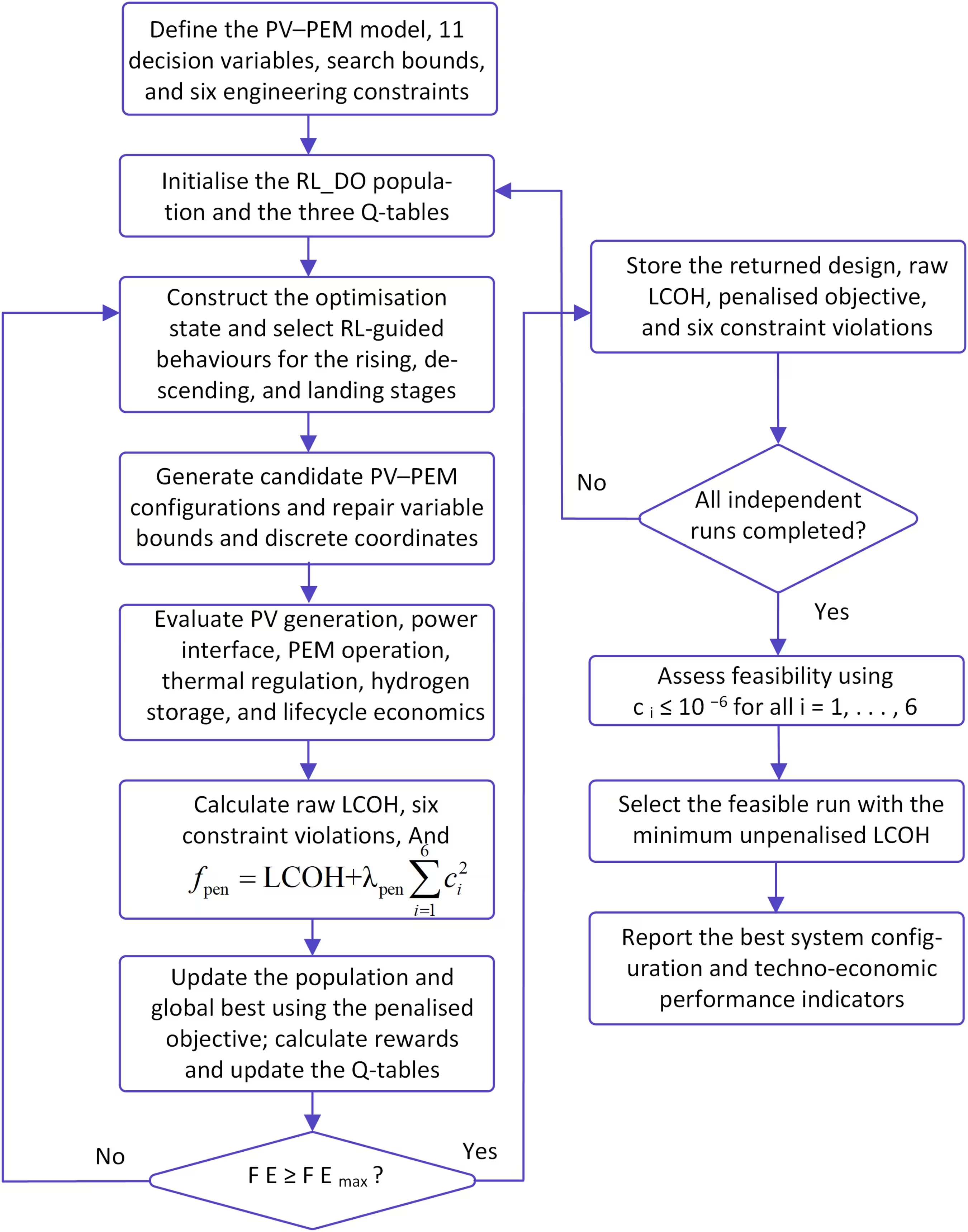
To overcome this limitation, the team introduced three independent Q-learning policies to dynamically regulate the rising, descending, and landing stages according to the evolving population state. Instead of replacing the original search operators, reinforcement learning acts as a high-level behavioural decision layer. The optimiser observes population diversity, search progress, and stagnation, adjusting its search behaviour within a fixed budget of fifty thousand objective-function evaluations.
What Did the Techno-Economic Analysis Reveal About Hydrogen Costs?
The team applied RL_DO to an 11-variable system design case constrained by six engineering rules, including annual hydrogen production targets, capacity factors, and voltage-matching limits. Over thirty independent runs, the RL_DO framework achieved a mean unpenalised levelized cost of hydrogen of about six dollars per kilogram, with a standard deviation of 0.0310. This represented a more consistent performance and a lower run-to-run variability compared to the baseline algorithm.
The best feasible configuration identified by the optimiser featured a photovoltaic capacity of 17.85 kilowatts and an electrolyser capacity of 7.59 kilowatts. The economic analysis demonstrated that the lowest hydrogen cost is not achieved by simply maximising system capacity or conversion efficiency, but by carefully matching equipment scale to annualised lifecycle expenditures and equipment utilisation.
What Are the Dominant Cost Sensitivities of Solar-Hydrogen Systems?
A deterministic one-at-a-time sensitivity analysis revealed that capital expenditure for the proton exchange membrane electrolyser exerts the largest influence on the levelized cost of hydrogen. A twenty percent reduction in electrolyser capital cost decreased the hydrogen cost by over ten percent, whereas a twenty percent increase raised it by a similar margin. Photovoltaic capital expenditure and the real discount rate emerged as the second and third most influential economic drivers.
The authors note that the study relies on reduced-order engineering models and representative operating profiles rather than long-term time-series meteorological data or explicit component degradation modeling. Future research directions will incorporate high-resolution environmental data, degradation-aware lifecycle models, and multi-objective criteria to further improve the deployment of renewable hydrogen energy systems.
The research was published in PLOS One on November 24, 2026.
This article has been fact checked for accuracy, with information verified against reputable sources. Learn more about us and our editorial process.
Last reviewed on .
Article history
- Latest version
Reference(s)
- Liu, Lei., et al. “Reinforcement learning-guided Dandelion Optimizer for techno-economic optimisation of PV–PEM hydrogen production systems.” PLOS One, vol. 21, no. 11, November 24, 2026, pp. e0362199 Public Library of Science (PLoS), doi: 10.1371/journal.pone.0362199. <https://doi.org/10.1371/journal.pone.0362199>.
Cite this page:
- Posted by Omar Mirza