Why Border Travel Bans And Screening Fail To Stop Epidemics
Mathematical modeling reveals that silent infections slip past checkpoints and local case triggers arrive far too late.

When infectious pathogens cross borders, the window of time to stop a community outbreak before it explodes is shockingly narrow and usually vanishes long before local health workers spot their first official patient. A mathematical analysis published in arXiv by Julien Arino and colleagues at the University of Manitoba and Memorial University of Newfoundland reveals why reactive travel bans and destination screening frequently fail to keep diseases out.
Why Do Border Restrictions Often Fail to Stop Outbreaks?
During global health emergencies, governments routinely rely on travel interruptions, border screening, and quarantines to delay the spread of viruses like SARS-CoV-2. Yet the success rates of these measures vary wildly across different jurisdictions, leaving policymakers wondering why piecemeal bans so often arrive too late. To unpack this, the researchers formulated a coupled two-location epidemic model dividing populations into an exporter region and an importer region. This framework explicitly separates recently arrived travellers into an introduction layer to track how imported cases interact with local communities.
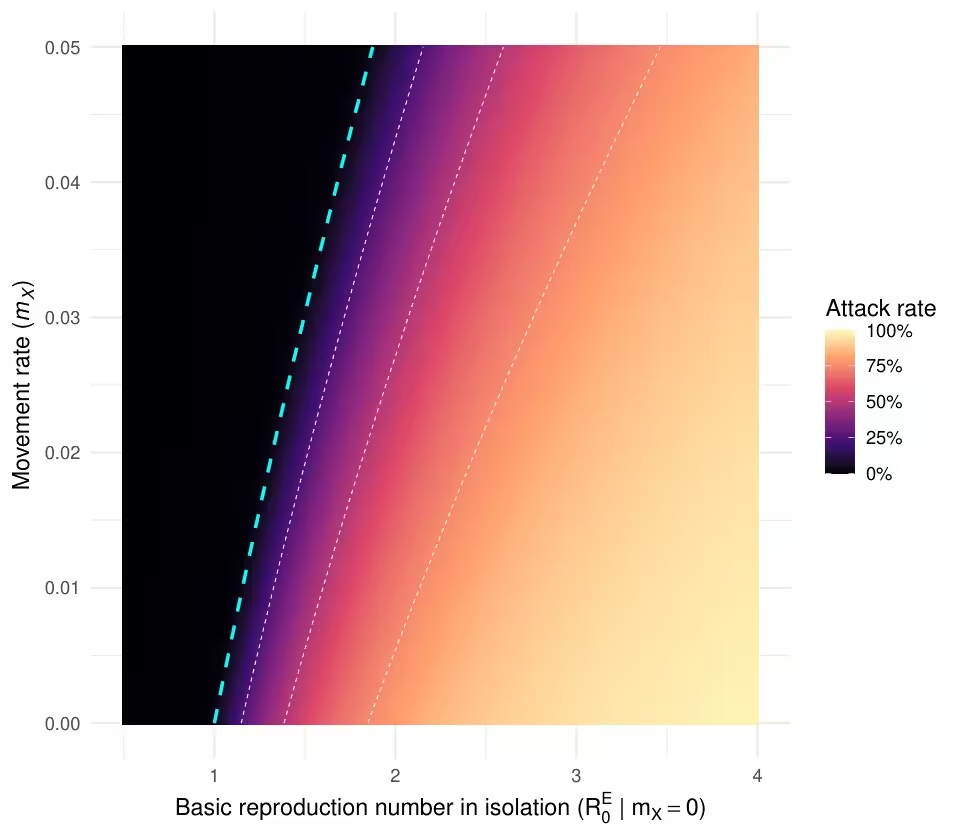
The authors utilized both deterministic ordinary differential equations and stochastic continuous-time Markov chains to simulate disease transmission dynamics. A key structural challenge involves the latent period, during which infected individuals carry the pathogen without showing symptoms or testing positive. Because air travel durations are typically much shorter than incubation windows, latently infected travellers cross borders completely undetected. As the study demonstrates, pre-departure screening in the exporter alone cannot prevent outbreaks in a receptive importer community because these silent carriers slip right past the checkpoint.
How Fast Do Silent Introductions Ignite Local Spread?
When an importer community has a reproduction number larger than unity, meaning each infected person transmits the virus to more than one other individual on average, a single imported case can rapidly ignite a self-sustaining epidemic. The stochastic simulations show that waiting for local case counts to rise before triggering a travel ban acts far too late. Local detection inherently lags behind actual arrivals because silent introductions precede any official diagnosis. Consequently, reactive travel restrictions imposed after local cases start mounting fail to cut off the inflow before community transmission is already established.
The analysis also highlights a profound operational tension under international health regulations. While exit screening at the source is logistically far more efficient than entry screening across dozens of destination airports, it places the entire financial and operational burden on the exporting jurisdiction. Furthermore, because exit screening cannot catch latently infected travellers, stand-alone screening leaves destination communities vulnerable to invisible leakages.
What Combination of Measures Actually Protects Isolated Regions?
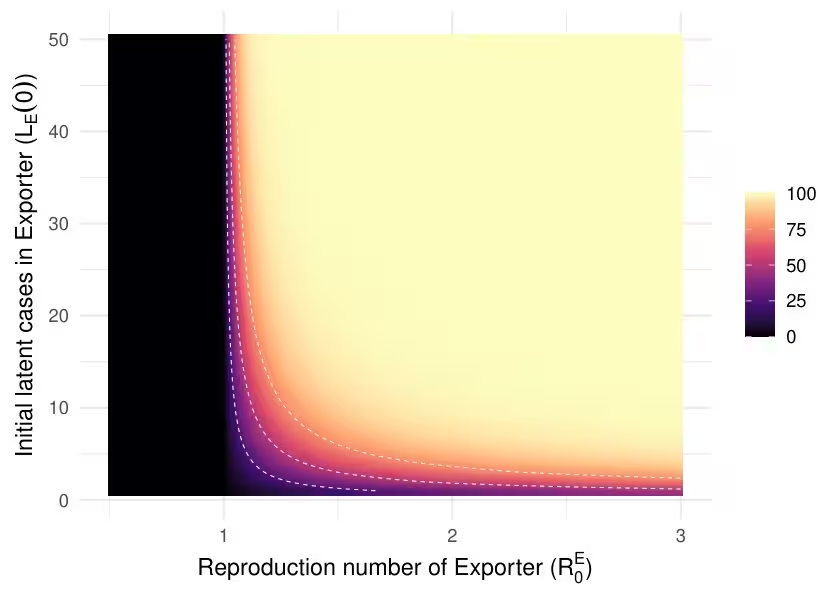
The research clarifies why remote or geographically isolated jurisdictions achieved remarkable success with travel controls during the COVID-19 pandemic. Places like Newfoundland and Labrador, Nunavut, Prince Edward Island, Yukon, and northern Manitoba maintained exceptionally low incidence rates by combining geographic isolation with strict post-arrival quarantines and mandatory testing. By isolating incoming travellers in a dedicated introduction layer before they could mix freely with residents, these regions intercepted latent arrivals successfully.
However, the model proves there is no single silver bullet. Effective protection requires a layered strategy combining proactive, exporter-informed border measures with robust local public health interventions that keep community transmission near or below one. Without keeping local reproduction numbers under control, even minor border leakages can spark major outbreaks. Ultimately, the findings demonstrate that relying on local case counts alone to trigger travel interventions is insufficient, and policymakers must monitor real-time intelligence from connected exporting regions to get ahead of spreading pathogens.
The study was posted to the arXiv preprint server on November 22, 2026.
This article has been fact checked for accuracy, with information verified against reputable sources. Learn more about us and our editorial process.
Last reviewed on .
Article history
- Latest version
Reference(s)
- Arino, Julien. “Introduced cases, spread of infection in a community and travel control measures.” arXiv.org <http://arxiv.org/abs/2611.29584v1>.
Cite this page:
- Posted by Linda Wilson