Hidden Physiological Traits Can Trigger Evolutionary Diversification In Stable Populations
Mathematical modeling reveals that unobserved internal traits can spark visible species divergence and generate mysterious correlations.

Invisible biological traits interacting beneath the surface can trigger unexpected evolutionary branching in populations that should otherwise remain uniform. When evolutionary biologists track how new species emerge, they typically focus on a small handful of observable traits such as body size, wing span, or coloration. However, an organism’s internal physiology, metabolism, and gene regulation form a vast network of unmeasured characteristics that actively shape evolutionary outcomes. A new mathematical theory published in arXiv reveals that these hidden traits do much more than simply add noise or distort data, because their complex interactions can actually create evolutionary diversification from scratch.
How Hidden Physiological Networks Spark Trait Diversification
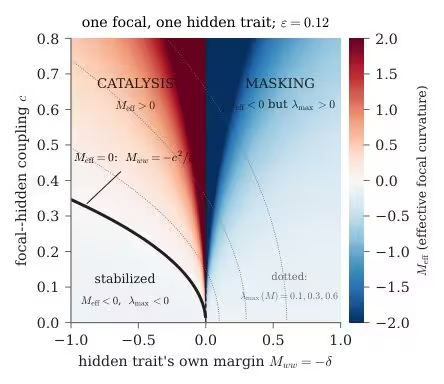
The research team led by Vikas Kumar Jha and their colleagues at the Indian Institute of Technology Madras set out to solve a long-standing puzzle in evolutionary ecology. Natural populations frequently display far more phenotypic variation than standard mutation and selection models can explain. To investigate why, the authors developed a theoretical framework by partitioning phenotype space into a visible focal sector and an unobserved hidden sector. By mathematically eliminating the hidden variables through a matrix operation known as a Schur complement, the team calculated an exact effective operator that governs the visible traits.
The analysis demonstrates that stable hidden traits can act as catalysts. Even when a visible trait is individually stable and shows no tendency to split into multiple forms on its own, coupling it to a stable hidden trait can push it across the threshold into active diversification. This effect becomes exceptionally powerful as the hidden trait approaches a critical marginal state. Conversely, if the hidden sector is already undergoing diversification itself, it drives variation in the visible traits as a correlated response. In this second scenario, which the authors term masking, no analysis restricted solely to the visible traits can predict their diversification because the true driver remains hidden.
Can Uncoupled Traits Develop Mysterious Correlations?
The mathematical model also explains why two completely separate visible traits can become statistically correlated even when they share no direct biological interaction. If both observable traits interact with the same hidden physiological factor, such as a specific metabolic rate or hormone level, an effective coupling is forged between them. The authors found that the sign of this induced correlation is entirely determined by the product of the individual couplings to the hidden trait. Reversing the sign of just one coupling flips the correlation from positive to negative, offering a testable prediction for laboratory experiments.
To verify these theoretical findings, the researchers conducted continuous-time birth-death simulations incorporating finite population drift and mutation. In one-dimensional Gaussian models, the individual-based simulations accurately reproduced the predicted variance scaling above the diversification threshold. Furthermore, simulations using a quartic model demonstrated that coupling subthreshold traits successfully splits a single population distribution into two distinct clusters. When the team tested three focal traits coupled to three hidden traits, the populations reliably diversified along specific geometric directions dictated by the theoretical calculations.
What Happens in High-Dimensional Biological Systems?
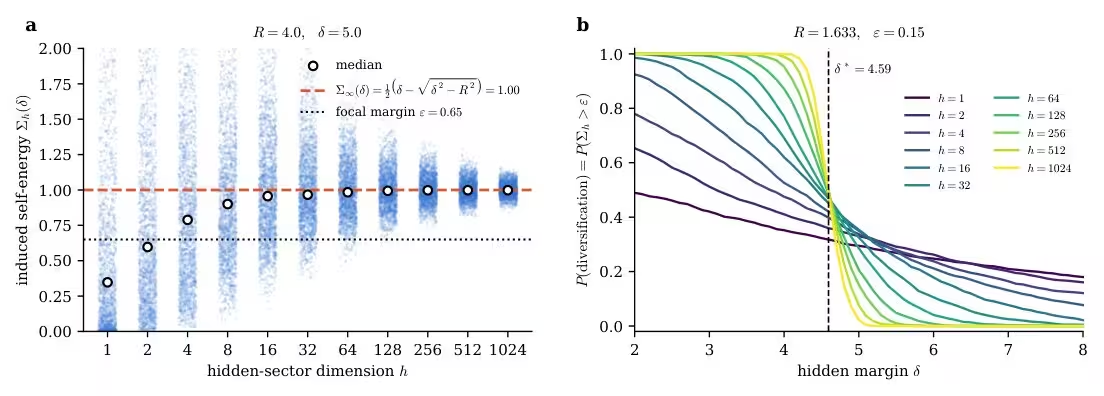
As biological systems grow more complex, tracking thousands of unmeasured parameters becomes impractical. To understand how large hidden sectors behave, the authors examined the limit where the number of hidden dimensions increases toward infinity. Using random matrix theory, they showed that with dimension-normalized couplings, the self-energy correction approaches a stable deterministic limit rather than growing without bound. As the hidden sector dimension increases, the transition between uniform populations and diversifying populations sharpens dramatically, turning the onset of diversity into a sharp threshold phenomenon.
These findings impose fundamental limits on what scientists can infer by observing only a restricted set of physical traits. A trait that appears evolutionarily stable based on its immediate environment may actively diversify simply because it is wired to an unobserved physiological driver. The authors suggest that empirical researchers should prioritize measuring traits that sit closest to their own critical thresholds rather than simply targeting traits with the largest visible effects. While these theoretical insights currently await direct experimental confirmation in multi-dimensional living systems, they bridge the gap between microscopic genetic networks and large-scale phenotypic diversity.
The study was posted to the arXiv preprint server on November 23, 2026.
This article has been fact checked for accuracy, with information verified against reputable sources. Learn more about us and our editorial process.
Last reviewed on .
Article history
- Latest version
Reference(s)
- Jha, Vikas. “Interactions with hidden traits induce diversification and conceal its origin.” arXiv.org <http://arxiv.org/abs/2611.30408v1>.
Cite this page:
- Posted by Omar Mirza