Invasive Beech Leaf Disease Nematodes Found Hitching Rides on Migratory Birds
New research reveals that the destructive forest pathogen disperses across landscapes through a combination of bird feet, stream currents, and rain-driven winds.
Tiny invasive nematodes responsible for devastating American beech forests across North America do not just crawl from tree to tree, they hitch rides on migratory birds, drift in forest streams, and take to the air during rainstorms. Since its initial detection in Ohio in 2012, beech leaf disease has expanded aggressively across 16 U.S. states and Ontario, severely damaging Fagus grandifolia trees. While the destructive impact of the pathogen has been well documented, how it manages to spread across fragmented landscapes remained a major mystery.
To solve this puzzle, researchers conducted a comprehensive investigation integrating field surveys, environmental monitoring, and experimental validation across two forest sites in central Pennsylvania during the 2024 and 2025 growing seasons. The study, published in PLOS One, reveals that the invasive foliar roundworm relies on a complex, multi-scale dispersal network combining water, wind, and wildlife vectors.
Seasonal Peaks and Distance Decay in Forest Stands
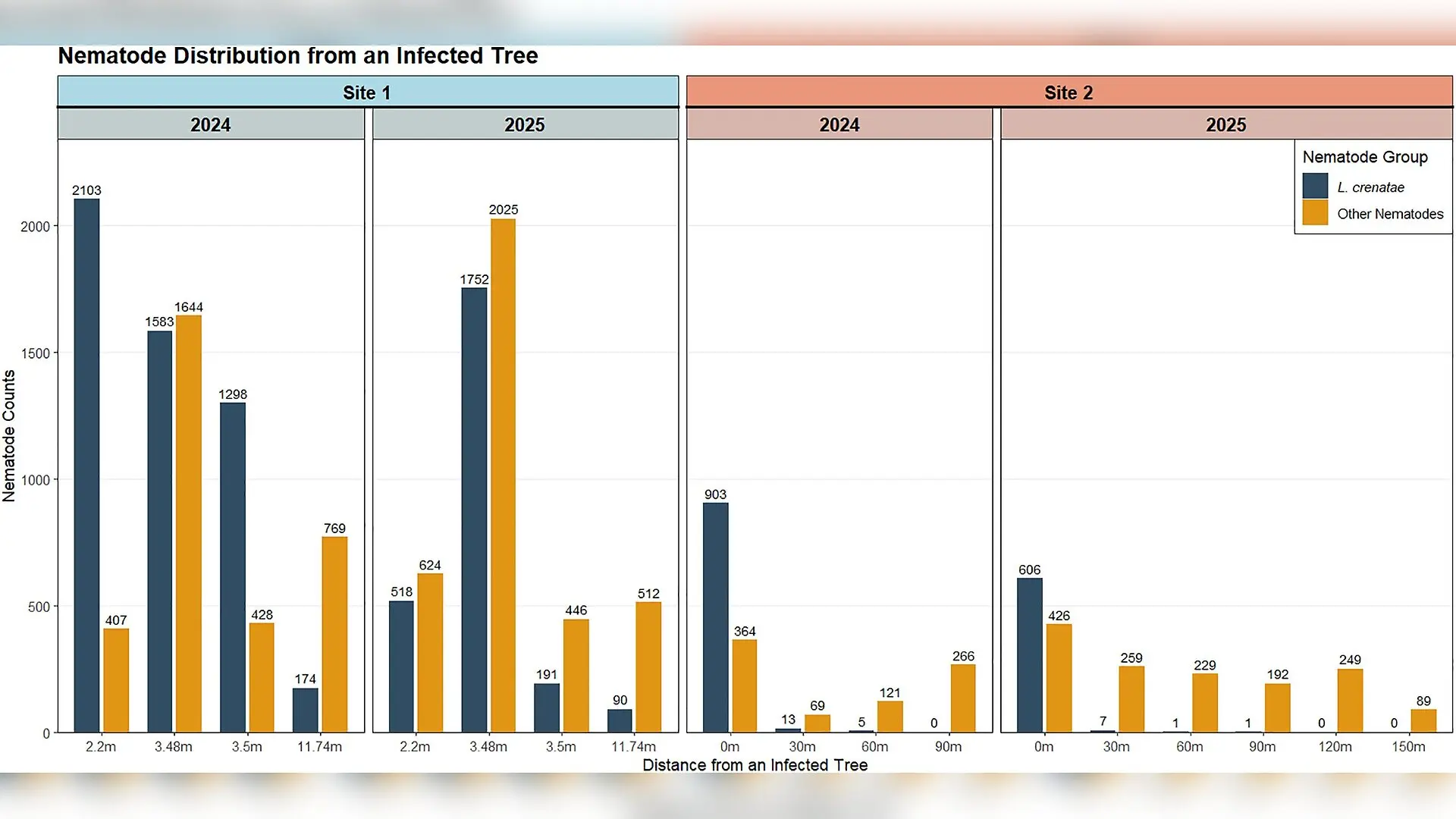
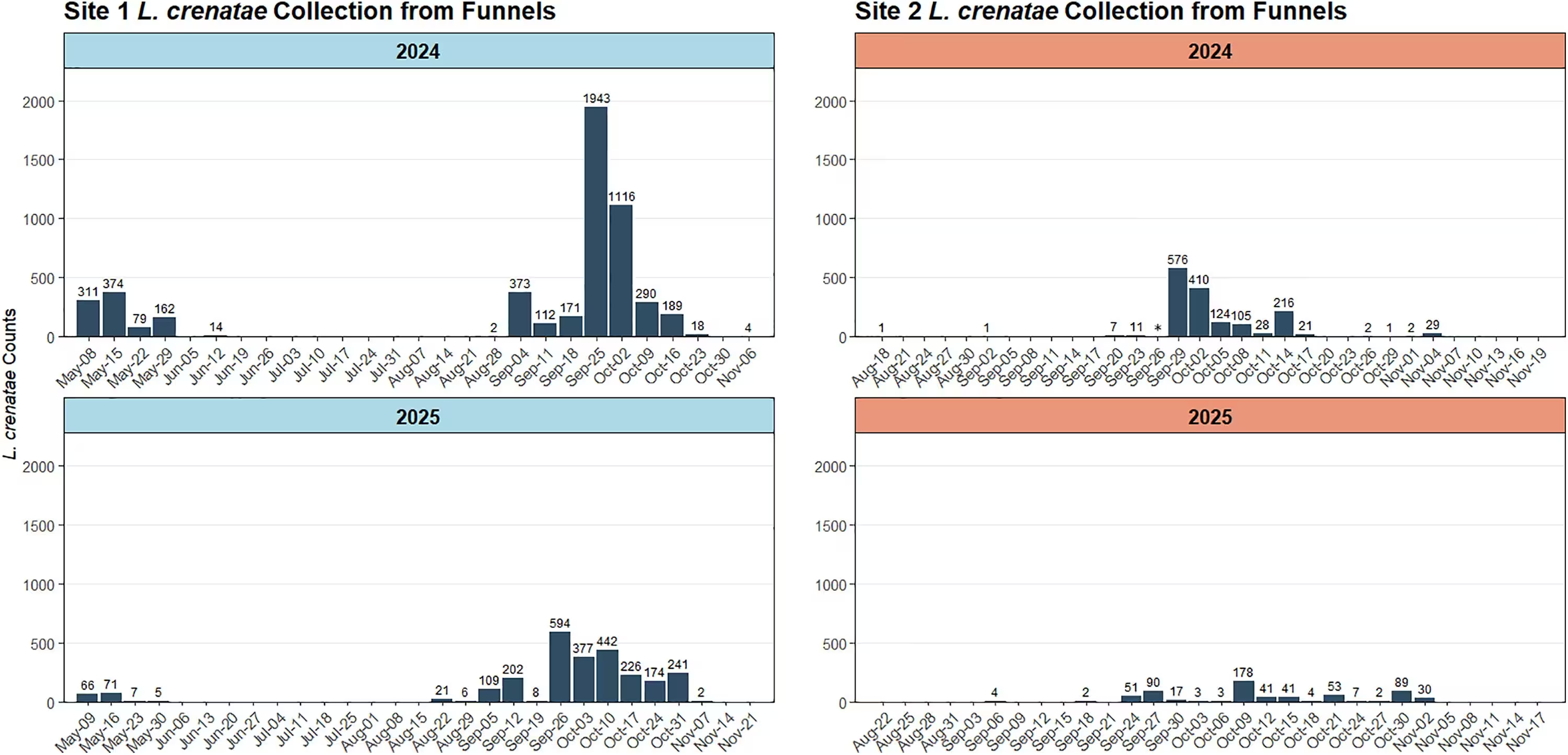
By monitoring nematode populations using specialized funnel traps positioned at varying distances from infected trees, the team found that roundworm movement occurs primarily during two distinct seasonal windows. The first wave happens in spring between May and June, coinciding with bud swelling and bud break when expanding leaves emerge from bud scales. A much larger wave occurs in fall between late August and early November, aligning with peak leaf senescence and the formation of overwintering buds. During the autumn peak in September 2024, more than 1,900 specimens were recovered in a single week at Site 1.
Statistical models identified distance from infected trees as the strongest predictor of nematode abundance, following a classic distance-decay pattern. Most roundworms were captured within 30 meters of the source. However, active individuals were recovered up to 90 meters away from infected stands, proving that the tiny pests can travel well beyond the immediate canopy.
Aerial Movement and Waterborne Corridors
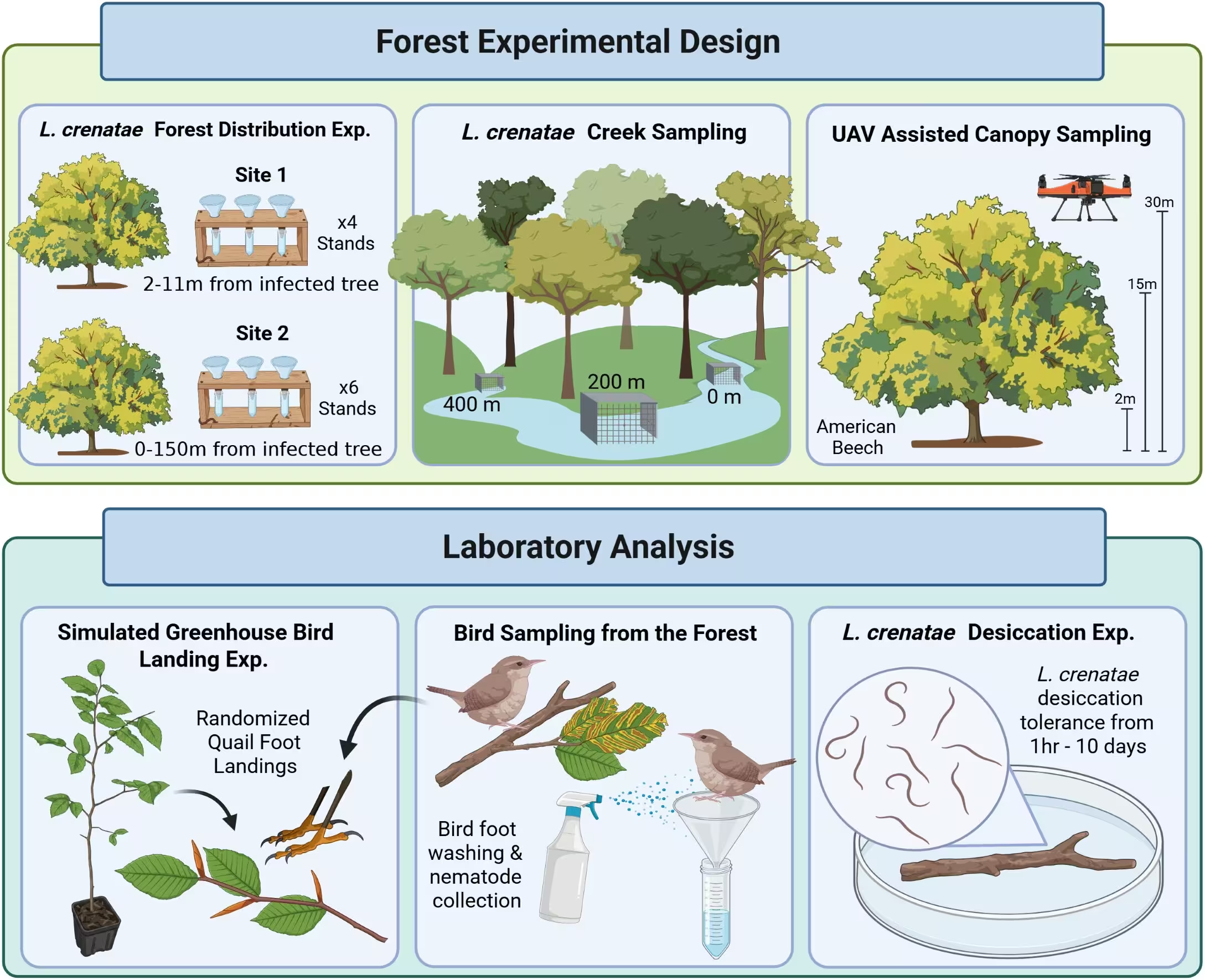
To evaluate whether the pathogens travel through the air, researchers deployed an unmanned aerial vehicle equipped with custom collection chambers during precipitation events. The drone successfully captured active roundworms at altitudes of 2 meters and 15 meters near infected tree canopies, though no specimens were detected above the canopy at 30 meters. This suggests that wind-driven rain and moisture facilitate short-distance aerial dispersal within the lower and mid-canopy layers.
For long-distance travel, stream sampling along forest creeks demonstrated that hydrological networks act as major transport corridors. Active roundworms were recovered up to 400 meters downstream from infected stands, with peak waterborne counts occurring in late September and October when rain runoff sweeps fallen leaves and debris into waterways.
Migratory Birds as Living Transport Vectors
Perhaps most surprisingly, the study confirmed that migratory birds can carry the pathogens externally. By washing the feet of birds captured at a banding station during high-moisture events, researchers recovered roundworms from six migratory species, including the Magnolia Warbler, Hooded Warbler, Northern Waterthrush, and Lincoln’s Sparrow. Subsequent greenhouse experiments using quail feet to simulate bird landings demonstrated that contaminated feet could successfully transfer the organisms to healthy beech saplings and induce typical disease symptoms.
Laboratory desiccation assays further revealed that the roundworms possess remarkable environmental resilience, surviving up to 10 days in a dry state through anhydrobiosis, a dormant survival mechanism. This ability to withstand temporary drying ensures they remain viable during transport on bird feet, exposed bark, or leaf litter.
Implications for Future Forest Management
The findings indicate that managing beech leaf disease requires looking far beyond local containment strategies. Because the epidemic is driven by a dynamic network of wind, streams, and avian vectors, conservationists must account for landscape-level dispersal pathways to protect vulnerable temperate hardwood ecosystems.
The research was published in PLOS One on October 26, 2026.
This article has been fact checked for accuracy, with information verified against reputable sources. Learn more about us and our editorial process.
Last reviewed on .
Article history
- Latest version
Reference(s)
- Consoli, Erika., et al. “When nematodes take flight: Multi-scale dispersal of the beech leaf disease nematode in forest ecosystems.” PLOS One, vol. 21, no. 10, October 26, 2026, pp. e0361390 Public Library of Science (PLoS), doi: 10.1371/journal.pone.0361390. <https://doi.org/10.1371/journal.pone.0361390>.
Cite this page:
- Posted by Omar Mirza