New Browser Tool Renders One Million Evolutionary Tree Branches In Under Three Seconds
Big Tree Viewer brings automated taxonomy mapping and an innovative spiral layout to help biologists navigate massive datasets without crashing.

Phylogenetic trees mapping millions of evolutionary branches can now render in less than three seconds thanks to a new browser-based tool designed to tackle data overload in modern biology. As low cost DNA sequencing generates massive gene and species trees containing up to a million tips, traditional software built for just a few hundred entries struggles to display or navigate the complex branching networks.
To overcome this performance bottleneck, John B. Allard and Sudhir Kumar from Temple University developed a software package called Big Tree Viewer. The details of the new system are available in a study published on the arXiv preprint server, outlining how the browser utility processes enormous biological datasets without bogging down user computers or uploading sensitive data to central servers.
How Do Scientists View Trees With One Million Tips?
When phylogenetic diagrams grow beyond a few thousand branches, individual tip labels overlap into an unreadable wall of text. Standard visualization tools often collapse distant clades or hide data entirely, forcing researchers to work blindly across vast portions of the evolutionary history they want to study.
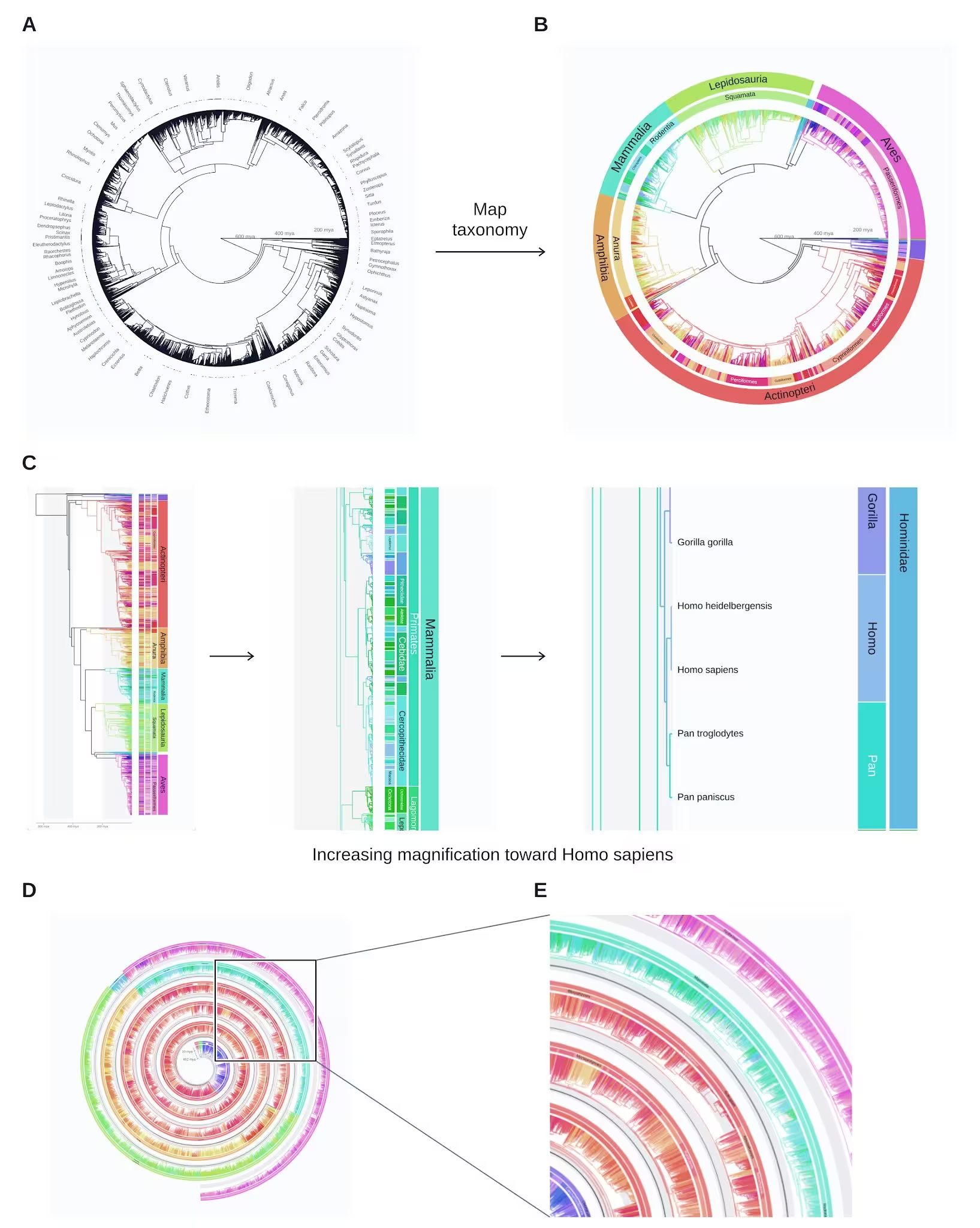
The new software solves this display crisis by automatically scanning tip labels for binomial species names and grouping neighboring entries by genus. When individual names are too dense to read on a screen, the application displays clear, large-scale landmarks that adapt dynamically as the user zooms in and out of specific lineages.
Can Public Taxonomic Databases Enhance Evolutionary Navigation?
The viewer goes beyond simple text parsing by integrating directly with established biological references such as the NCBI Taxonomy and the Catalogue of Life. By mapping species names to these databases, the software projects colored ribbons along the outer edges of the tree that clearly indicate major taxonomic groups, such as specific animal classes or viral families.
During performance benchmarks comparing several popular tree-viewing platforms across six different dataset scales ranging from one thousand to one million tips, the browser application achieved the fastest median loading times. For a one-thousand-tip tree, it loaded in about forty milliseconds, while a massive one-million-tip tree fully rendered in roughly two seconds.
What Role Does Spiral Geometry Play in Modern Phylogenetics?
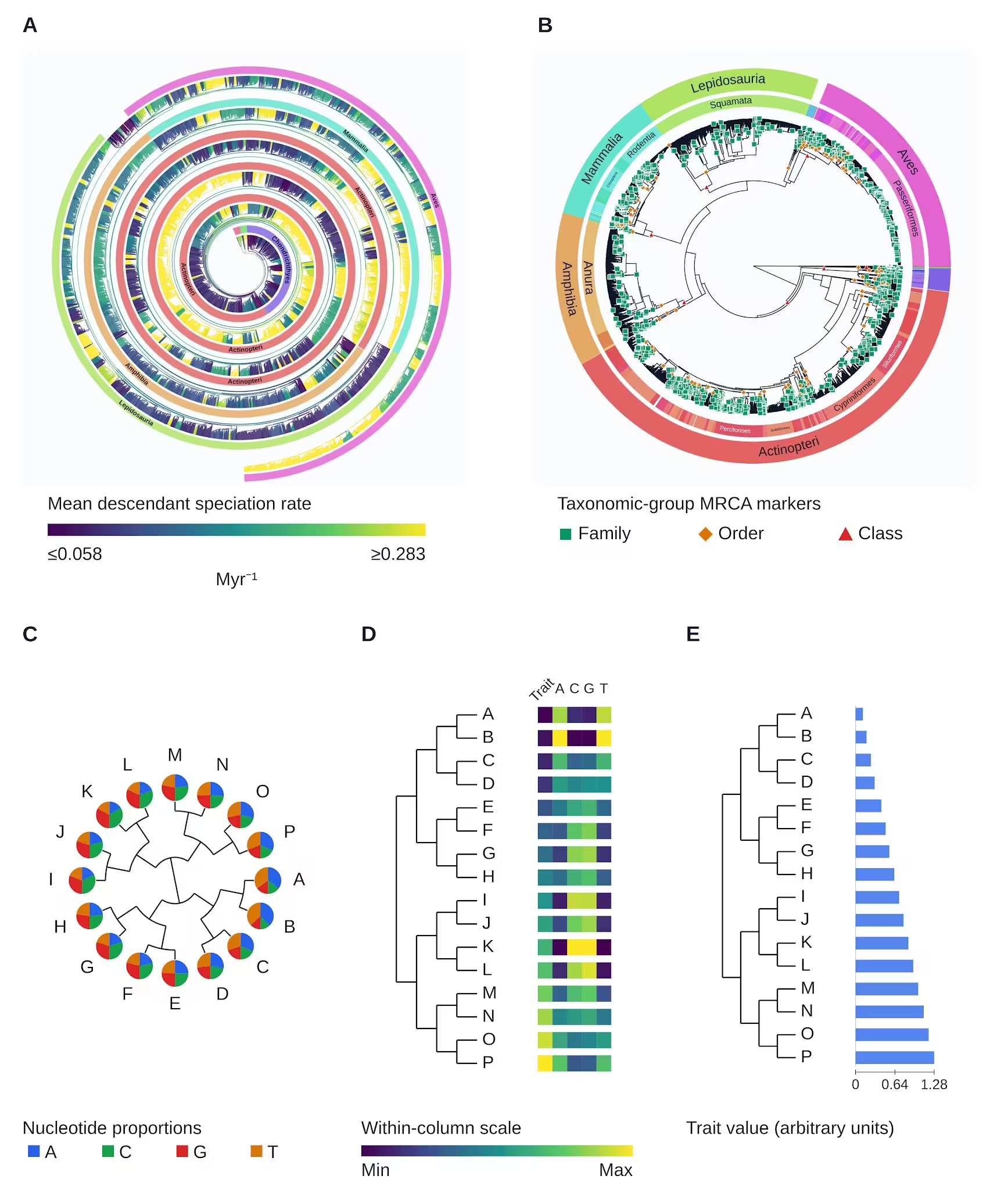
To make sense of deep evolutionary timelines alongside recent species divergences, the platform introduces an interactive spiral layout. Inspired by the 2015 TimeTree of Life project, this spiral arrangement coils evolutionary history so that deep ancestral splits are compressed near the center while recent branches receive more physical display space along the outer edge.
This coiled view allows researchers to overlay complex metadata, such as speciation rates or calendar dates for viral samples, directly onto the branching structure. The interface also connects with agentic artificial intelligence tools through a local Model Context Protocol server, enabling automated scripts to style, annotate, and inspect massive trees on demand.
The study was posted to the arXiv preprint server on November 23, 2026.
This article has been fact checked for accuracy, with information verified against reputable sources. Learn more about us and our editorial process.
Last reviewed on .
Article history
- Latest version
Reference(s)
- Allard, John. “Big Tree Viewer: A high-performance browser-based phylogenetic tree viewer with agentic AI integration.” arXiv.org <http://arxiv.org/abs/2611.30920v1>.
Cite this page:
- Posted by Linda Wilson