AI Coding Agents Rebuild Legacy Wildfire Model Bit for Bit in PyTorch
A PyTorch reconstruction of a major weather and fire model matches legacy code bit for bit while unlocking a fivefold speedup on graphics hardware.
Artificial intelligence coding agents have successfully rebuilt a complex, legacy weather and wildfire model into a modern machine-learning framework, matching the original calculations bit for bit across twelve hours of simulation. The research team, led by John S. Schreck and colleagues at the NSF National Center for Atmospheric Research in Boulder, Colorado, addressed the decades-old challenge of running traditional scientific physics models on modern graphics hardware. Traditional weather forecasting relies heavily on massive, established Fortran codes that are notoriously difficult to adapt to high-performance graphics processing units. Instead of throwing away decades of validated atmospheric physics to train purely data-driven models, the authors developed a PyTorch-based framework called WRF-Speed to translate selected configurations of the Weather Research and Forecasting model and its coupled fire physics.
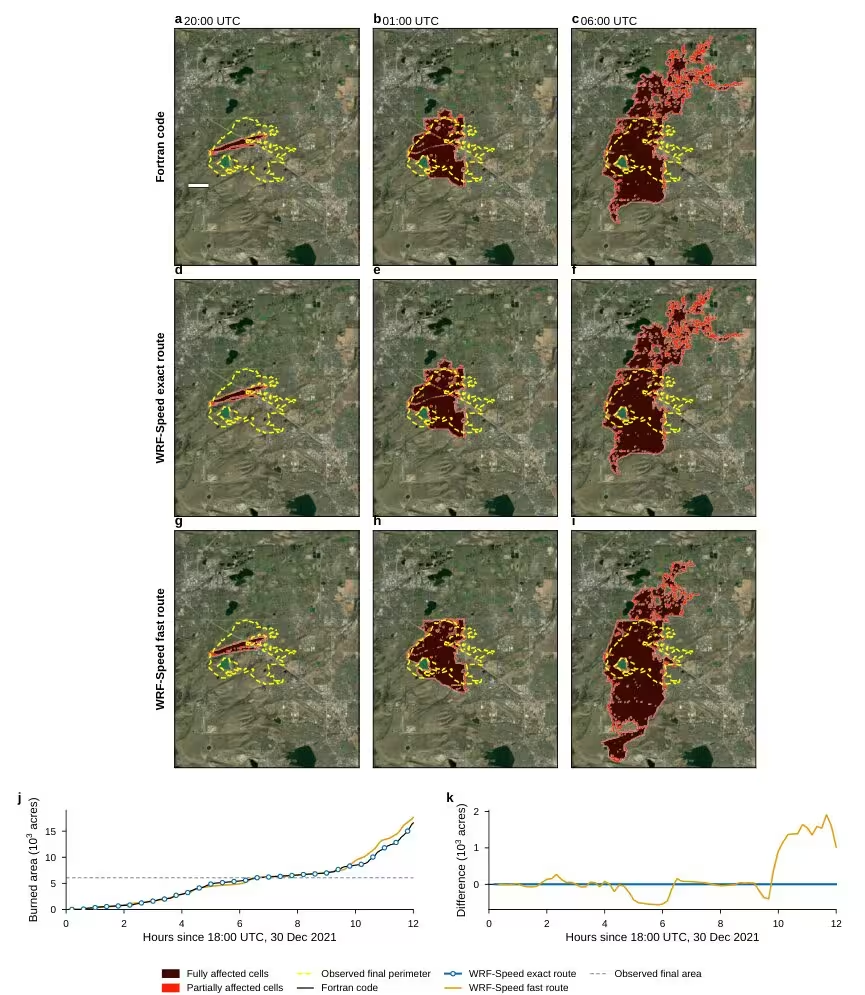
The translation process treated any discrepancy from the corrected Fortran code as a bug, ensuring that the software restructuring did not alter the underlying numerical results. The study is available on the arXiv preprint server and details how the team decomposed physical schemes into parallel tensor operations while preserving the strict mathematical order required for dependent grid calculations. In its exact execution route, the rewritten model achieved absolute bit-for-bit agreement across thirty-six checkpoint comparisons during a twelve-hour simulation of the December 2021 Marshall Fire, which stands as Colorado’s costliest wildfire to date. This exact match encompassed millions of floating-point values across atmospheric fields, fire spread patterns, heat and moisture fluxes, and even individual airborne firebrand particles.
How Did the Rebuilt Model Outperform Traditional Supercomputers?
Beyond achieving exact mathematical replication, the researchers established a separate fast route that utilized standard graphics card arithmetic and compiled GPU kernels to bypass the strict bitwise constraints. When running this fast configuration on a single modern graphics processor, the reconstructed model completed nested forecast steps about five times faster than the double-precision Fortran reference code running on a massive one hundred twenty-eight-core central processing unit node. This significant speedup opens the door for high-resolution ensemble forecasting, where meteorologists must run numerous simulations simultaneously within strict operational time limits to make urgent evacuation decisions during fast-moving natural hazards.
The speed and flexibility of the machine-learning framework also unlocked advanced gradient-based capabilities that are notoriously difficult to implement in legacy Fortran environments. By leveraging automatic differentiation, which acts as the neural network backpropagation equivalent for physical equations, the team performed a single backward pass through the coupled fire simulation to map how fire heat release and burned area respond to wind variations across roughly eleven million grid points. In synthetic tests, these calculated derivatives successfully guided adjustments to initial wind offsets and fuel moisture values, correcting a misplaced fire front and reducing positional errors within minutes of simulation time.
What Happens When Neural Networks Replace Physical Formulas?
The team further explored the framework by training small neural networks to stand in for computationally expensive physical schemes, such as solar shortwave radiation, infrared longwave radiation, and Rothermel fire spread rate formulas. When these neural components were integrated directly into twenty-four-hour coupled forecasts, the models ran stably and produced total burned areas comparable to ensembles generated by perturbing initial weather conditions by a single bit. However, the experiments revealed that matching overall burned area can sometimes conceal underlying differences in local fire front positioning and atmospheric feedback.
The authors note important limitations, emphasizing that the trained neural networks were tested as demonstrations rather than optimized replacements for operational forecasting, and their actual predictive skill against observed wildfire perimeters remains to be thoroughly validated. Nevertheless, the successful integration demonstrates that established physical equations and modern machine-learning tools can coexist within a single architecture. Other scientific communities struggling to modernize legacy codes can adopt similar translation protocols to retain decades of trusted physical knowledge while harnessing the computational speed and differentiability of artificial intelligence frameworks.
The study was posted to the arXiv preprint server on November 23, 2026.
This article has been fact checked for accuracy, with information verified against reputable sources. Learn more about us and our editorial process.
Last reviewed on .
Article history
- Latest version
Reference(s)
- Schreck, John. “An exact and differentiable rewrite of a coupled weather and fire model.” arXiv.org <http://arxiv.org/abs/2611.30866v1>.
Cite this page:
- Posted by Vikram Desai