Engineered Nanomaterials Offer New Hope for Treating Aging-Related Diseases
Specialized nanoscale structures bypass biological barriers and actively regulate cellular aging mechanisms.

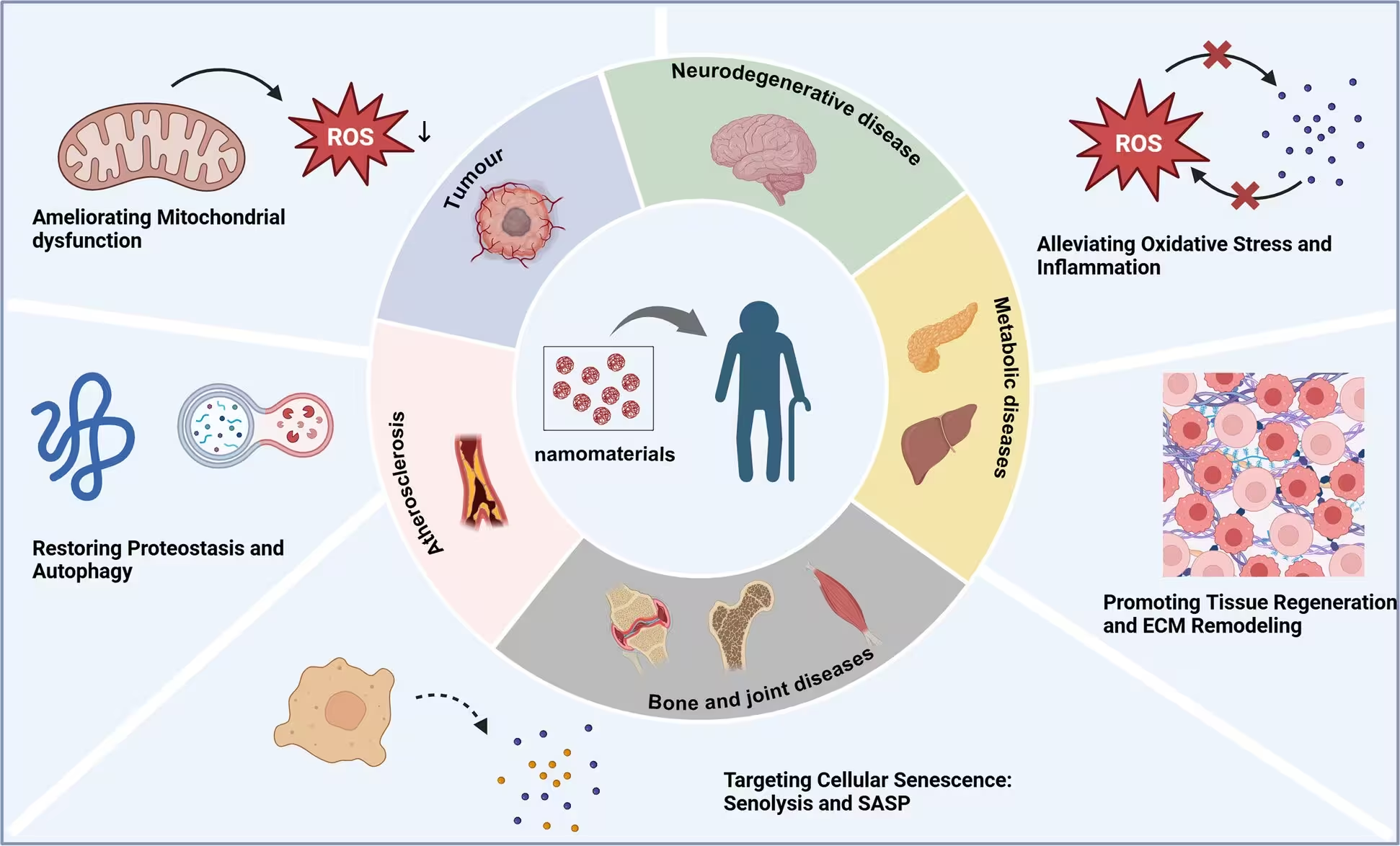
A new review article published in Molecular Biomedicine details how specialized nanomaterials could transform the treatment of aging-related diseases by interacting directly with biological structures from subcellular compartments to aged tissue microenvironments. Chunhui Wang from Qingdao University and colleagues integrated current evidence to show that nanoscale therapeutics do more than simply carry drugs. Because their physical dimensions align naturally with biological architecture, these materials can actively regulate the fundamental cellular processes that break down as people age.
How Can Nanomaterials Target the Core Hallmarks of Aging?
Aging is driven by an interconnected network of biological changes, including mitochondrial dysfunction, cellular senescence, and the accumulation of misfolded protein aggregates. Traditional small-molecule drugs often struggle to cross physiological barriers like the blood-brain barrier or to reach therapeutic concentrations within dense, aged tissue microenvironments. Nanomaterials bypass these hurdles by uniting size-dependent physical advantages with intrinsic bioactivities. Inorganic, carbon-based, polymeric, lipid, two-dimensional, and biomimetic nanosystems can sense endogenous pathological cues such as altered pH and elevated reactive oxygen species to trigger site-specific therapeutic activation.
Which Nanomaterial Properties Combat Neurodegeneration and Metabolic Decline?
Precious metal nanoparticles and cerium oxide nanoparticles possess high enzyme-like catalytic properties, allowing them to sequentially scavenge superoxide anions and hydrogen peroxide in neurodegenerative and cardiovascular models. Carbon-based nanomaterials like graphene oxide use their delocalized electron networks and hydrophobic interactions to interfere with the aggregation of amyloid-beta or alpha-synuclein proteins. Meanwhile, lipid nanoparticles and polymeric carriers provide controlled degradation kinetics and pH-sensitive phase transitions, making them efficient delivery platforms for nucleic acid therapies that restore missing physiological functions in aged tissues.
What Challenges Remain Before Clinical Translation Becomes Reality?
Despite promising preclinical results in disease models, several translational hurdles must be cleared before these nanotherapies reach elderly patients. Natural aging alters hepatic phagocytic activity, renal function, and immune status, meaning biodistribution and safety data obtained from young animal models cannot be directly extrapolated to older populations. Furthermore, large-scale manufacturing reproducibility remains a challenge, as batch-to-batch variations in surface chemistry and particle size can alter biological activity and toxicity. Future research must prioritize mechanism-guided material design, age-adapted safety assessments, and standardized quality control to ensure these advanced therapies deliver consistent clinical benefits.
The research was published in Molecular Biomedicine on November 24, 2026.
This article has been fact checked for accuracy, with information verified against reputable sources. Learn more about us and our editorial process.
Last reviewed on .
Article history
- Latest version
Reference(s)
- Wang, Chunhui., et al. “Nanomaterials for the treatment of aging-related diseases: applications, mechanisms and perspectives.” Molecular Biomedicine, vol. 7, no. 1, November 24, 2026 Springer Science and Business Media LLC, doi: 10.1186/s43556-026-00635-w. <https://doi.org/10.1186/s43556-026-00635-w>.
- Posted by Bilal Abbasi