Power to Ammonia Transition Could Cut Thermal Generation by Ninety Eight Percent
New energy modeling reveals how converting renewable electricity into clean ammonia can reshape regional power grids and slash carbon emissions.
Converting surplus renewable electricity into clean ammonia could slash traditional thermal power generation by over ninety-eight percent by the middle of the century. Energy modelers from the China University of Geosciences and partner institutions evaluated how power-to-ammonia systems might reshape regional and national grids across China, focusing detailed provincial case studies on Hubei Province.
The transition toward carbon neutrality requires innovative ways to store variable wind and solar energy without relying entirely on short-term battery storage, which incurs high degradation costs over repeated charging cycles. Power-to-ammonia technology synthesizes ammonia from hydrogen and nitrogen using renewable electricity. Because ammonia possesses high energy density and can be liquefied easily, it serves as an efficient chemical energy carrier for transporting surplus power from resource-rich regions to energy-deficient urban centers.
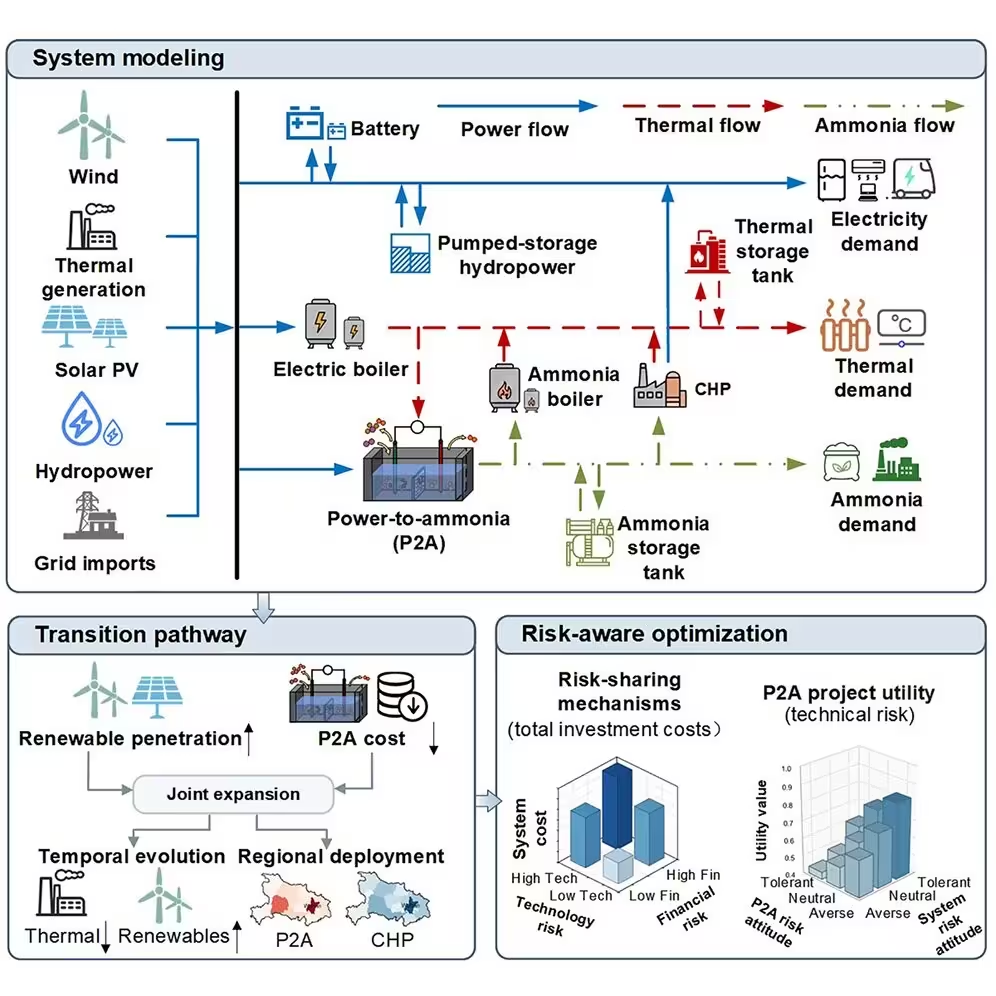
To examine the long-term viability of this approach, the researchers built an optimal expansion-planning model that couples electrical, ammonia, and thermal energy networks. Their findings, published in iScience, indicate that under high renewable penetration scenarios, conventional thermal generation in Hubei Province would drop from fifty-four and a half terawatt-hours in 2030 down to zero point sixty-five terawatt-hours by 2050. This represents a reduction of ninety-eight point eight percent.
How Does Material Scarcity Affect Costs?
The economic feasibility of electrochemical ammonia synthesis depends heavily on the catalysts and membranes used in the reaction cells. The research team analyzed price sensitivities for four principal components, including iridium oxide anode catalyst, platinum on carbon cathode catalyst, Nafion membranes, and graphite bipolar plates. Their model identified a high-risk zone where material prices surge due to supply chain disruptions and geopolitical tensions, leading to exponential cost escalation.
Among all components, the iridium oxide anode catalyst showed the steepest price sensitivity due to severe natural scarcity. Once its relative price exceeds one point two, system costs climb rapidly. Conversely, when relative material prices fall below zero point seven, economies of scale and localized supply chains create a cost-reduction zone that makes large-scale deployment economically viable.
What Happens When Capital Costs Drop?
Evaluating different capital expenditure targets reveals a strong relationship between technology costs and regional infrastructure expansion. When capital costs fall from fifteen hundred dollars per kilowatt down to one hundred dollars per kilowatt, total active power-to-ammonia capacity in Hubei Province expands significantly. Urban centers with high industrial demand, such as Wuhan and Yichang, emerge as primary deployment hubs for ammonia synthesis.
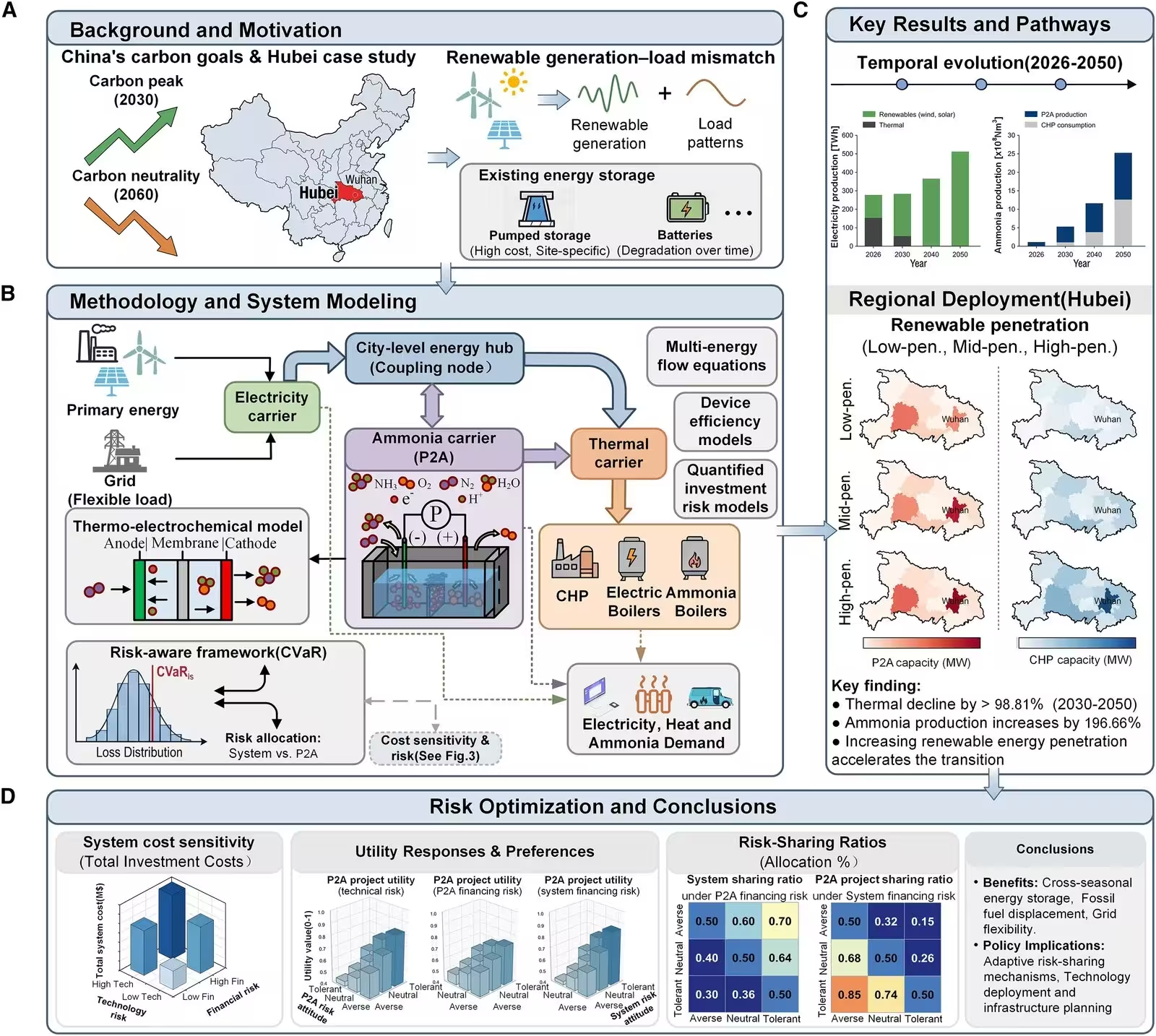
Lower technology costs also stimulate combined heat and power generation, which provides essential grid balancing as fossil fuels are phased out. On a national scale, total wind and solar generation increases substantially across the decades, displacing millions of tons of direct carbon emissions while establishing a secure chemical storage network.
What Are the Risks and Limitations of the Model?
Large-scale energy transitions involve complex financial and technological uncertainties. The authors incorporated conditional value-at-risk optimization to evaluate how risk-sharing mechanisms distribute potential losses between energy system operators and ammonia project investors. Their simulations show that financial conditions exert a stronger influence on total system costs than technological uncertainties alone.
Despite these promising pathways, the authors note several limitations in their current model. The projections rely on specific scenario assumptions, including expected improvements in electrocatalytic efficiency and the timely development of supportive safety regulations and transportation infrastructure. Furthermore, the analysis does not explicitly account for surging power demands from emerging energy-intensive loads such as artificial intelligence data centers, which may alter future energy allocation strategies.
The research was published in iScience on November 16, 2026.
This article has been fact checked for accuracy, with information verified against reputable sources. Learn more about us and our editorial process.
Last reviewed on .
Article history
- Latest version
Reference(s)
- Xu, Da., et al. “Unlock the potential of power-to-ammonia in future multi-energy transition pathways.” iScience, vol. 29, no. 12, December 1, 2026, pp. 118242 Elsevier BV, doi: 10.1016/j.isci.2026.118242. <https://doi.org/10.1016/j.isci.2026.118242>.
Cite this page:
- Posted by William Moore