New Ethical Framework Addresses Privacy Risks and Consent Challenges in Wastewater Surveillance
Researchers propose practical criteria and technical safeguards to balance public health benefits against privacy risks as sewage monitoring becomes routine.
Analyzing the liquid flowing through urban sewage networks can catch outbreaks of infectious diseases before clinics notice a surge, but tracking germs in wastewater creates hidden privacy dangers that experts argue require a complete overhaul of public health ethics. Because sewage samples pool the waste of hundreds or millions of individuals at once, traditional personal consent is practically impossible to obtain, leaving authorities to rely on emergency waivers or blanket permissions that fail to address modern technological capabilities.
To address these rising concerns, Yimei Sun from Duke-NUS Medical School and an international team of researchers published in BMC Global and Public Health a comprehensive evaluation framework that translates five classic public health principles into practical rules for sewage monitoring projects. The authors propose that as wastewater surveillance moves from a temporary emergency response during the pandemic into routine monitoring for endemic diseases, public health agencies must adopt rigorous safeguards to protect community trust.
How Can Public Health Ethics Keep Up With Advanced Sewage Testing Technologies?
The primary driver behind this ethical reassessment is the rapid advancement of laboratory techniques such as next-generation sequencing, a high-throughput technology that can sequence millions of DNA fragments in parallel. While this capability allows scientists to track variants and spot emerging pathogen threats with remarkable speed, it also creates the risk of detecting human genetic material. In hyper-localized settings like residential dormitories, office buildings, or transport vehicles, small contributing populations mean that pooled genetic data can sometimes approach individual identification.
The researchers emphasize that sequencing and sharing genetic information without proper legal frameworks or technical safeguards can violate privacy protections and erode public confidence. To counter this, the framework adapts five core justificatory conditions from public health ethics: public justification, effectiveness, proportionality, necessity, and least infringement.
Why Must Communities Have the Power to Say No to Surveillance Projects?
Under the proposed framework, public justification goes far beyond traditional top-down communication or legal authorization. The authors argue that surveillance projects must actively build a social licence, defined as ongoing community acceptance and perceived legitimacy regarding how data are gathered, interpreted, and acted upon. This requires meaningful public consultation, co-designing monitoring programs with local leaders, and establishing community ethical review boards to evaluate potential impacts.
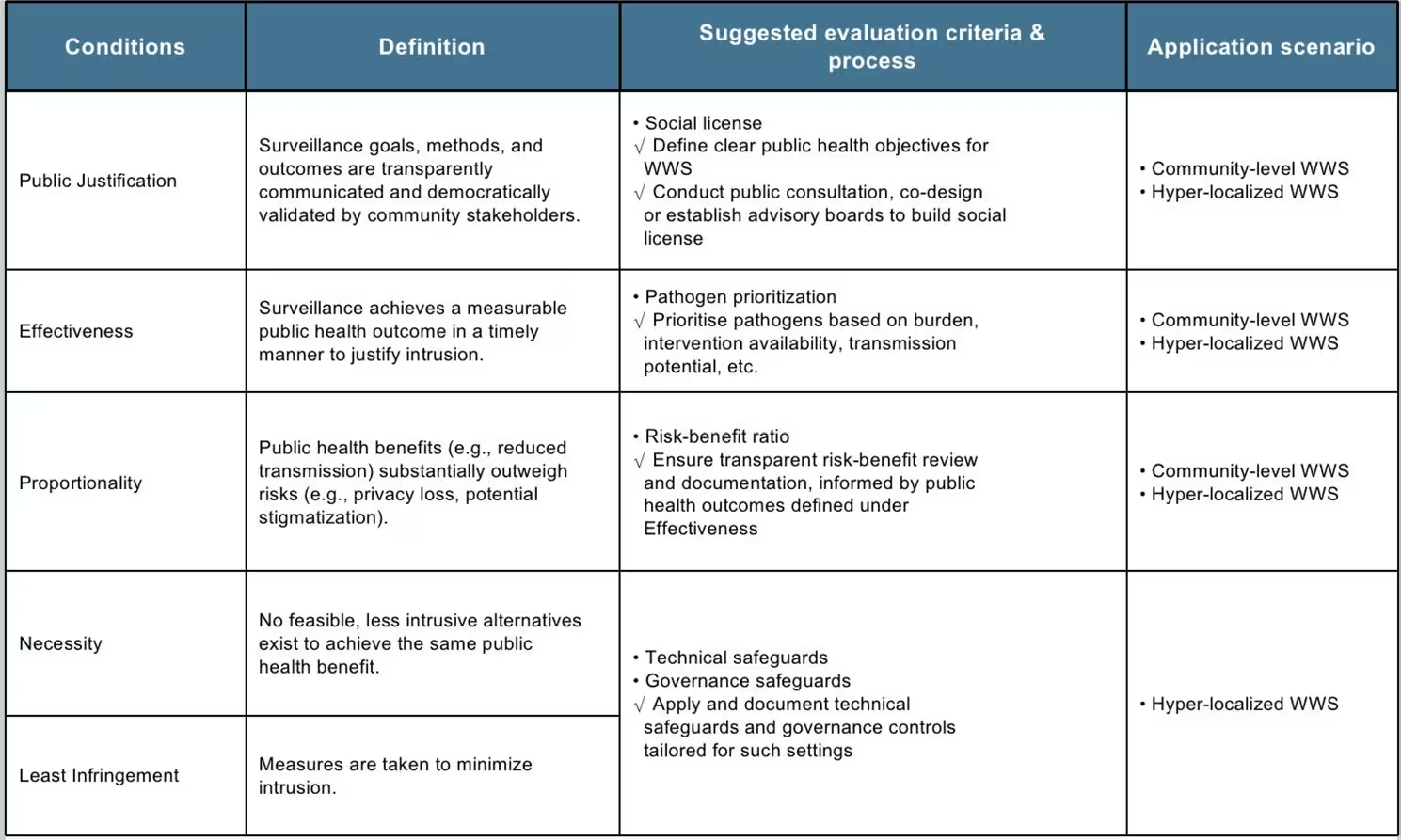
Crucially, the authors argue that not conducting a wastewater monitoring program must remain a legitimate, viable option when the anticipated public health benefits do not justify the social burdens. For instance, World Health Organization guidance notes that routine sewage monitoring for typhoid fever may offer limited added value given slow transmission dynamics and existing environmental testing methods. In other cases, weekly sewage positivity signals have been shown to lag behind mandatory saliva testing, meaning the technology might offer too little benefit to warrant implementation.
What Technical Safeguards Protect Privacy in Hyper-Localized Monitoring Settings?
When wastewater surveillance targets specific sub-groups such as prisons, migrant worker dormitories, or low-income households, the risks of stigmatization, discrimination, and privacy loss increase significantly. To safeguard vulnerable populations, the authors recommend implementing robust technical protections alongside community engagement. These measures include host-DNA depletion methods during sequencing, rigorous quality checks, differential privacy algorithms, strict limits on data retention, and avoiding public data dissemination unless justified by a clear health benefit.
The research team concludes that as sewage monitoring becomes a permanent pillar of modern public health systems, its legitimacy will depend entirely on how transparently, proportionately, and ethically it is conducted. Without clear operational criteria and robust safeguards, public agencies risk undermining the very trust that makes this epidemiological tool effective.
The research was published in BMC global and public health on November 20, 2026.
This article has been fact checked for accuracy, with information verified against reputable sources. Learn more about us and our editorial process.
Last reviewed on .
Article history
- Latest version
Reference(s)
- Sun, Yimei., et al. “Operational criteria for the ethical justification of wastewater surveillance.” BMC Global and Public Health, vol. 4, no. 1, November 20, 2026 Springer Science and Business Media LLC, doi: 10.1186/s44263-026-00342-2. <https://doi.org/10.1186/s44263-026-00342-2>.
Cite this page:
- Posted by William Moore