University Dental Clinic Study Reveals Hidden Carbon Hotspots
Secondary operational processes account for nearly all emissions in an El Salvador dental facility baseline assessment.
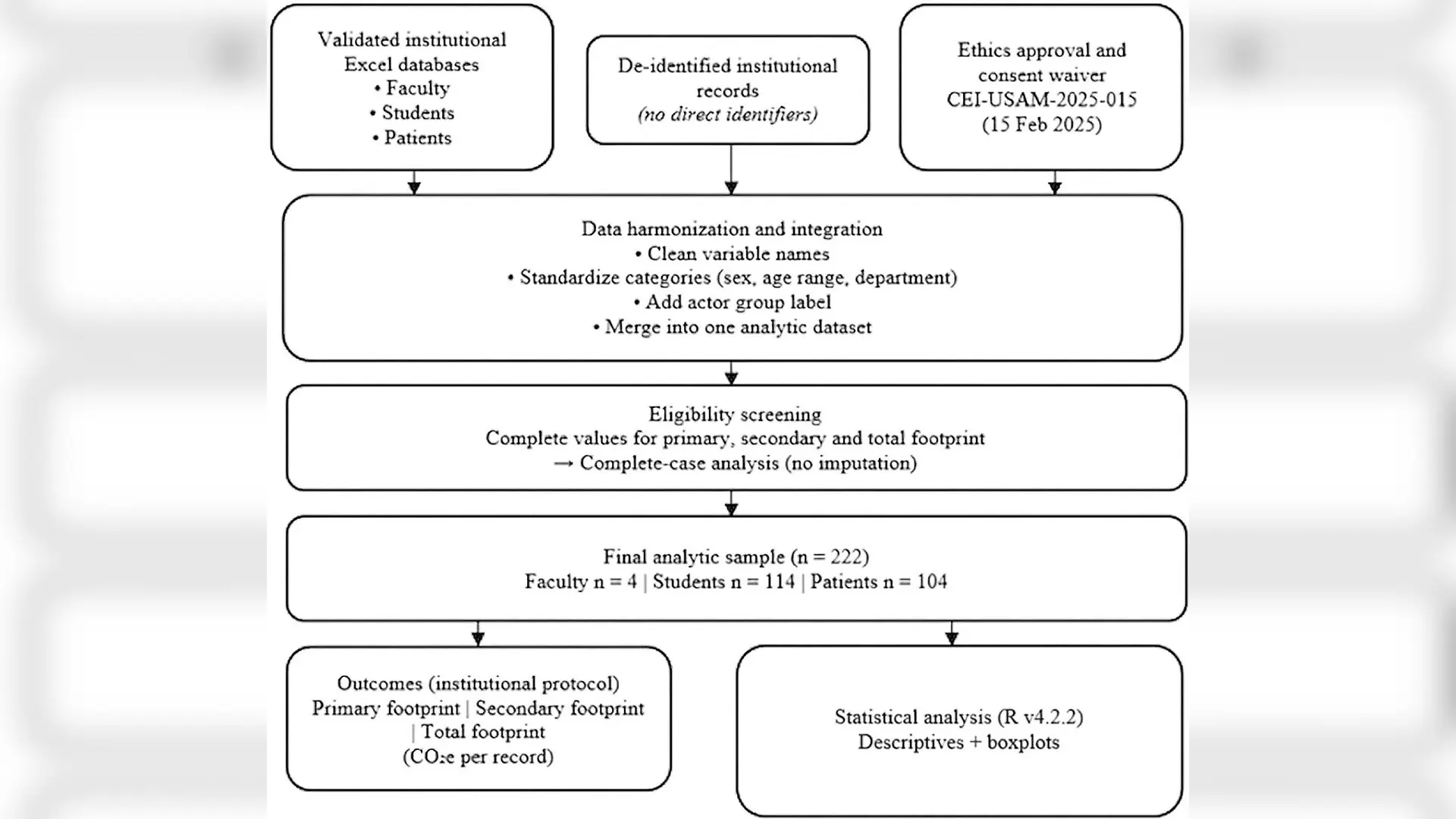
University dental clinics in El Salvador generate significant environmental impacts that are largely driven by operational infrastructure rather than individual patient actions, according to a baseline analysis. Researchers evaluated institutional data from 222 participants at the Universidad Salvadoreña Alberto Masferrer (USAM) Dental Surgery Clinic to profile carbon emissions across different groups.
The study, published in BDJ Open, revealed that secondary emissions, which encompass facility operations, electricity consumption, and personal protective equipment, accounted for roughly 99.99 percent of the total carbon footprint across all evaluated cohorts. The research team noted that students exhibited the highest mean total carbon footprint at 1,228.54 kilograms of carbon dioxide equivalent per record, followed by patients at 920.01 kilograms, while faculty members recorded a lower mean of 846.23 kilograms with significantly greater variability.
How Operational Systems Shape Clinical Emissions
Healthcare delivery systems face mounting pressure to incorporate measurable decarbonization strategies as climate change threatens global health infrastructure. While high-income nations have increasingly published sustainability audits, baseline evidence from low- and middle-income settings remains comparatively scarce. University clinics present unique monitoring challenges because they combine high-throughput educational activities, clinical care, and rigorous infection-prevention workflows.
The investigation utilized a cross-sectional design incorporating three validated Excel databases containing 222 complete records, consisting of 4 faculty members, 114 students, and 104 patients. Primary footprints, which captured direct individual actions such as travel distance and transport mode, were found to be orders of magnitude smaller than institutional overhead. Secondary footprints reflected fixed facility allocations for equipment use, heating, ventilation, air conditioning, and protective gear like masks, gloves, and gowns.
What These Findings Mean for Future Sustainability
The stark dominance of secondary emissions highlights that institutional decarbonization must target system-level operations rather than focusing exclusively on individual behavior. Because resources like dental chairs, suction systems, sterilization units, and personal protective equipment are utilized across all patient care activities, their fixed allocation resulted in near-constant footprint values among students and patients.
The authors emphasized that these baseline metrics provide a scalable framework for academic institutions seeking to benchmark environmental performance. Although the small faculty sample size and standardized allocation rules limit individual-level causal interpretations, the methodology offers a reproducible foundation for regional tracking. Translating these insights into practice requires targeted interventions, such as optimizing heating and cooling schedules, enforcing equipment shutdown protocols, and refining procurement standards to prioritize lower-impact materials.
The research was published in BDJ open on November 18, 2026.
This article has been fact checked for accuracy, with information verified against reputable sources. Learn more about us and our editorial process.
Last reviewed on .
Article history
- Latest version
Reference(s)
- Rojas de Campos, Alma Lorena., et al. “Environmental footprint profiling in a university dental clinic: replicable framework and pilot data from El Salvador.” BDJ Open, vol. 12, no. 1, November 18, 2026 Springer Science and Business Media LLC, doi: 10.1038/s41405-026-00505-1. <https://doi.org/10.1038/s41405-026-00505-1>.
Cite this page:
- Posted by Raj Joshi