Engineered Artificial Photoenzyme Drives Light-Activated Ring Closures With Near-Perfect Stereocontrol
Researchers evolved a protein scaffold to catalyze challenging electrocyclizations, achieving over ninety-nine percent enantiomeric excess.
Chemists have engineered an artificial photoenzyme that folds flexible precursor molecules into complex ring structures with near-perfect stereocontrol, overcoming a major limitation in synthetic chemistry. The engineered biocatalyst, named PhotoElectroCyclase PEC1.3, harnesses light energy to drive challenging chemical ring-closing steps known as electrocyclizations with unprecedented precision. By using a genetically incorporated light-absorbing amino acid, the enzyme achieves high catalytic efficiency and selectivity that traditional small-molecule catalysts struggle to match.
How Do Engineered Photoenzymes Drive Light-Activated Ring Closures?
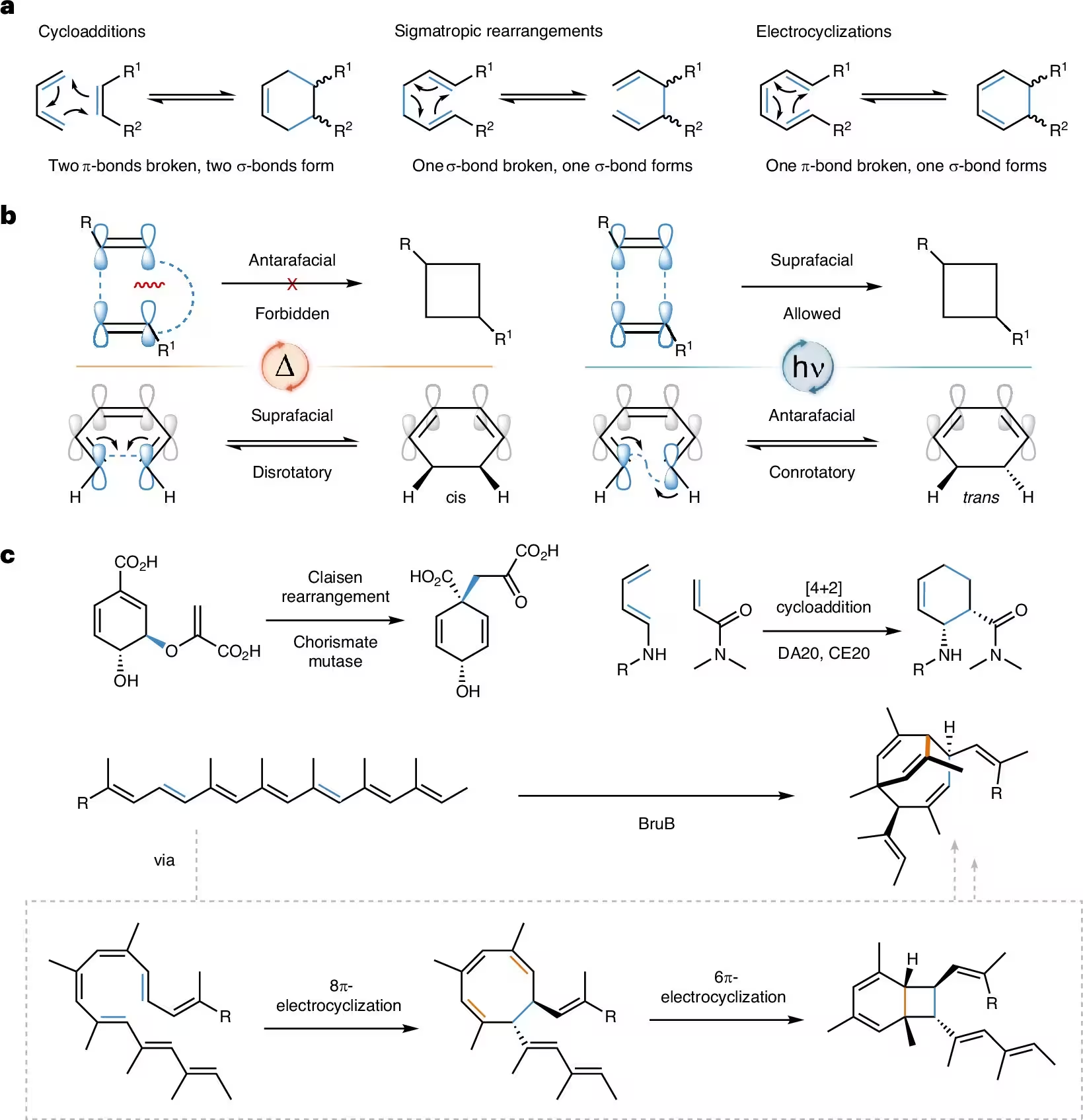
Pericyclic reactions are fundamental transformations in organic chemistry that allow complex molecular architectures to be constructed through concerted bond rearrangements. While thermal activation has long been studied, photochemical activation opens up alternative reaction pathways that are otherwise forbidden in the ground state. However, controlling the stereochemical outcome of these light-driven processes using small chiral catalysts remains notoriously difficult in aqueous environments.
To address this challenge, researchers led by Anthony Green and Sam Hay at the University of Manchester set out to build an artificial electrocyclase from the bottom up. Starting from an existing protein template engineered for light-driven [2 plus 2] cycloadditions, the team subjected the protein to four rounds of directed evolution. They individually randomized active-site and loop positions using degenerate codons, screening thousands of clones to improve both catalytic turnover and stereoselectivity.
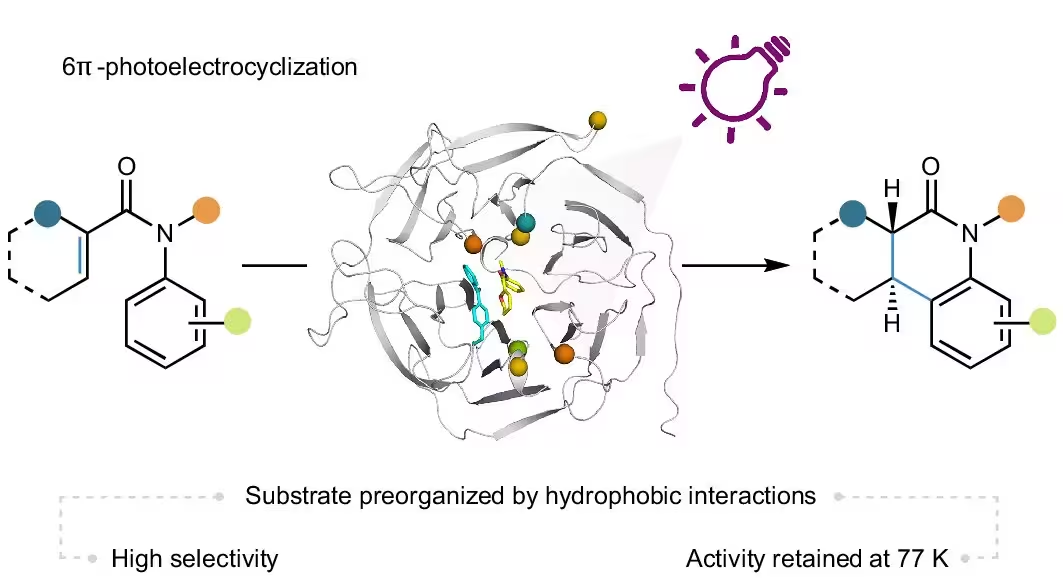
The resulting enzyme variant, PEC1.3, incorporates seven distinct mutations that collectively boost the yield of the target dihydroquinolone product over tenfold compared to its precursor. The study is published in Nature Chemistry, detailing how the biocatalyst achieves high diastereocontrol and greater than ninety-nine percent enantiomeric excess across a broad scope of acrylanilide substrates.
What Structural Features Enable Cryogenic Catalysis in PEC1.3?
To understand the molecular mechanism behind this high selectivity, the researchers solved a 1.3 angstrom crystal structure of PEC1.3 in complex with its substrate. The structural data reveal that evolution completely reshaped the active-site pocket, abandoning key hydrogen-bonding interactions utilized by the ancestral enzyme in favor of an extensive network of hydrophobic contacts.
This hydrophobic pocket snugly positions the substrate directly adjacent to a genetically encoded benzophenone triplet sensitizer, shielding the intermediates from bulk water and preventing unwanted side reactions. Surprisingly, spectroscopic and low-temperature experiments demonstrated that PEC1.3 retains catalytic activity even at seventy-seven Kelvin, a temperature where large protein motions are entirely frozen out. Quantum mechanics and molecular mechanics calculations confirmed that the enzyme rigidly pre-organizes its substrate into an ideal geometry for rapid energy transfer and subsequent ring closure.
What Are the Limitations and Future Applications of These Catalysts?
Despite its impressive performance, the current catalyst system relies on ultraviolet irradiation at 365 nanometers and exhibits limits in total turnover numbers before deactivating. Furthermore, while the enzyme tolerates a diverse array of substituted acrylanilides and enamides, certain bulkier non-cyclic substrates still suffer from reduced enantioselectivity.
The findings nevertheless demonstrate that a handful of active-site mutations can successfully repurpose a rigid protein scaffold for entirely new classes of pericyclic chemistry. Future efforts will likely focus on incorporating triplet sensitizers with superior photophysical properties and leveraging computational protein design tools to expand the repertoire of light-driven enzymatic cascades.
The research was published in Nature Chemistry on November 23, 2026.
This article has been fact checked for accuracy, with information verified against reputable sources. Learn more about us and our editorial process.
Last reviewed on .
Article history
- Latest version
Reference(s)
- Trimble, Jonathan S.., et al. “An artificial photoenzyme constrains substrates for selective antarafacial electrocyclizations.” Nature Chemistry, November 23, 2026 Springer Science and Business Media LLC, doi: 10.1038/s41557-026-02297-1. <https://doi.org/10.1038/s41557-026-02297-1>.
Cite this page:
- Posted by Bilal Abbasi