Machine Learning Reveals How Hydrogen Bonds Control Green Solvent Catalysis
Atomistic simulations uncover why certain eco-friendly solvent mixtures trap active sites while others achieve near-quantitative conversion.
A new machine-learning simulation method reveals how microscopic hydrogen-bond networks in sustainable green solvents control chemical reaction speeds and stereoselectivity. Michele Tomasini and colleagues at their respective institutions published these findings in Nano-Micro Letters, offering a predictive framework for designing eco-friendly liquid catalysts without trial-and-error experimentation.
How Do Machine-Learning Potentials Decode Liquid Solvent Structures?
Traditional molecular simulations require extensive, system-specific parameter adjustments that slow down the discovery of novel chemical formulations. To bypass this bottleneck, the researchers utilized a pre-trained machine-learning interatomic potential implemented through the Matlantis framework. This approach processes complex atomic arrangements as high-dimensional inputs to predict potential energy values with quantum-mechanical accuracy. The computational setup allowed the team to simulate simulation boxes containing one hundred hydrogen-bond acceptor molecules and one hundred hydrogen-bond donor molecules at three hundred kelvin under periodic boundary conditions.
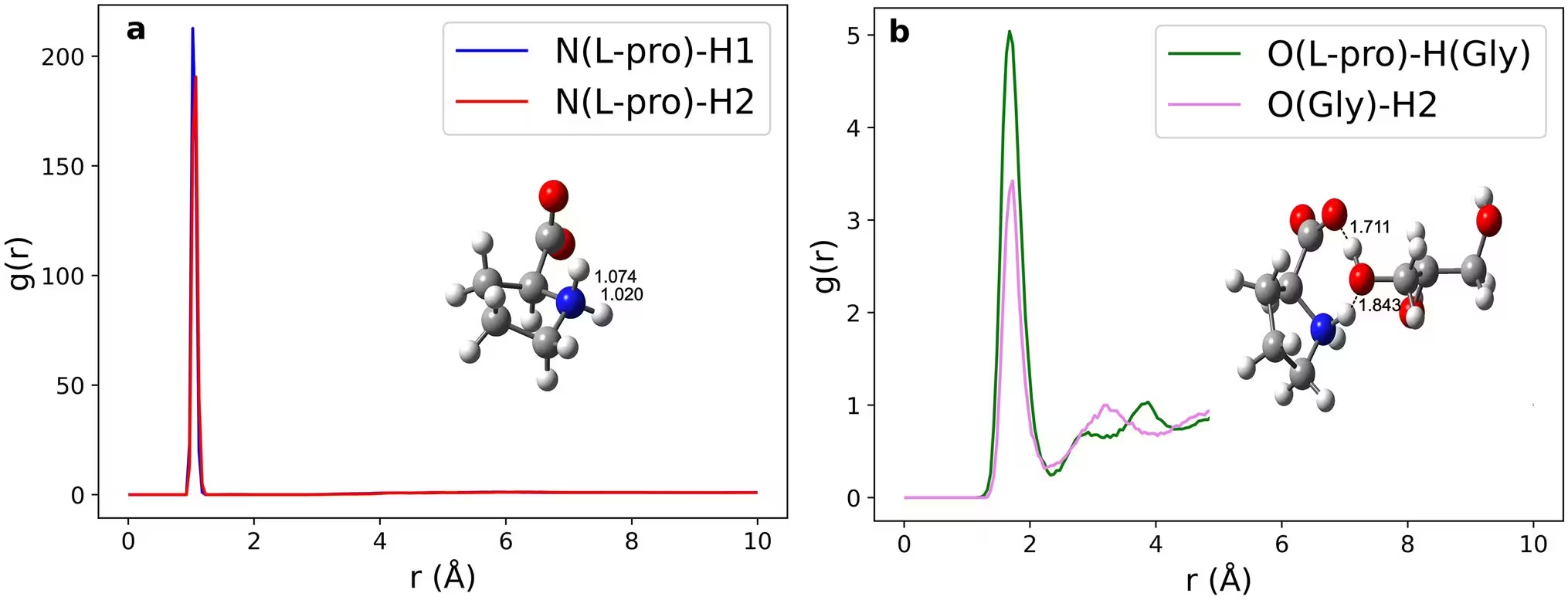
By capturing the temporal evolution of these liquid mixtures over hundred-picosecond trajectories, the model mapped out detailed radial distribution functions and noncovalent interaction plots. Density functional theory calculations further validated the optimized molecular clusters using dispersion-corrected functionals and standard basis sets. This combination of atomistic simulations and quantum mechanics exposed how microscopic solvent organization dictates macroscopic chemical reactivity.
Why Do Certain Green Solvents Trap Catalytic Active Sites?
The study examined L-proline and quaternary ammonium pyrrolidine-based chiral deep eutectic solvents used in asymmetric Michael addition reactions. Experimental results showed dramatic differences in catalytic conversion, ranging from fifteen percent up to more than ninety-nine percent depending on the specific mixture. The simulations demonstrated that strongly interacting hydrogen-bond donors form persistent supramolecular cages that sequester the active site and hinder intermediate enamine formation.
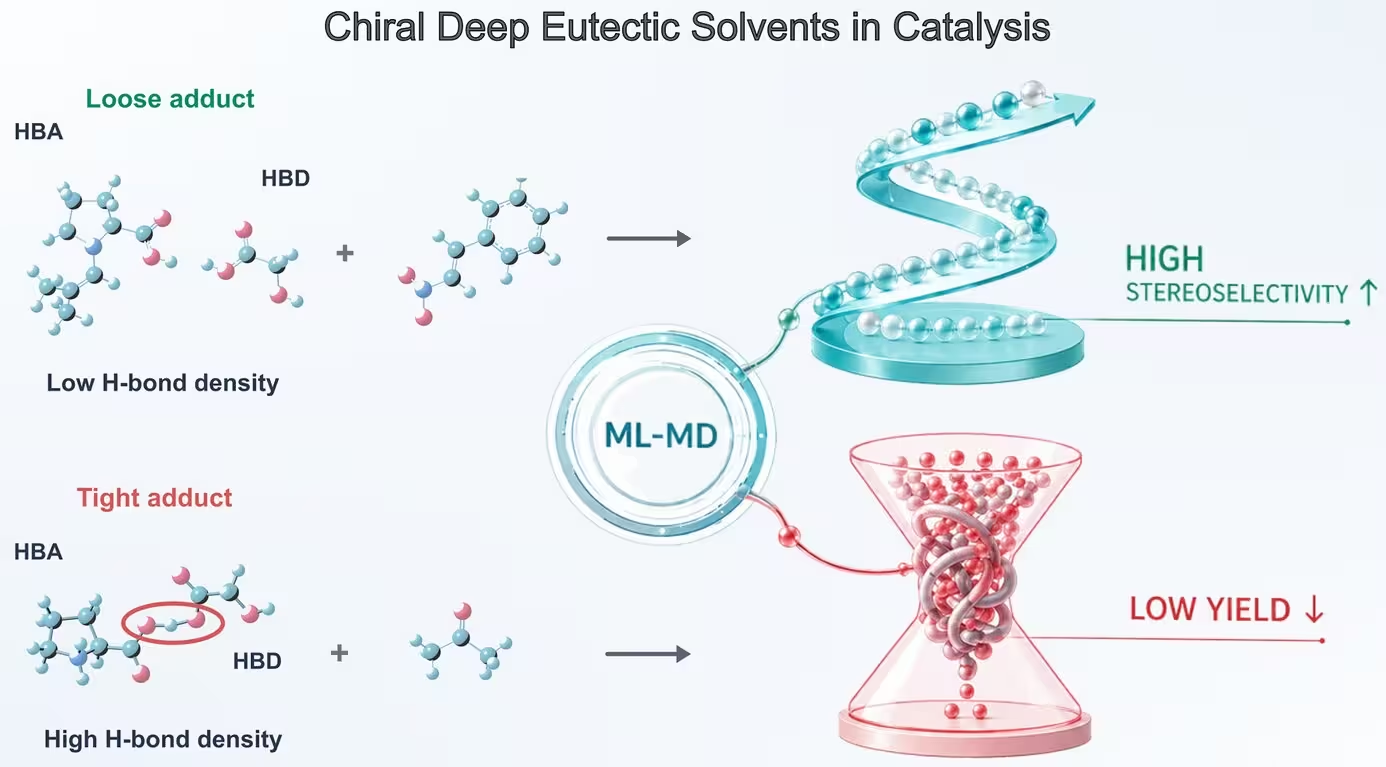
For instance, pairing L-proline with glycolic acid produced an average hydrogen-bond lifetime of 4.58 picoseconds, which proved too rigid for efficient turnover and yielded only fifteen percent conversion. Conversely, more flexible donors such as glycerol or 1,4-butanediol maintained a dynamic lability window that preserved molecular flexibility and achieved high conversions between ninety-two and ninety-five percent.
What Controls Stereoselectivity in Chiral Eutectic Mixtures?
Beyond reaction speed, the researchers investigated the molecular origins of enantiomeric excess during ketone additions to trans-beta-nitrostyrene. The data established a specific threshold where a minimum of about 0.60 enamine-to-substrate hydrogen bonds is required to impose the geometry-defining contacts necessary for high stereocontrol. Systems falling below this threshold suffered from competing enamine-donor interactions that washed out stereoselectivity.
In pre-quaternized ammonium systems where the catalytic nitrogen remained unprotonated, catalytic efficiency relied entirely on avoiding the cage effect. Mixtures featuring weaker intermolecular interactions prevented solvent trapping, allowing the substrate easy access to the active center and delivering near-quantitative conversions within eighteen hours.
What Limitations Affect These Predictive Descriptors?
While the identified hydrogen-bond count thresholds provide valuable design rules, the authors note that the specific numerical values remain system-dependent rather than universal constants. The current models capture short timescales of one hundred picoseconds, which may not fully reflect slower collective rearrangements across larger mesoscale structures. Furthermore, experimental translation requires balancing solvent recyclability, viscosity, and feedstock availability alongside catalytic performance.
These findings elevate chiral deep eutectic solvents from passive green media to rationally designable catalytic platforms. The established descriptors provide physically meaningful input features for future high-throughput virtual screening workflows, helping researchers navigate the vast combinatorial space of sustainable chemical formulations.
The research was published in Nano-Micro Letters on November 23, 2026.
This article has been fact checked for accuracy, with information verified against reputable sources. Learn more about us and our editorial process.
Last reviewed on .
Article history
- Latest version
Reference(s)
- Tomasini, Michele., et al. “Predicting Asymmetric Organocatalysis via Machine-Learning-Driven Molecular Dynamics of Chiral Deep Eutectic Solvents.” Nano-Micro Letters, vol. 19, no. 1, November 23, 2026 Springer Science and Business Media LLC, doi: 10.1007/s40820-026-02358-7. <https://doi.org/10.1007/s40820-026-02358-7>.
Cite this page:
- Posted by Bilal Abbasi