Microscopic Noise Alters Particle Collisions and Unveils Hidden Corrections in Active Matter Physics
A new kinetic analysis shows how stochastic fluctuations during prolonged particle encounters challenge traditional deterministic collision rules in active systems.
When active particles collide and align in crowded environments, tiny fluctuations in their motion can trigger unexpected shifts in collective behavior. Researchers investigating dry aligning active matter have uncovered how microscopic noise alters collision integrals in kinetic theory, revealing non-analytic corrections that traditional models miss entirely. The findings address a long-standing challenge in statistical physics by testing whether standard deterministic collision rules hold true under noisy conditions.
How Does Noise Influence Particle Collisions?
Active systems are frequently described by generalized effective equations of motion that incorporate stochastic terms at the smallest resolved scales. In equilibrium statistical mechanics, noise is typically tied to temperature via fluctuation-dissipation relations, but active matter lacks an underlying Hamiltonian framework. This absence makes it difficult to construct standard statistical descriptions directly from conservation laws. Researchers often rely on kinetic theory, a systematic approach for deriving ensemble-level behavior from microscopic equations of motion.
A widespread simplification in this field is mean-field theory, which assumes that interacting agents remain statistically independent under the principle of molecular chaos. Going beyond mean-field descriptions requires tracking the correlations that build up while particles are in contact. Traditionally, kinetic frameworks like the Landau equation assume that these collision processes unfold along smooth, deterministic trajectories. When weak noise is introduced, however, relative trajectories become random, causing fluctuations in both the geometry and duration of each encounter.
What Happens When Collision Times Diverge?
To evaluate how weak noise affects these interactions, the authors of the study performed a Dyson expansion of the noisy free propagator. They examined two distinct types of stochasticity: standard free-flight noise acting continuously on single-particle dynamics, and gated noise restricted strictly to active contact events. Their analysis, published on the arXiv preprint server, demonstrates that incorporating a deterministic collision integral alongside standard diffusion is indeed the correct leading-order description for free-flight noise.
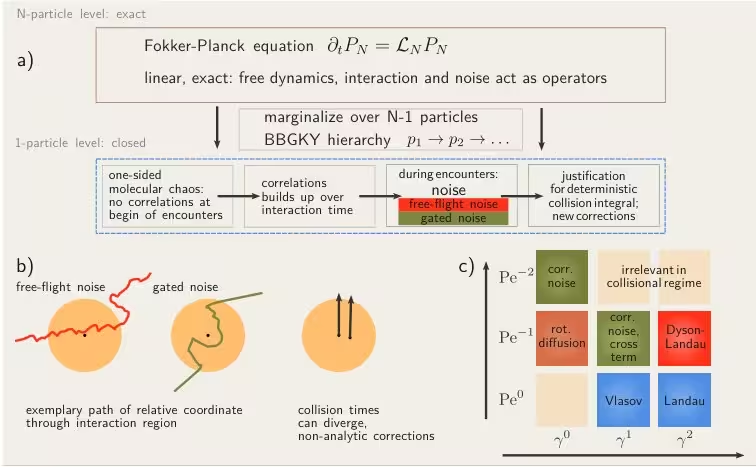
For nearly parallel particles, however, relative velocities approach zero, causing collision durations to diverge. Under these conditions, the standard perturbative expansion breaks down because even weak noise has a profound impact on long encounters. For gated noise, this interaction generates non-analytic corrections and logarithmic enhancements that depend heavily on the magnitude and sign of the coupling strength. Agent-based simulations confirmed that these cross-terms lead to an asymmetry in relaxation rates, meaning aligning and anti-aligning systems respond differently to stochastic perturbations.
Why Do These Corrections Matter for Active Matter?
The emergence of non-analytic terms highlights the limits of phenomenological modeling in active systems. Standard approaches that rely on intuitive, instantaneous collision rules frequently overlook how microscopic noise modifies the duration of encounters. By capturing these subtle corrections, the theoretical framework offers a more rigorous foundation for deriving hydrodynamic equations in active fluids. Future extensions of the work aim to incorporate spatial gradients and explore how similar stochastic mechanisms operate in chiral or non-additive active systems.
The study was posted to the arXiv preprint server on November 23, 2026.
This article has been fact checked for accuracy, with information verified against reputable sources. Learn more about us and our editorial process.
Last reviewed on .
Article history
- Latest version
Reference(s)
- Boltz, Horst-Holger. “Statistical mechanics of noisy collisions in active matter: Dyson-Landau theory.” arXiv.org <http://arxiv.org/abs/2611.30910v1>.
Cite this page:
- Posted by Bilal Abbasi