Hidden Basin Faults and Pressure Limits Reveal Major Constraints on Large-Scale Carbon Storage
Researchers reveal that underground rock variations and pressure buildup can slash carbon storage capacity, demanding new basin-wide management strategies.

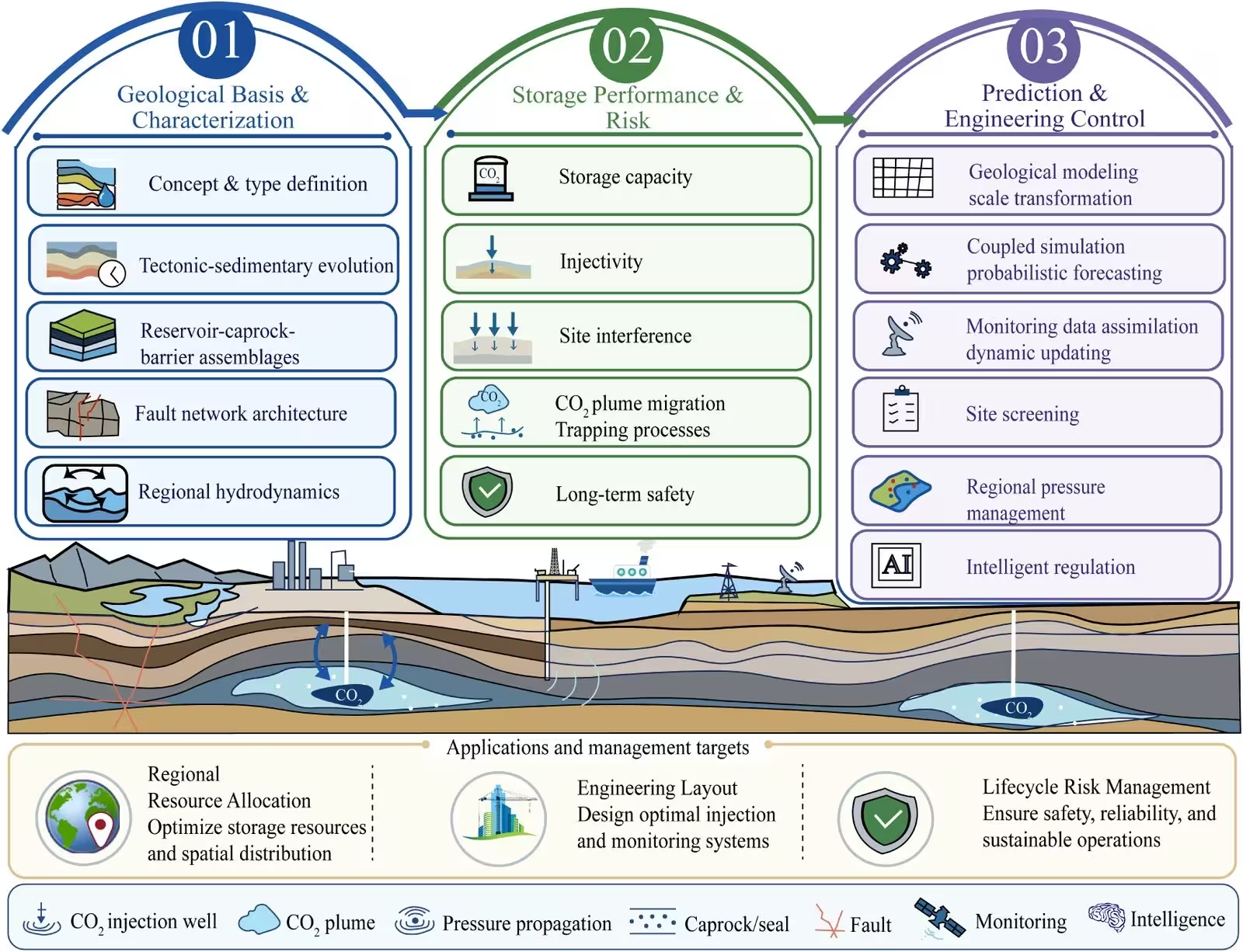
Massive underground carbon storage projects face hidden geological obstacles across entire sedimentary basins that can drastically reduce their actual capacity. A comprehensive review published in ACS Omega reveals that local rock variations, underground faults, and regional pressure boundaries often prevent millions of tonnes of injected carbon dioxide from spreading as expected. Led by researchers Xueting Wang and Keyao Lin from the Chinese Academy of Sciences, the study synthesizes data from representative sedimentary basins and engineering sites worldwide to reshape how engineers evaluate permanent greenhouse gas storage.
How Does Regional Heterogeneity Limit Carbon Storage Capacity?
Sedimentary basins are not uniform, continuous underground sponges, meaning that calculations based purely on total rock pore volume will severely overestimate how much carbon dioxide can be safely trapped. Tectonic shifts, ancient river deposits, and mineral changes over millions of years create complex mosaics of thick sandstones, tight shales, and broken fault zones. When researchers refine static storage estimates to account for actual net reservoir thickness rather than gross thickness, usable capacity can drop by about twenty-five percent. Furthermore, multiple injection projects operating within the same regional aquifer often interfere with one another, creating overlapping pressure plumes that restrict overall fluid acceptance.
Different types of sedimentary basins respond uniquely to large-scale injections based on their boundary conditions and structural compartmentalization. Rift basins feature intensely faulted blocks that form localized pressure compartments, whereas foreland basins contain wedge-shaped sedimentary layers with significant facies variations. Cratonic basins offer stable, gently dipping strata with slow groundwater movement, making them highly suitable for massive regional storage networks. However, closed or semi-closed hydrodynamic boundaries trap fluids and cause rapid pressure build-up, restricting injectivity long before physical pore spaces are completely filled with carbon dioxide.
What Role Do Faults and Caprocks Play in Long-Term Safety?
Underground barriers and faults act as double-edged swords that can either contain carbon dioxide securely or provide unintended pathways for upward fluid migration. Primary and secondary caprocks, such as regional mudstone layers, rely on capillary forces to prevent buoyant carbon dioxide from escaping toward shallow freshwater aquifers. Yet tectonic uplift, erosion, and insufficient compaction create weak zones where caprock integrity may fail under high injection pressures. Similarly, faults sealed with fine-grained mineral gouge can divide a basin into separate pressure compartments, but high-pressure injection can reactivate these faults and trigger cross-formational leakage.
Pressure footprints routinely extend tens to hundreds of kilometers beyond the physical boundary of the trapped carbon dioxide plume. When multiple wells inject gas simultaneously, these expanding pressure zones superimpose and push surrounding saline formation waters outward against distant faults and boundaries. Historical data from oil and gas fields demonstrate that legacy wells and abandoned boreholes represent major potential leakage pathways if operational pressures exceed critical thresholds. Consequently, long-term safety assessments must evaluate entire storage complexes as interconnected systems rather than focusing solely on individual injection reservoirs.
What Are the Next Steps for Basin-Scale Management?
To overcome these geological uncertainties, the authors outline a shift from isolated site selection toward coordinated basin-wide management and digital twin simulations. Integrating core samples, well logs, and three-dimensional seismic surveys helps resolve multiscale variations, while stochastic models and Monte Carlo simulations generate probabilistic capacity distributions instead of misleading single-plume predictions. Advanced engineering strategies, such as active brine extraction, can relieve regional overpressure, expand storage capacity by up to one hundred percent, and reduce the required area of regulatory review by seventy-five percent.
Ultimately, the proposed framework calls for a three-level management architecture that coordinates basin-wide resource zoning, site-level well patterns, and operational pressure controls. By combining real-time monitoring data with artificial intelligence and continuous model updating, operators can track plume migration and dynamically adjust injection rates. This proactive approach ensures that large-scale decarbonization efforts balance high storage efficiency with long-term environmental security across complex geological formations.
The research was published in ACS omega on November 5, 2026.
This article has been fact checked for accuracy, with information verified against reputable sources. Learn more about us and our editorial process.
Last reviewed on .
Article history
- Latest version
Reference(s)
- Wang, Xueting., et al. “Basin-Scale Heterogeneity in CO2 Geological Storage: Mechanisms, Prediction, and Management.” ACS Omega, vol. 11, no. 45, November 5, 2026, pp. 69470-69497. American Chemical Society (ACS), doi: 10.1021/acsomega.6c09382. <https://doi.org/10.1021/acsomega.6c09382>.
Cite this page:
- Posted by Vikram Desai