New AI Framework Reconstructs Hidden Hourly Weather Details From Coarse Daily Data
By leveraging null-space parameterization and hierarchical coarsenings, a novel generative model recovers missing sub-daily atmospheric dynamics with high accuracy.

A breakthrough generative framework successfully reconstructs high-resolution weather states and complex fluid trajectories from sparse, coarse observations without losing physical realism. Weather and climate simulations routinely store only daily or monthly summaries, or sparse snapshots spaced hours apart, because saving full continuous trajectories requires prohibitive computational storage. When researchers attempt to fill in the missing intermediate time steps, standard artificial intelligence models typically output a single smoothed average, washing away realistic storm variability and small-scale turbulence. To solve this dilemma, a team of researchers led by scientists at Inria and Sorbonne Université introduced a novel approach called MUNDO, which stands for Multiresolution UNified DOwnscaling.
The study, published on the arXiv preprint server, demonstrates that this generative architecture can reconstruct fine-scale details across diverse physical systems. By splitting the reconstruction task into structured mathematical components, the method ensures that every generated sample strictly obeys the overarching coarse observations. Ordinary machine learning models often require iterative trial-and-error solver steps or artificial penalty terms to nudge outputs toward the correct target. In contrast, the new framework achieves exact observational consistency in a single network evaluation by leveraging a mathematical property known as the null space.
How Does Null-Space Parameterization Guarantee Perfect Data Consistency?
When computers try to fill in missing weather data between two known hourly checkpoints, they face a classic mathematical hurdle where multiple different pathways could theoretically produce the same end result. The authors designed their system to split any candidate reconstruction into two distinct pieces. The first piece represents the exact baseline information that the coarse observation already fixes, while the second piece represents the hidden residual variability that the coarse data leaves entirely undetermined.
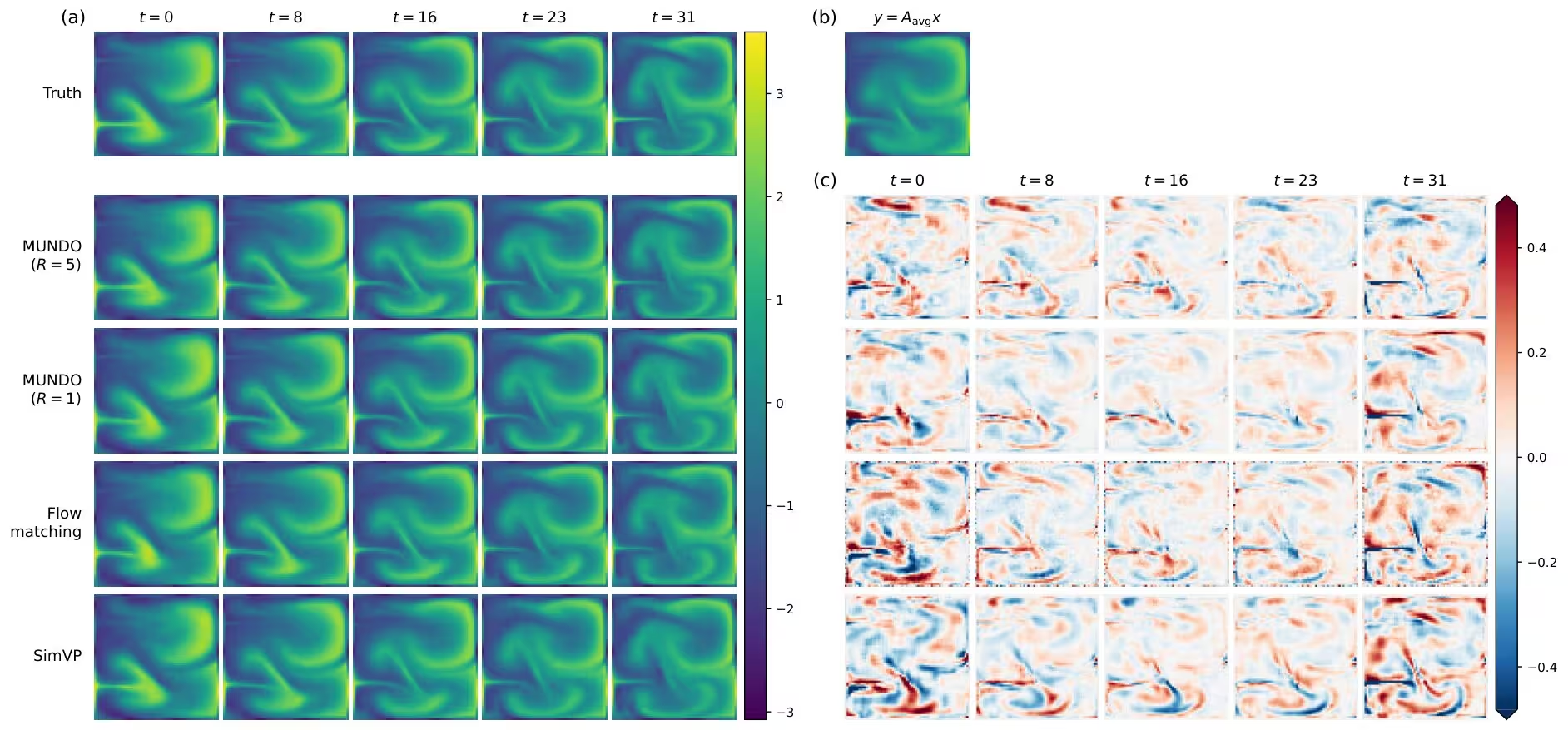
By constraining the neural network to operate exclusively within the null space of the observation operator, every generated trajectory matches the original coarse measurements by construction. The researchers tested the technique across chaotic mathematical models like Lorenz-96, four distinct two-dimensional physical simulations covering fluid dynamics and wave propagation, and real-world European weather data from the European Centre for Medium-Range Weather Forecasts.
Why Does Recursive Multiresolution Sampling Outperform Single-Step Models?
Complex natural systems involve multiple interacting scales of motion, ranging from continent-spanning high-pressure cells down to localized afternoon thunderstorms. Instead of forcing a single neural network to predict all missing hours at once, the recursive version of the framework factorizes the problem into a hierarchy of successive coarsenings. Each level in the hierarchy handles only the degrees of freedom lost between adjacent time resolutions, passing constraints seamlessly from coarse scales down to fine-scale hourly details.
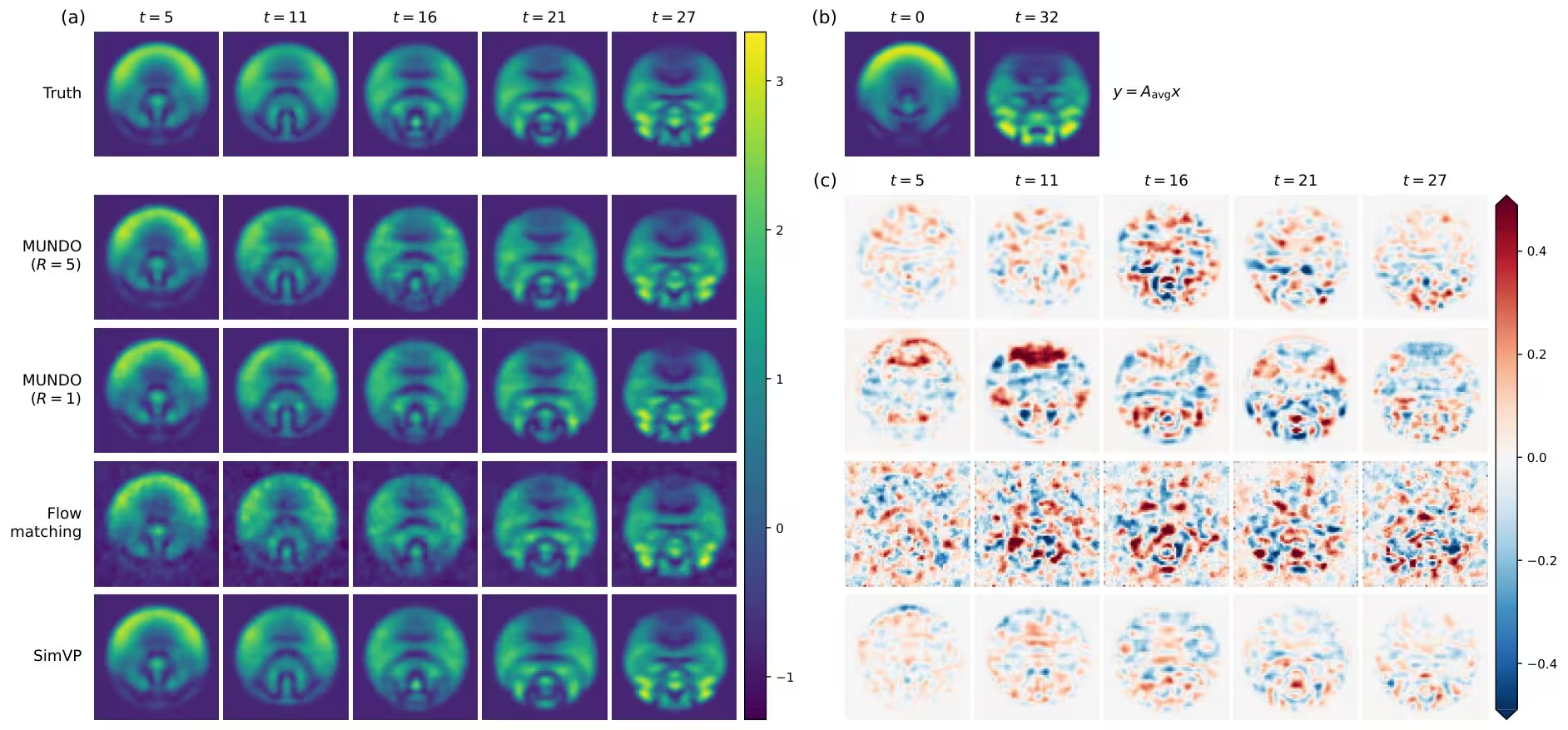
Across rigorous evaluations, the authors found that single-step models often excel at simple interpolation tasks, but recursive multiresolution sampling substantially improves ensemble calibration and temporal realism in chaotic regimes. When applied to daily-to-hourly downscaling of European weather fields, the recursive model reduced continuous ranked probability scores by over twenty percent compared to existing flow-based baselines. Furthermore, the approach preserved realistic spatial power spectra and captured the natural diurnal cycle of surface temperatures without generating artificial grid-scale noise.
What Limitations Remain for Real-World Climate Projections?
Despite strong performance across physical benchmarks, the study highlights important boundaries and technical challenges for operational forecasting. For instance, linear constraints do not inherently enforce non-negative boundaries, meaning raw precipitation models can occasionally generate physically impossible negative rainfall rates. To correct this, the team applied specialized Euclidean projections onto valid non-negative subsets during post-processing.
Additionally, recursive architectures can suffer from error propagation if upstream coarse predictions drift from reality. The authors mitigated this issue by incorporating end-to-end fine-tuning on generated samples. Future work will extend the framework to joint spatiotemporal datasets and operational data assimilation systems, offering a promising tool for generating plausible high-resolution climate projections from coarse global model archives.
The study was posted to the arXiv preprint server on November 23, 2026.
This article has been fact checked for accuracy, with information verified against reputable sources. Learn more about us and our editorial process.
Last reviewed on .
Article history
- Latest version
Reference(s)
- Delefosse, Aymeric. “MUNDO: a multiresolution generative framework for temporal downscaling.” arXiv.org <http://arxiv.org/abs/2611.30868v1>.
Cite this page:
- Posted by Michael Ellison