Massive Wind Farms Can Trigger Severe Storms Forty Miles Downstream
New atmospheric modeling reveals that towering wind turbines alter heat transport and gravity waves enough to jump-start rainstorms.
Massive wind farms towering over landscapes do more than just generate clean electricity, because new atmospheric modeling reveals they can actively trigger rainstorms and severe weather dozens of miles downstream. The research, carried out by scientists at Peking University, demonstrates that large wind turbines alter local air currents and thermal profiles so significantly that they can jump-start convective clouds long before nature would have done so on its own.
As global wind energy capacity expands rapidly toward the thirteen hundred gigawatt mark, researchers are paying closer attention to how colossal rotating blades interact with the planetary boundary layer, which is the lowest layer of the atmosphere directly influenced by Earth’s surface. While previous field and satellite studies focused mostly on how wind parks warm the ground at night by mixing air layers, the mechanics of how industrial turbine arrays affect precipitation and storm formation remained largely unexplored. To investigate these atmospheric ripples, the authors implemented a standardized wind farm parameterization scheme into a specialized numerical simulator known as Cloud Model 1, publishing their technical validation and simulation findings on the arXiv preprint server.
How Can 22-Megawatt Turbines Reorganize Lower Atmosphere Heat Flow?
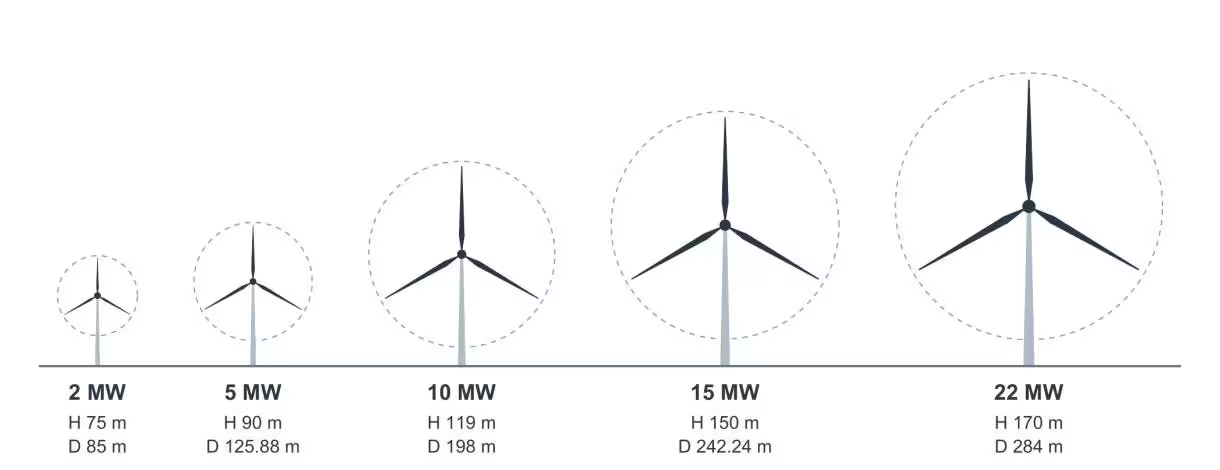
The research team tested different turbine capacities ranging from standard two-megawatt models up to massive twenty-two-megawatt behemoths with rotor diameters stretching nearly three hundred meters. Their simulations show that giant wind turbines act as elevated momentum sinks that slow down regional winds while injecting turbulent kinetic energy into the rotor-swept layer. Under stable nighttime conditions, this mechanical churning produces V-shaped surface temperature anomalies and wind deficits that extend far beyond the physical boundaries of the farm itself.
Heat-budget calculations within the model revealed a surprising thermodynamic shift. While enhanced friction slightly alters surface sensible heat flux, the dominant driver of downstream boundary layer warming is actually turbulent entrainment. The spinning blades force downward mixing, pulling warmer air from the upper atmosphere down toward the surface. This organized thermal restructuring creates an elongated warm band aligned with the background wind, which then sets the stage for large-scale atmospheric adjustments.
What Triggers Severe Storm Development Forty Kilometers Downwind?
When the researchers simulated conditions favorable for atmospheric convection, they discovered that high-capacity turbine arrays of fifteen megawatts and twenty-two megawatts consistently promoted thunderstorm development about forty to fifty kilometers downwind. Two distinct physical mechanisms drive this phenomenon. First, the wind farm excites vertically propagating gravity waves that ripple through the troposphere, supplying the initial vertical push of air. Second, transverse roll-like secondary circulations form across the warm downstream band, creating continuous low-level convergence and lifting.
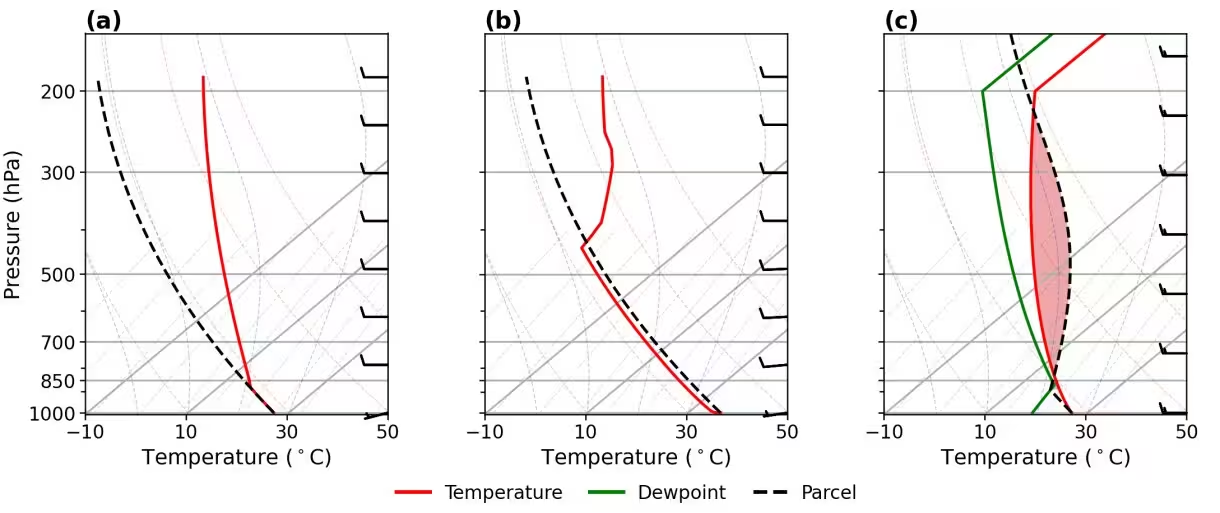
Because the background environment possessed near-zero convective inhibition, meaning there was very little atmospheric resistance holding down rising air parcels, these weak turbine-induced lifting forces were enough to sustain continuous growth. The initial wave disturbances evolved into deep, localized convective updrafts that triggered radar-detectable precipitation much earlier than in control simulations running without any wind farms.
What Are the Limitations of These Idealized Weather Models?
The authors emphasize that their conclusions rely on idealized numerical experiments using uniform initial conditions and flat terrain, which means real-world validation against actual meteorological observations is still needed. Furthermore, the parameterization scheme treats turbines as subgrid-scale momentum drains rather than resolving every individual blade tip, and variations in regional land cover or complex topography could alter the timing of storm initiation. As wind developers continue building taller turbines and larger offshore arrays, understanding these mesoscale weather interactions will become increasingly vital for regional climate forecasting and energy planning.
The study was posted to the arXiv preprint server on November 23, 2026.
This article has been fact checked for accuracy, with information verified against reputable sources. Learn more about us and our editorial process.
Last reviewed on .
Article history
- Latest version
Reference(s)
- Li, Jianxiang. “A Fitch-Based Wind Farm Parameterization for CM1: Implementation, Validation, and Impacts on Convection Initiation.” arXiv.org <http://arxiv.org/abs/2611.30806v1>.
Cite this page:
- Posted by Michael Ellison