River Microbes Discovered Driving Toxic Oil Sands Pollutant Release Into Canadian Waters
Native bacteria in oil-rich river basins actively control how toxic bitumen compounds dissolve and break down, reshaping environmental risk assessments.

Rivers eroding through natural oil deposits in Western Canada do not just wash away bitumen through simple physical weathering, as living microscopic organisms actively control how toxic petroleum compounds dissolve and break down in the water. That is the key finding from a team of researchers led by Jordyn Broadbent at Environment and Climate Change Canada, who discovered that native river microbes play an essential, driving role in mobilizing hydrocarbon pollutants from riverbank sediments.
The study, published in ACS Environmental Au, focuses on the Athabasca Oil Sands Region in Alberta, an immense landscape where rich bitumen deposits sit beneath boreal forests and wetlands that emerged from under ice sheets between eleven thousand and sixteen thousand years before present. Heavy freshwater extraction supports massive surface mining and in situ operations in the area, producing about three and a half million barrels of oil per day and generating vast quantities of toxic oil sands process-affected water that has accumulated since the nineteen sixties. While earlier work focused heavily on physical leaching, the researchers set out to determine whether natural riverbank erosion introduces these chemical pollutants into clean waterways through standard fluid dynamics or biological mechanisms.
How Do River Microbes Alter Contaminant Levels?
To untangle these chemical and biological processes, the team conducted controlled laboratory experiments combining fresh river waters and bank soils from the Steepbank and Ells Rivers. In initial setups using sterilized and non-sterilized water samples, the researchers tracked a group of oxygenated hydrocarbon pollutants known as naphthenic acid fraction compounds, which are structurally diverse molecules largely responsible for the toxicity of oil sands wastewater. Using high-resolution liquid-chromatography Orbitrap mass spectrometry alongside amplicon-based DNA sequencing, the scientists monitored how these contaminants behaved over thirty-one days in sealed and oxygenated glass vials.
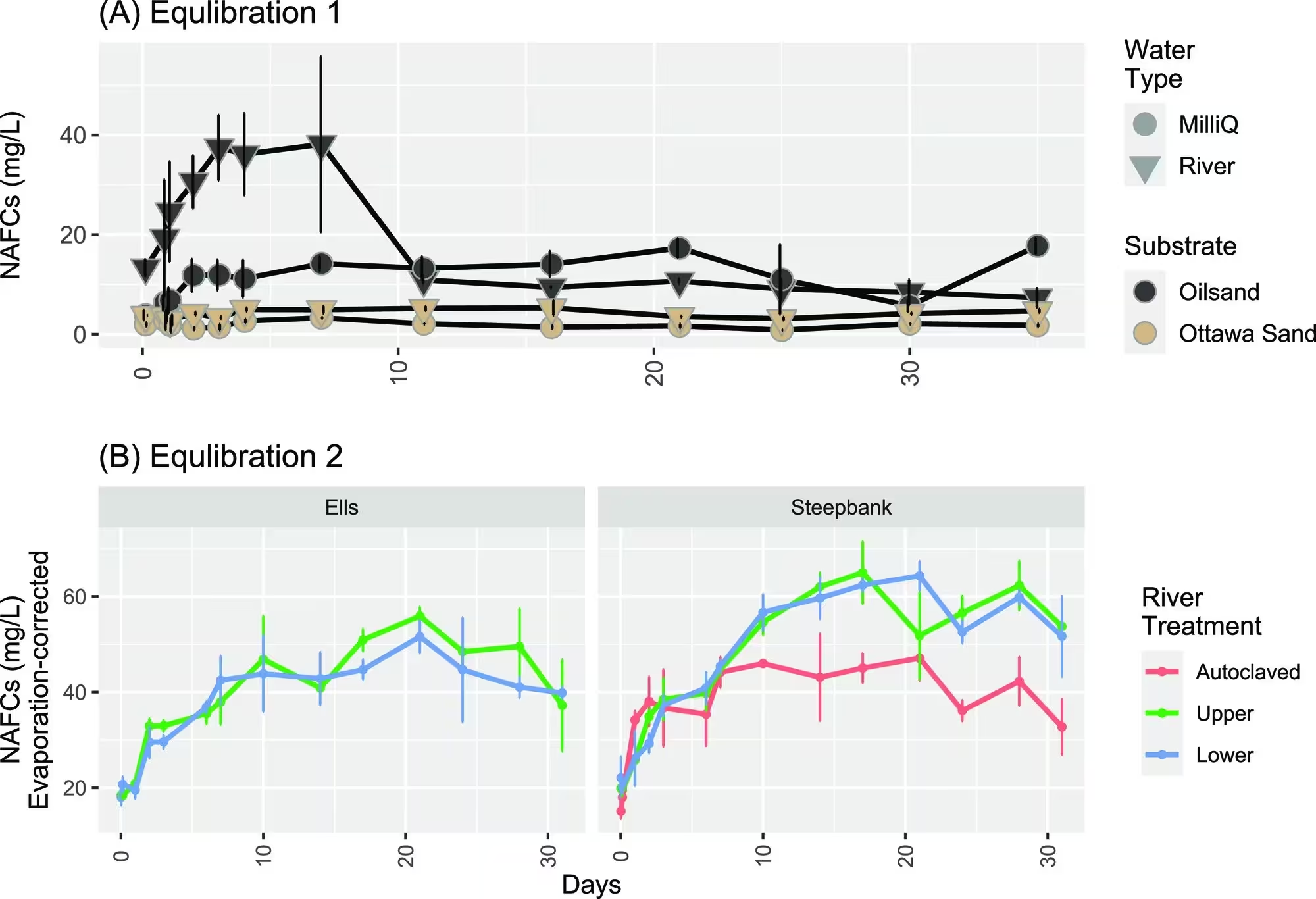
The team found that live, non-autoclaved river water mixed with fresh oil sands led to roughly fifty percent higher concentrations of mobilized pollutants compared to sterilized control samples. Rather than a purely passive chemical dissolution, the data revealed a dynamic two-way interaction where oil sands and water matrices became functionally coupled yet taxonomically distinct during incubation. Microbes in the water rapidly shifted toward specialized hydrocarbon-degrading and methylotrophic lineages, such as Methylophilaceae and Polynucleobacter, while the solid oil sands developed resilient anaerobic communities enriched in sulfate-reducing and fermentative bacteria like Geobacteraceae.
What Happens to Pollutants Over Time?
The experiments demonstrated that active microbial communities do more than just enhance the initial release of bitumen-derived compounds into the water column, as they also drive subsequent attenuation. In tests using fresh materials, pollutant concentrations rose sharply over the first two weeks before declining significantly as resident bacteria consumed and restructured the carbon structures. In contrast, autoclaved water controls lacking active microbial populations failed to show these structured community shifts and maintained erratic chemical profiles, confirming that biological activity dictates both the speed and the molecular speciation of contaminant mobilization.
The authors note that these findings are subject to certain limitations, as laboratory simulations cannot fully replicate every complex environmental variable found in wild river systems, including fluctuating flow rates, changing temperatures, and variable sediment porosities. Furthermore, the analysis concentrated strictly on naphthenic acid fraction compounds, meaning other petroleum hydrocarbon classes such as volatile aromatics and polycyclic compounds warrant further study. Nonetheless, understanding how indigenous fluvial consortia naturally adapt to and mitigate bitumen-derived ecosystem pressures provides vital baseline data for future environmental monitoring, risk assessments, and regulatory frameworks governing industrial water management.
The research was published in ACS environmental Au on September 3, 2026.
This article has been fact checked for accuracy, with information verified against reputable sources. Learn more about us and our editorial process.
Last reviewed on .
Article history
- Latest version
Reference(s)
- Vander Meulen, Ian J.., et al. “Microbes Endogenous to Oilsands-Eroding Tributaries Can Enhance Mobilization of Bitumen-Derived Naphthenic Acid Fraction Compounds into Water.” ACS Environmental Au, vol. 6, no. 6, September 3, 2026, pp. 1044-1058. American Chemical Society (ACS), doi: 10.1021/acsenvironau.6c00077. <https://doi.org/10.1021/acsenvironau.6c00077>.
Cite this page:
- Posted by Vikram Desai