Household Robots Fail One-Third of Spatial Tasks Despite Knowing Final Answers
A new robotics benchmark reveals that advanced artificial intelligence agents frequently guess correct answers without completing required exploration and room searches.
Robotic household agents struggle to connect basic room exploration with spatial reasoning, failing on roughly one-third of household evaluation tasks even when utilizing advanced vision-language models. A comprehensive evaluation framework known as ROAM-Bench, published in a study on the arXiv preprint server by researchers from The University of Hong Kong, JD.com, and partner institutions, exposes significant gaps between simply reporting a correct answer and actually completing the required physical exploration.
How Does ROAM-Bench Test Robot Spatial Intelligence?
The evaluation platform places simulated mobile manipulators into 27 distinct indoor environments comprising up to 13 rooms and hundreds of household objects. Autonomous agents receive visual inputs from an eye-level camera, odometer readings, and proprioceptive feedback, utilizing up to 325 high-level actions per house to solve 250 tasks across five core categories. These include semantic grounding, spatial aggregation, metric and comparative geometry, reference-frame integration, and goal-directed spatial actions such as object relocation.
Unlike traditional benchmarks that measure only final answers, ROAM-Bench separates outcome correctness from task-required evidence and stronger corroboration checks. Independent validation scripts inspect simulation states and episode records to verify whether the robot thoroughly searched specified rooms, observed target objects, and executed proper interaction sequences before offering a final response.
Why Do Advanced Vision-Language Models Fail Routine Exploration Tasks?
Evaluations across seven prominent vision-language models reveal that strict task success remains below 70 percent, with top-performing architectures failing on nearly 30 percent of assigned episodes. The authors identified two primary failure modes during testing. First, models frequently report correct final answers while completely missing required observation targets, such as counting five mirrors while neglecting a sixth in an adjacent lounge, or leaving entire rooms unexplored.
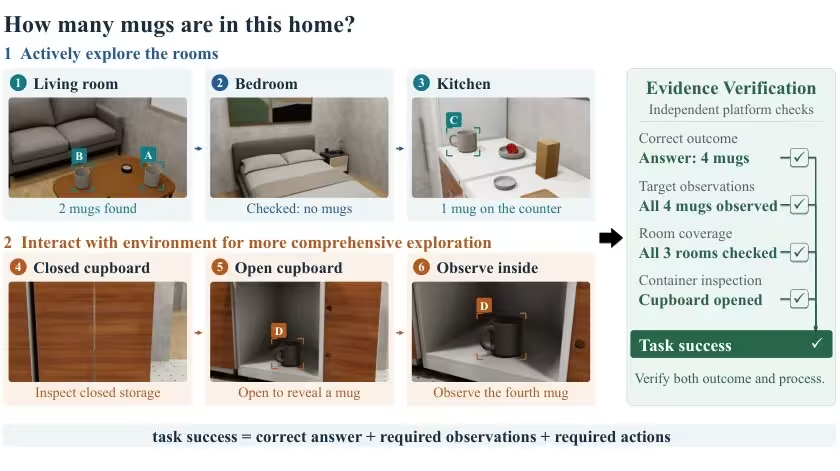
Second, robots often fail to execute correct actions even after gathering adequate visual data. In object relocation challenges, models successfully picked the correct target in fewer than half of the test episodes. Common physical breakdowns included selecting image points situated on walls or floors instead of graspable objects, or failing to verify target identities before attempting interaction.
What Improvements Help Robots Reason Better in Physical Spaces?
Diagnostic tests using ground-truth trajectory data demonstrated that supplying additional target views and calibrated spatial sensors significantly boosts accuracy. When researchers provided aligned radial-depth maps alongside RGB visual frames, model accuracy on spatial questions increased from 45.2 percent to 77.6 percent. These findings indicate that autonomous systems require explicit geometric awareness, robust cross-view instance tracking, and feedback-guided planning to reliably operate inside complex human environments.
The study was posted to the arXiv preprint server on November 24, 2026.
This article has been fact checked for accuracy, with information verified against reputable sources. Learn more about us and our editorial process.
Last reviewed on .
Article history
- Latest version
Reference(s)
- Ran, Xingjian. “ROAM-Bench: Evaluating Embodied Active Spatial Intelligence through Evidence Verification.” arXiv.org <http://arxiv.org/abs/2611.33143v1>.
Cite this page:
- Posted by Asif Iqbal