New Universal Robotic Policy Controls One Million Different Mechanical Arms
Researchers trained a single artificial intelligence model to master unfamiliar hardware by mapping robot joints directly into camera views.

A single artificial intelligence policy can now control one million different robotic arms by reading their moving parts like a map, solving a major hurdle in physical automation. Researchers at the University of Washington trained a universal system that lets unfamiliar robots pick up objects without any custom programming.
Controlling diverse machines has long challenged engineers because two robots with the same goal often need entirely different physical movements. A robotic arm with six joints moves differently than an arm with eight joints, and traditional software struggles when dropped into a new mechanical body.
How Does A Kinematic Graph Help Machines Adapt?
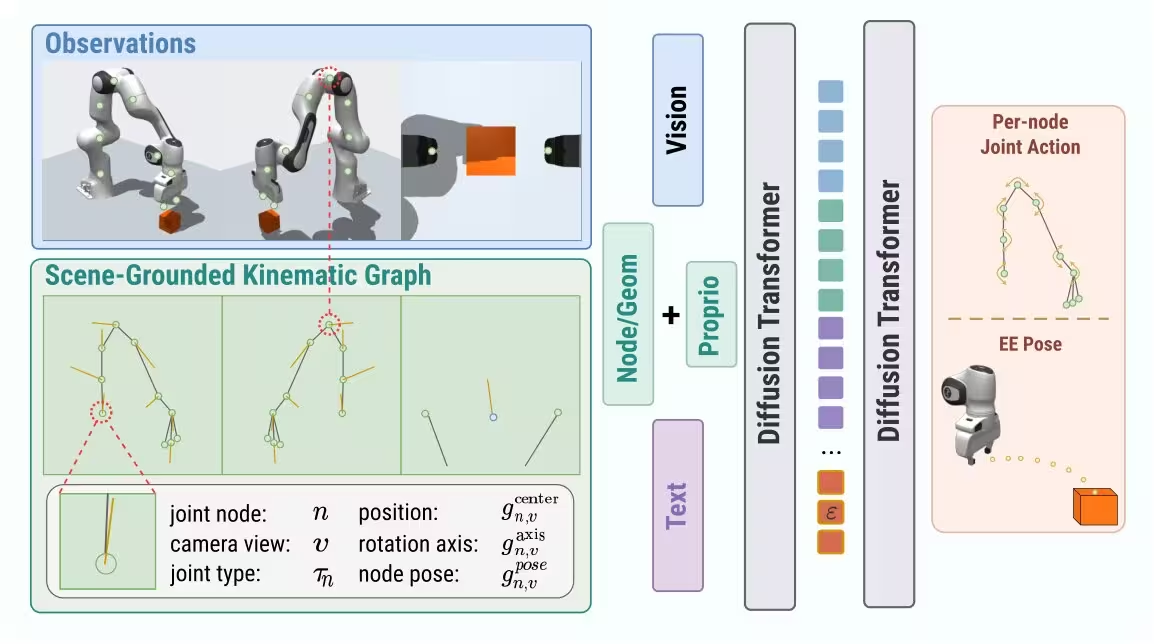
Led by computer science doctoral student Xiang Fan, the research team developed a system named OmniAct to bridge this gap. Instead of forcing every robot to use the same preset movements, the policy relies on a scene-grounded kinematic graph. This mathematical network translates a robot skeleton into three-dimensional camera coordinates, tracking joint positions, motion axes, and connectivity directly from visual observations.
By processing these geometric relationships alongside language instructions, the neural network predicts relative joint motions and end-effector pose updates. Detailed descriptions of the study are available published in a preprint from the arXiv server, outlining how the model bypasses the need for individual robot training.
What Happens When Robots Face Unseen Shapes In Real Tests?
To teach the network how physical structure dictates movement, the authors procedurally generated one million unique robotic embodiments with randomized joint limits, link lengths, and degrees of freedom. Filtering out physically impossible designs left a massive training dataset of simulated manipulation tasks.
During zero-shot evaluations, meaning tests on hardware the model had never encountered before, OmniAct succeeded in sixty-three percent of held-out simulation episodes. When tested on a physical OpenYAM robotic arm featuring a fine-tip flange gripper never seen during training, the policy achieved a sixty-eight percent success rate, outperforming specialized baselines that managed only thirty-five percent or lower.
Why Do Flexible Motion Strategies Matter For Automation?
The researchers noticed that the policy alters its physical strategy depending on the robot morphology and the specific task. When picking up a cube, the system approaches from above and closes vertically. When facing a knife lying flat on a surface, the arm pitches its wrist sideways to grasp the blade securely.
These adaptive behaviors emerge naturally because the training corpus includes diverse successful trajectories across different morphologies. Rather than retargeting one rigid grasp onto incompatible bodies, the system calculates the most effective approach based on local kinematic constraints.
Despite these advances, real-world deployment still faces hurdles when mechanical designs push past the edges of training distributions. Future work will likely focus on scaling the approach toward more complex structures like bimanual arms and humanoids.
The study was posted to the arXiv preprint server on November 24, 2026.
This article has been fact checked for accuracy, with information verified against reputable sources. Learn more about us and our editorial process.
Last reviewed on .
Article history
- Latest version
Reference(s)
- Fan, Xiang. “OmniAct: One Policy, One Million Embodiments.” arXiv.org <http://arxiv.org/abs/2611.33158v1>.
Cite this page:
- Posted by Asif Iqbal