Bacterial Biomass Cuts Yeast Costs in Half for Mass-Reared Sterile Fruit Flies Without Harming Fitness
Adding nitrogen-fixing bacteria to larval diets maintains vital flight and emergence traits while replacing expensive protein sources.
Mass-rearing facilities producing hundreds of millions of sterile Mediterranean fruit flies and Mexican fruit flies each week could slash their largest expense by up to fifty percent by incorporating nitrogen-fixing bacteria into larval diets. Researchers led by Martín Aluja and Carlos Pascacio-Villafán at the Instituto de Ecología in Mexico designed optimized larval diets where a bacterial biomass partially replaced expensive brewer’s yeast without compromising the fitness, emergence rates, or flight performance of the insects.
The sterile insect technique relies on releasing massive quantities of sterilized male pests to suppress wild populations, but feeding trillions of larvae over decades has required enormous quantities of dried torula yeast as a protein source. At the Moscamed-Mexico facility alone, annual spending on dietary yeast exceeds one million five hundred thousand dollars. To find a cheaper alternative, the research team published in PeerJ experimented with adding biomass from the nitrogen-fixing bacterium Gluconacetobacter diazotrophicus PAL5, a growth-promoting agent, into artificial diets containing reduced yeast and sugar.
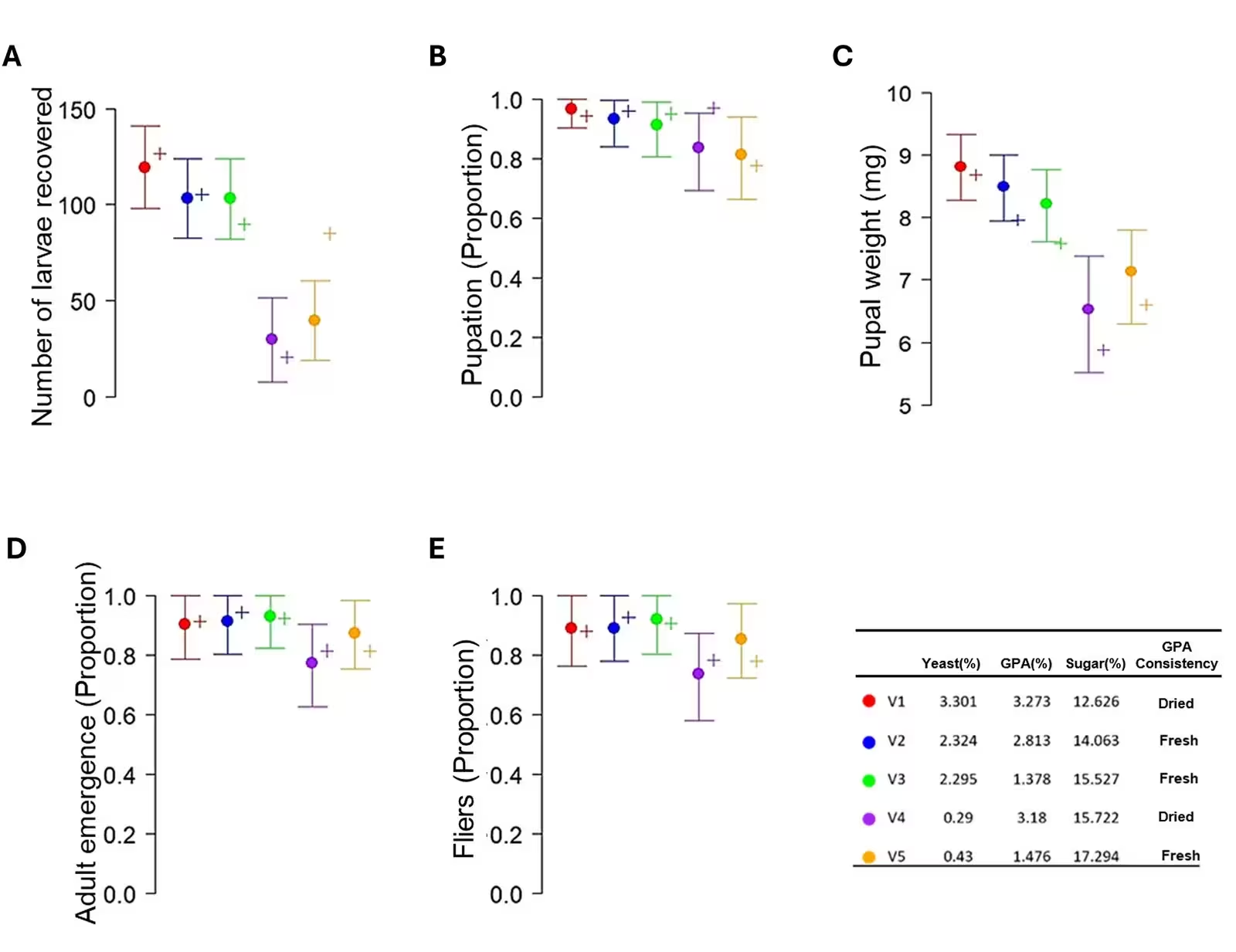
Using response surface methodology, the investigators tested various mixture combinations across three experimental phases for two major agricultural pests, Ceratitis capitata (the Mediterranean fruit fly) and Anastrepha ludens (the Mexican fruit fly). For the Mediterranean fruit fly, formulations reducing yeast by about fifty percent down to three to four percent, alongside three to four percent dried bacterial biomass and twelve percent sugar, produced flies with quality metrics comparable to standard diets. Specifically, pupal recovery, pupal weight, adult emergence, and flight ability remained strong, with emergence and flight proportions reaching about zero point nine five, matching or exceeding the control group.
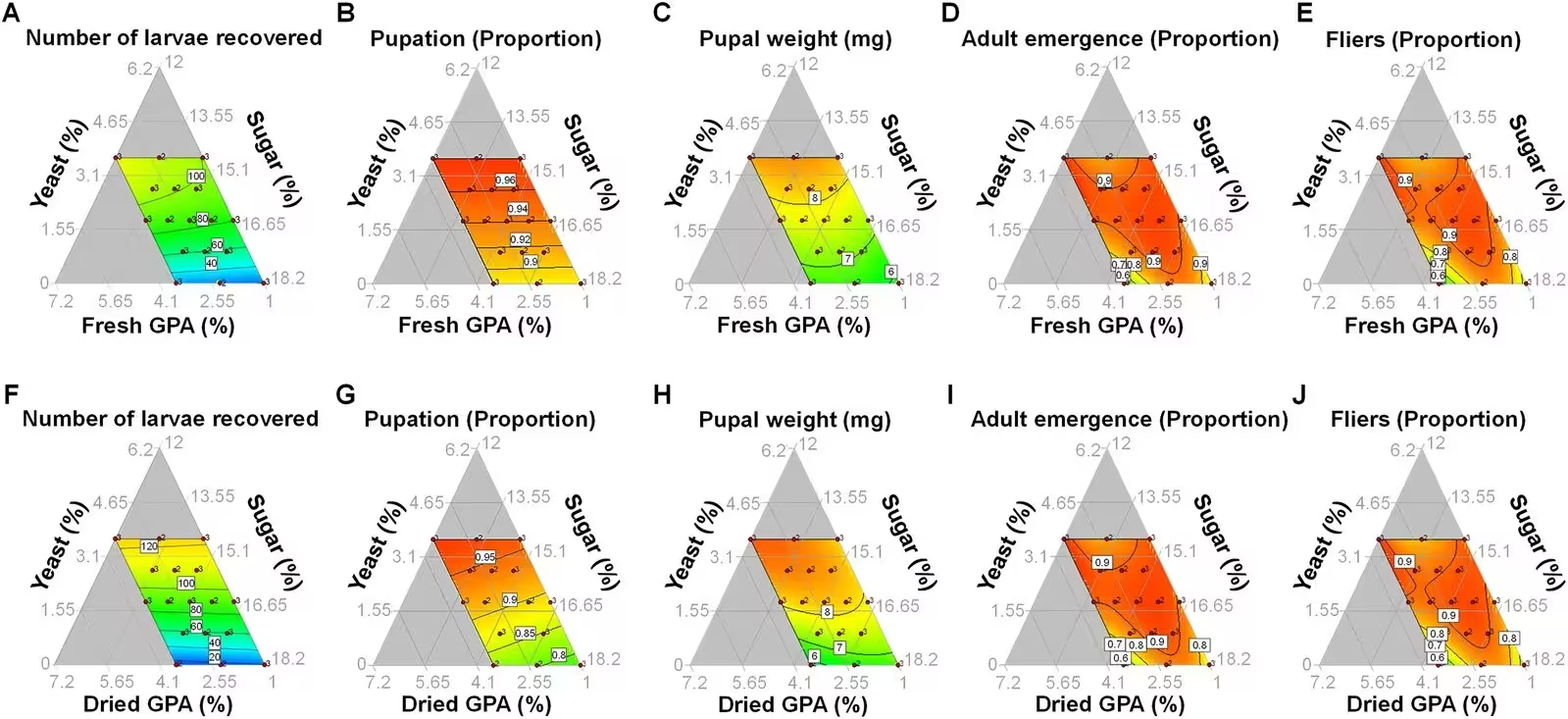
For the Mexican fruit fly, reducing yeast by fifty-seven percent down to roughly two point two to two point six percent while incorporating three percent dried bacterial biomass successfully sustained yield and flight ability. The team noted that bacterial single-cell protein typically exhibits a higher nitrogen density than brewer’s yeast, providing a biochemical explanation for how the insects maintained robust flight performance despite lower yeast levels.
Can Preservatives Be Removed Safely from Symbiont-Centric Diets?
The researchers also investigated whether standard chemical preservatives like formalin and methylparaben damaged living bacteria in fresh formulations. Tests revealed that removing these preservatives from fresh bacterial diets did not significantly alter pupation, pupal yield, pupal weight, adult emergence, or flight ability. However, dried bacterial biomass generally proved more consistent and yielded superior results compared to fresh bacterial applications across multiple parameters.
When analyzing volatile organic compounds emitted by sexually mature males during courtship, the team identified distinct profiles. While Mediterranean fruit flies reared on bacterial diets showed volatile profiles largely similar to control flies, Mexican fruit flies reared on bacterial diets exhibited higher abundances of several specific compounds compared to control or wild males. The authors suggest that larval nutrition can modulate male scent bouquets, which warrants further study to ensure sexual competitiveness remains unaffected during field releases.
What Are the Implications for Pest Management Programs?
The findings point to a shift from viewing microbes merely as temporary probiotic supplements to re-engineering the nitrogen backbone of insect diets around native symbionts. In nature, fruit fly larvae inhabit sugar-rich and protein-poor fruit pulp, placing them under chronic nitrogen stress that they naturally offset through intimate alliances with gut bacteria capable of fixing atmospheric nitrogen.
While the study did not directly measure in situ nitrogen fixation within the larval gut, the results demonstrate that bacterial biomass successfully functions as a constitutive protein substitute. Next steps for the research group involve scaling up the optimized diets to large industrial mixers holding one thousand eight hundred kilograms of diet at mass-rearing centers, alongside developing local bioreactors to produce bacterial biomass from cheap agricultural byproducts.
The research was published in PeerJ on November 19, 2026.
This article has been fact checked for accuracy, with information verified against reputable sources. Learn more about us and our editorial process.
Last reviewed on .
Article history
- Latest version
Reference(s)
- Aluja, Martín., et al. “Symbiont-centric larval diets for mass-rearing Ceratitis capitata and Anastrepha ludens (Diptera: Tephritidae) maintain insect fitness while substantially reducing yeast content.” PeerJ, vol. 14, November 19, 2026, pp. e21839 PeerJ, doi: 10.7717/peerj.21839. <https://doi.org/10.7717/peerj.21839>.
Cite this page:
- Posted by Linda Wilson