AI Weather Models Struggle to Forecast Severe Tornado Environments
Evaluating leading artificial intelligence forecasting systems reveals a systemic blurring of extreme storm ingredients at extended lead times.
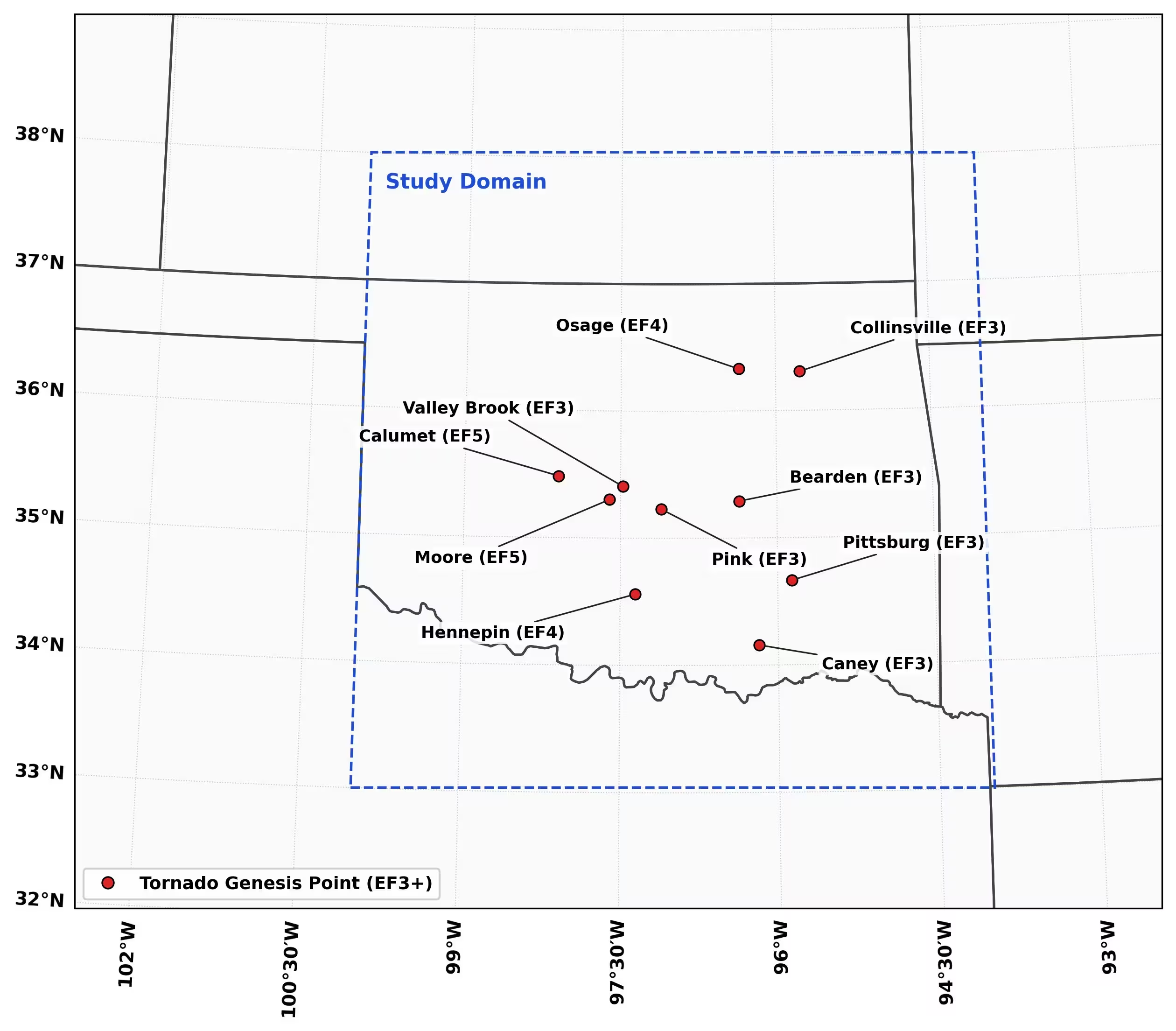
Over the plains of central Oklahoma, advanced artificial intelligence weather models struggle to resolve the violent atmospheric ingredients that spawn destructive tornadoes. A team of atmospheric scientists from the University of Washington evaluated how machine learning models reconstruct mesoscale convective environments. They found that while these modern forecasting systems excel at predicting large-scale patterns, they progressively blur the localized extremes essential for severe weather prediction.
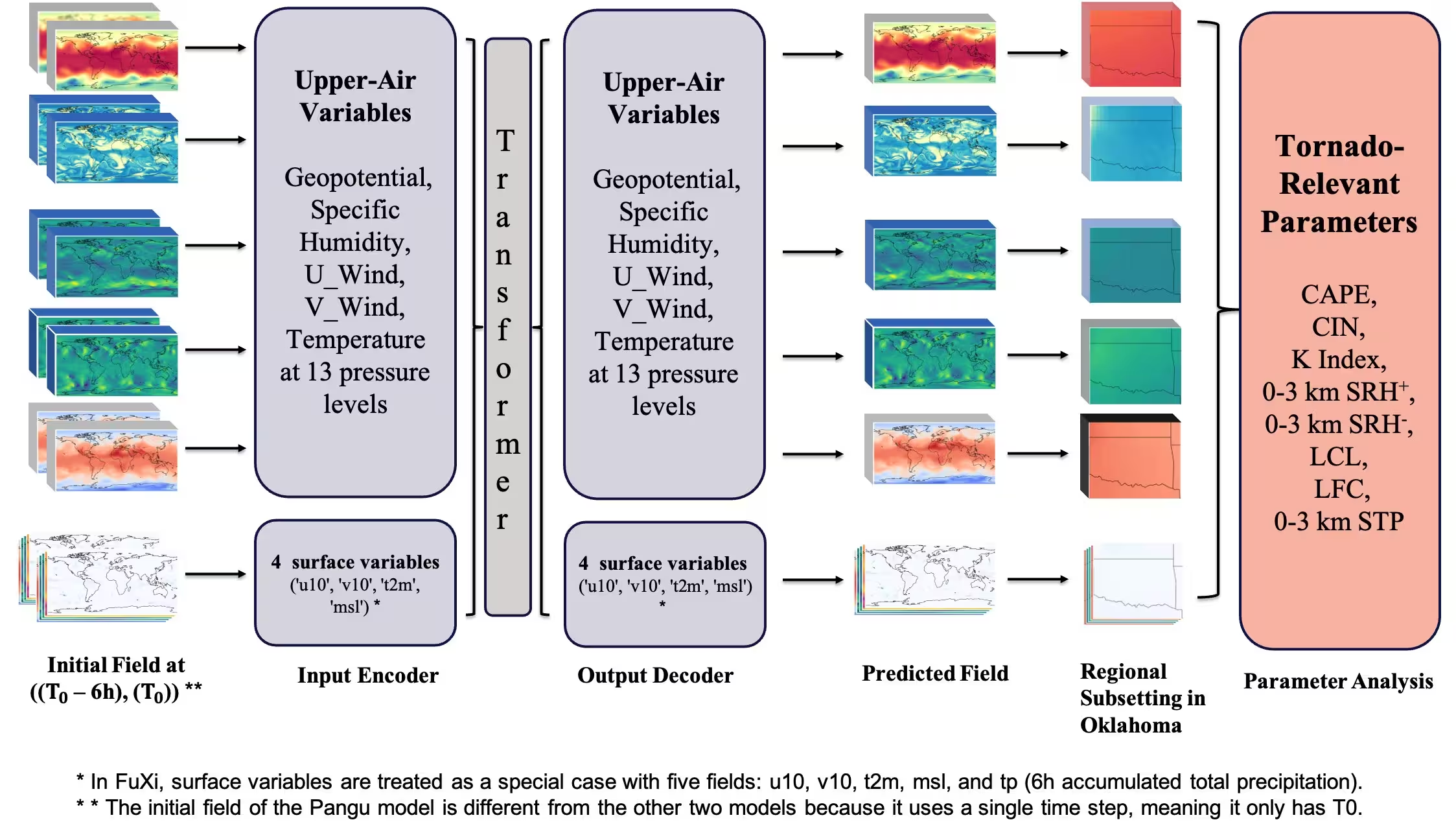
Led by Yiding Luo and colleagues at the University of Washington, the research team analyzed ten historically significant severe weather events from 2013 to 2025 that produced powerful tornadoes rated Enhanced Fujita scale three or higher. The study, published on arXiv, compared three major deep learning weather forecasting frameworks: Pangu-Weather, two versions of FengWu, and FuXi Weather. The researchers fed these artificial intelligence models global atmospheric data at lead times ranging from twenty-four to one hundred sixty-eight hours, evaluating eight specific tornado-relevant parameters.
Severe thunderstorm forecasting relies on diagnosing complex atmospheric variables such as Convective Available Potential Energy (which measures the amount of energy available for storms to rise), storm-relative helicity (describing rotation in the lower atmosphere), and composite indices like the Significant Tornado Parameter. Traditional numerical weather prediction models, such as the operational Global Forecast System, simulate physical equations but demand immense computing power and suffer from initial condition errors. Artificial intelligence models bypass these equations by learning from decades of historical reanalysis data, delivering forecasts in seconds at a fraction of the computational cost.
How Well Do Artificial Intelligence Models Predict Tornado Ingredients?
The comparative analysis revealed stark performance differences among the tested architectures across various atmospheric parameters. Pangu-Weather demonstrated superior skill in predicting positive storm-relative helicity, maintaining structural fidelity better than competing models at extended lead times. Conversely, FuXi Weather exhibited strong performance in thermodynamic indices like convective available potential energy, but systematically overpredicted their magnitudes by introducing excessive moisture into the lower troposphere.
The two versions of FengWu generally lagged behind the other artificial intelligence models in most metrics, though FengWu version two showed improved variance preservation for certain thermodynamic variables compared to its predecessor. Across all tested machine learning systems, a prominent trend emerged where forecast fields became increasingly oversmoothed as lead times grew longer. This mathematical blurring stems largely from loss function designs that penalize point-wise errors, inadvertently drawing extreme atmospheric values toward the climatological mean.
Why Do Artificial Intelligence Forecasts Blur Extreme Weather Features?
When evaluating forecast accuracy using traditional continuous metrics like root-mean-square error, models often appeared deceptively skillful because smoother fields yield smaller average deviations. However, event-based metrics and spatial verification tools revealed that this smoothness obliterates high-end extremes. Fine-scale structures such as cold pools, which mark rain-cooled air masses critical for storm dynamics, were consistently missed or smeared out by the data-driven models.
In a direct comparison using a May 2025 tornado event, the traditional numerical model successfully depicted a distinct cold-air boundary near the Red River region that the artificial intelligence models completely failed to resolve. Yet, while physical numerical models lost their convective signals entirely at one-hundred-sixty-eight-hour lead times, the machine learning models retained broad signals of the event, albeit with poor spatial precision. The authors caution that current deterministic artificial intelligence models should be used with extreme caution when assessing severe weather threats beyond seventy-two hours.
The study was posted to the arXiv preprint server on November 23, 2026.
This article has been fact checked for accuracy, with information verified against reputable sources. Learn more about us and our editorial process.
Last reviewed on .
Article history
- Latest version
Reference(s)
- Luo, Yiding. “Evaluation of Machine-Learning Weather Models in Reproducing Mesoscale Tornado-Favorable Convective Environments.” arXiv.org <http://arxiv.org/abs/2611.31564v1>.
Cite this page:
- Posted by Divya Iyer