Robots Master Complex Dexterous Tasks Using Ten Times Fewer Training Demos
A new framework reuses physics knowledge from virtual simulations to help robotic hands lift doors and assemble parts with minimal visual data.
Robotic arms can now master complex physical tasks like lifting doors and assembling parts using up to ten times fewer training demonstrations than standard vision models require, thanks to a new technique that reuses physics knowledge learned in computer simulations. Teaching robots fine-grained manipulation typically demands thousands of hours of visual examples because machines must simultaneously figure out what they are looking at and calculate precise finger and arm movements.
To overcome this data bottleneck, a team of researchers has developed a framework called Latent RL Prior. The method published in a preprint on arXiv in November 2026 bridges the gap between simulated physics practice and real-world visual perception by taking control strategies honed in virtual reality and adapting them for camera-equipped robots. The study was authored by Yixiao Wang, Peiyi Chen, Mustafa Mukadam, Shreekant Gayaka, Masayoshi Tomizuka, and Son Tran from the University of California, Berkeley and Amazon.
How Virtual Simulations Build Better Robotic Reflexes
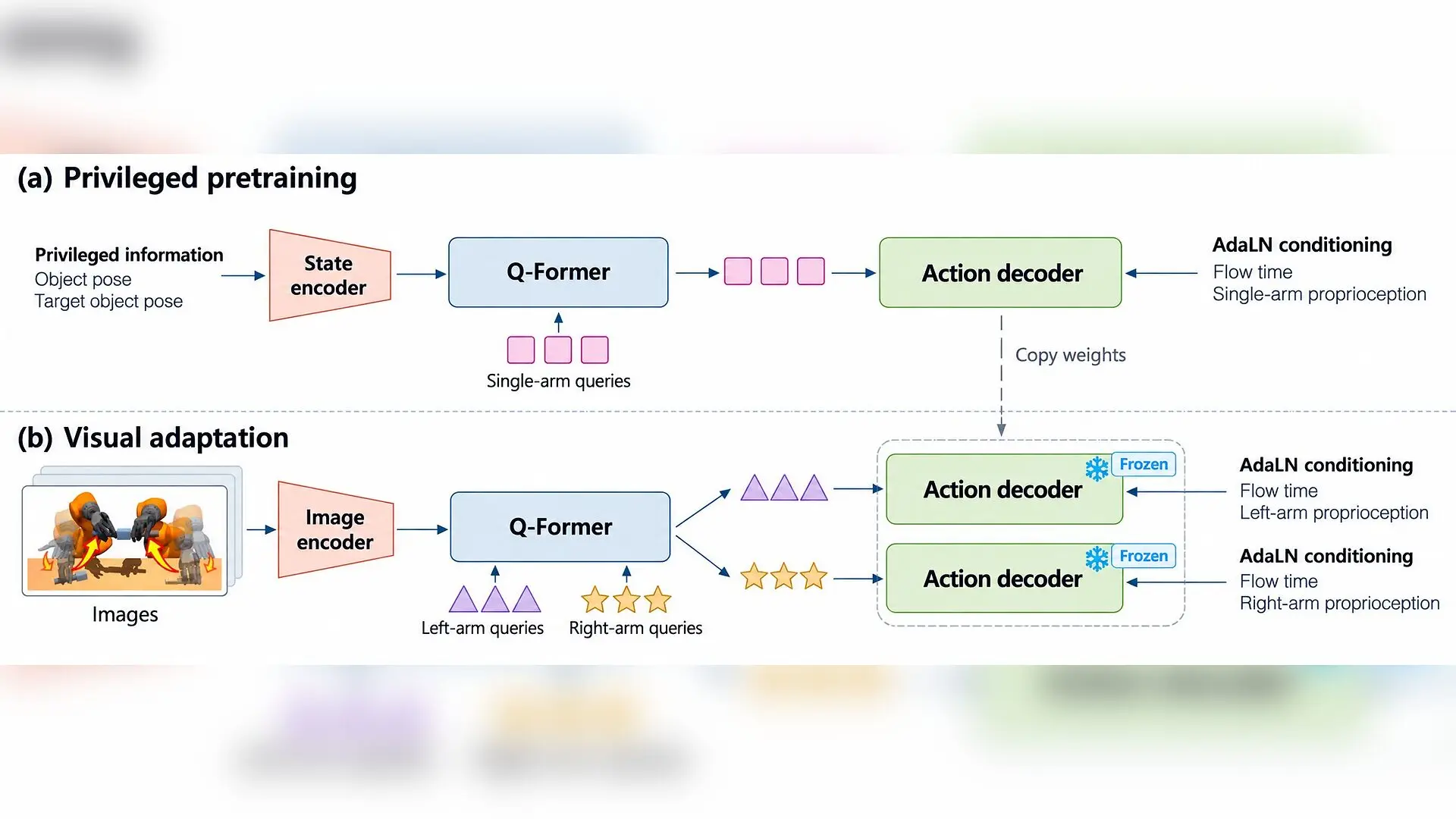
In virtual environments, reinforcement learning algorithms can interact with millions of digital objects under randomized shapes, sizes, and physics properties to learn robust control behaviors. However, these simulation teachers rely on privileged state information such as exact object coordinates and hidden goal states that cameras cannot detect in real-world settings. To solve this, the authors designed a two-stage training pipeline that preserves the control engine while retraining only the visual interpretation module.
During the first stage, the system distills massive simulation rollouts into a flow-matching action decoder. This component acts as the movement brain, learning how to sequence joint velocities and coordinate fingers. During the second visual adaptation stage, this core action decoder is completely frozen, and a visual interface is trained using only action supervision from a small set of demonstration videos.
Outperforming Full-Data Baselines with Fraction of Examples
When tested across three simulated robotic tasks in MuJoCo Warp, the approach drastically reduced the need for human or expert video demonstrations. For a door lifting task, the method achieved superior performance using only 50 demonstrations, outperforming traditional foundation models that required 500 full demonstrations, representing a tenfold efficiency gain. In bimanual assembly tasks involving two arms working together, the framework surpassed full-data baselines using five times fewer examples.
The researchers also evaluated the system on an unseen object, a blue brush, during a target pose alignment task. By freezing the core action decoder and applying only conservative updates to the image encoder, the network maintained stable learning trajectories across random seeds without overfitting to the small downstream dataset.
Decoding Hidden Physical Forces and Mass Variations
Further analysis into why the frozen reinforcement learning prior performs so well revealed deep structural advantages in the underlying neural representations. When tested on objects with increased mass that were absent from the visual demonstrations, policies powered by the Latent RL Prior degraded much more gradually than standard vision-language-action models. For instance, the system retained over 32 percent success on heavy door lifting at 5.0 kilograms, compared to less than 13 percent for baseline models.
Linear probing of the hidden decoder layers further demonstrated that contact-force information is substantially more accessible in the pre-trained models than in networks trained entirely from scratch. With just 200 visual demonstrations, the pre-trained model matched or exceeded the force prediction accuracy of scratch models trained on 4,000 demonstrations. This suggests that large-scale simulation training imprints structured physical awareness that persists even after visual adaptation.
Limitations and Future Hardware Deployment Goals
Despite the strong demonstration efficiency, the study comes with several important constraints. The approach relies entirely on simulation environments for initial policy generation and demonstration collection, meaning physical robot performance in real-world hardware remains untested. Furthermore, because the core action decoder is frozen, the robot may inherit any failure modes present in the original simulation teacher and could struggle if a new task requires entirely novel motor behaviors outside its pre-trained repertoire.
The study was posted to the arXiv preprint server on November 5, 2026.
This article has been fact checked for accuracy, with information verified against reputable sources. Learn more about us and our editorial process.
Last reviewed on .
Article history
- Latest version
Reference(s)
- Wang, Yixiao. “Latent RL Priors for Data-Efficient Dexterous Manipulation.” arXiv.org <http://arxiv.org/abs/2611.08458v1>.
Cite this page:
- Posted by Asif Iqbal