New Simulations Reveal Why Cosmic Cold Traps Cannot Lock Away All Disc Oxygen
Advanced disc models show that turbulent grain mixing halts runaway chemical depletion and caps carbon-to-oxygen ratios.
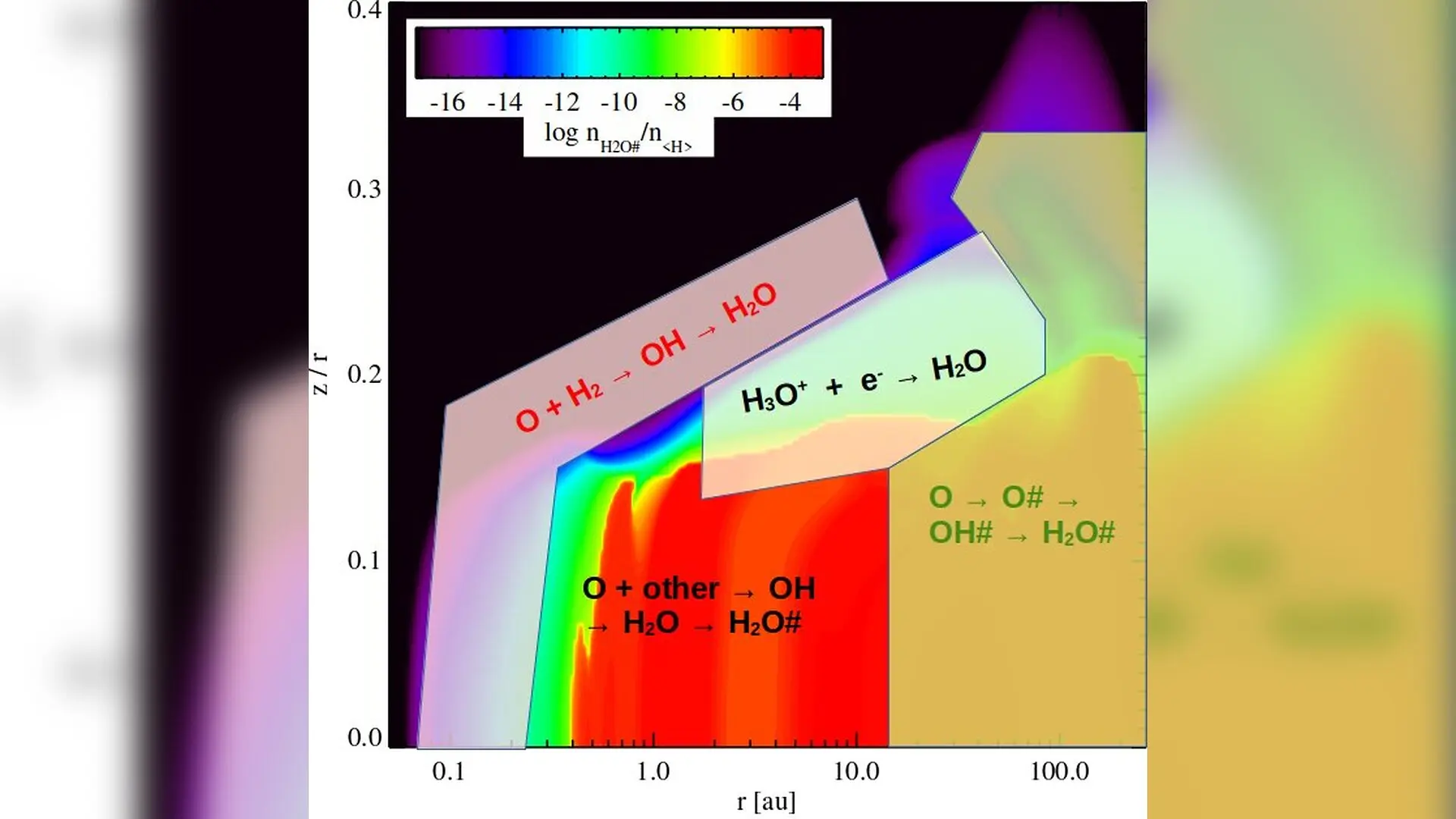
Protoplanetary discs surrounding young stars lock away life-giving water and vital chemical elements in freezing midplanes, but a newly simulated physical process suggests this trapping mechanism hits a natural ceiling. When planet-forming discs pull oxygen and carbon into dense, icy reservoirs, turbulence continuously lofts the tiny grains back upward, sparking a counter-flux that halts runaway chemical depletion.
Astronomers have long debated how planet-forming environments develop the peculiar chemical signatures observed by powerful observatories such as the Atacama Large Millimeter Array (ALMA). High-resolution data often reveal surprisingly bright hydrocarbon emissions alongside severe oxygen depletion in outer disc regions, a puzzle frequently blamed on a phenomenon called the vertical cold trap. In this setup, volatile molecules freeze onto dust grains in the cold, UV-shielded midplane and settle downward over time.
To investigate whether this cosmic filter permanently locks away atmospheric oxygen, Peter Woitke from the Space Research Institute at the Austrian Academy of Sciences developed a time-dependent one-dimensional vertical modelling framework named DiffuDrift. Published in arXiv, the research couples kinetic gas-phase chemistry, ice growth, thermal desorption, turbulent diffusion, and gravitational settling across million-year timescales in a T Tauri star disc spanning distances from 1 to 100 astronomical units.
How Vertical Mixing Disrupts Chemical Trapping
The simulations reveal that vertical cold trapping becomes highly efficient whenever the ratio of the diffusion timescale to the settling timescale exceeds unity. In outer regions such as 100 astronomical units, gas-phase carbon-to-oxygen ratios climb significantly while carbon-to-hydrogen abundances drop by up to two orders of magnitude. However, the models demonstrate that the trapping effect never proceeds indefinitely to create extreme carbon-rich environments where the carbon-to-oxygen ratio vastly exceeds one.
Instead, as icy particles settle into the deep midplane, turbulent gas motions whirl a fraction of those micron-sized grains back toward the upper layers. Once these transported grains reach warmer heights or encounter ultraviolet stellar radiation, their ice mantles sublimate and release volatile molecules back into the gas phase. This upward counter-flux balances the downward gravitational settling and gas diffusion, establishing a relaxed vertical equilibrium state after roughly ten thousand to one million years.
The Barrier of Carbon Monoxide Blocking
A central chemical limitation preventing the carbon-to-oxygen ratio from climbing past unity is a mechanism known as carbon monoxide blocking. Once water ice fully condenses out of the vapor phase, nearly all remaining gaseous oxygen becomes locked inside exceptionally stable carbon monoxide molecules. Breaking the carbon monoxide triple bond in shielded midplanes requires slow cosmic-ray chemistry, and any freed oxygen quickly recycles back into carbon monoxide through resilient chemical pathways.
Furthermore, the physical formation of ice alters the size distribution of dust grains across the disc. Because ice coats all available surfaces equally, sub-micron particles grow into uniform grains around one micrometer in size, radically changing opacity structures and the dynamical behavior of solids. The author notes that while the models successfully capture kinetic interactions and element conservation, future iterations will need to incorporate complex coagulation and fragmentation networks to fully understand how grinding dust collisions influence planetary building blocks.
The study was posted to the arXiv preprint server on November 25, 2026.
This article has been fact checked for accuracy, with information verified against reputable sources. Learn more about us and our editorial process.
Last reviewed on .
Article history
- Latest version
Reference(s)
- Woitke, Peter. “The oxygen cold trap in protoplanetary discs.” arXiv.org <http://arxiv.org/abs/2611.34867v1>.
Cite this page:
- Posted by Nida Rehman