New Software Classifier Could Double Asteroid Tracking Capacity For Planetary Defense
A novel Bayesian algorithm cuts false positives by up to seventy-five percent in Rubin Observatory simulations and real-world tests.
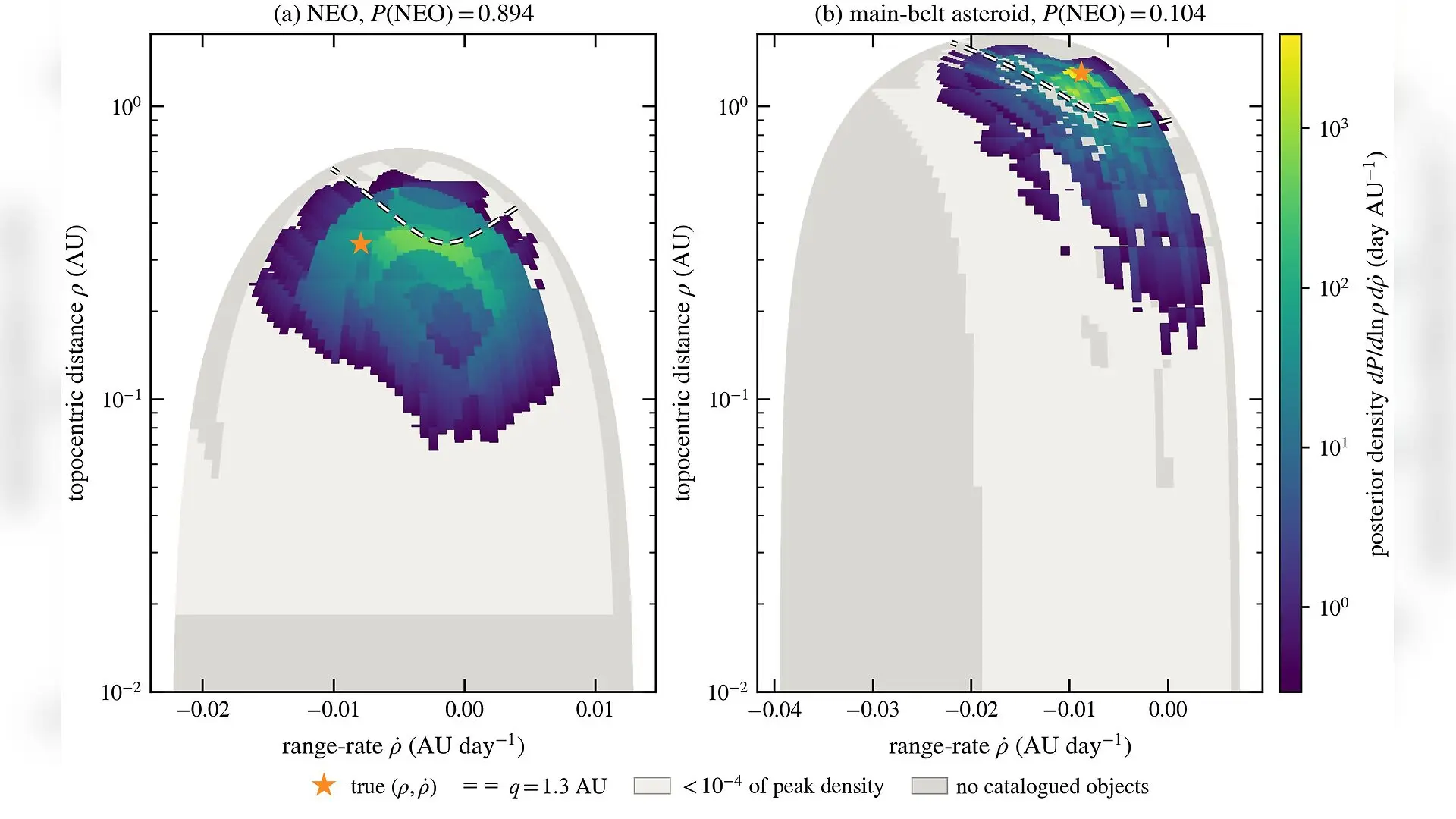
Astronomers have developed a powerful new software classifier that could double the efficiency of planetary defense follow-up programs by separating dangerous space rocks from distant asteroid background noise. The tool, named pneo, calculates the exact mathematical probability that a newly detected moving point of light is a near-Earth object rather than a harmless distant rock.
Near-Earth objects are asteroids and comets with orbits that bring them within one point three astronomical units of the Sun, requiring urgent tracking to evaluate potential collision hazards. When wide-field sky surveys detect these moving sources over a single night, they report short observational segments known as tracklets to the Minor Planet Center. However, a single night of observations cannot measure an object’s distance or radial velocity directly, leaving astronomers struggling to determine which detections require immediate telescope follow-up.
The new Bayesian classification framework, introduced in a study published on the arXiv preprint server by Devanshi Singh, Mario Jurić, and Željko Ivezić from the University of Washington, solves this ambiguity by integrating a comprehensive model of the Solar System across all bound orbits consistent with each tracklet. Unlike legacy scoring tools that rely on uncalibrated pseudo-probabilities, the pneo software computes precise posterior probabilities by accounting for the true phase-space volume of different distances.
How Does The Pneo Software Filter Out Distant Asteroids?
The core innovation lies in applying a rigorous change-of-measure mathematical factor that weighs how plausible each possible distance is based on known orbital populations. Distant objects appear to move slowly across the sky, and older ranking methods often fail because they treat slow-moving distant bodies as having an equal chance of being nearby, fast-moving hazards.
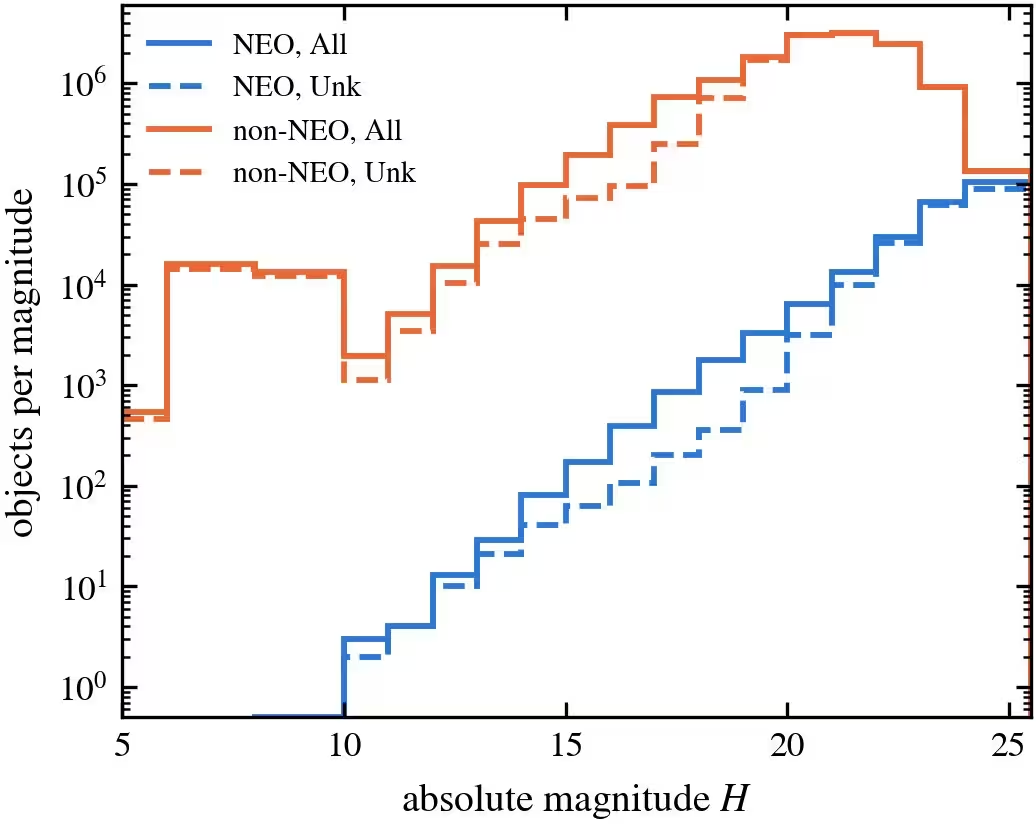
By weighting observations by their true phase-space volume, the new classifier gives distant objects the vast statistical weight they deserve, immediately exposing them as background asteroids rather than threatening near-Earth objects. When tested on simulated tracklets matching the expected depth of the Vera C. Rubin Observatory, the new software achieved a selection purity of ninety-six percent, compared to only forty-eight percent for the legacy tool currently in wide use.
What Happens When Testing The Classifier On Real Observatory Data?
The research team validated their algorithm against real-world observations from the Minor Planet Center confirmation page, the Rubin alert stream, and early survey data releases from Data Preview 2. On real discovery candidates, the classifier successfully flagged known near-Earth objects with high probability scores while cutting false positives by up to seventy-five percent.
In several notable instances using early Rubin Observatory commissioning data, the software successfully assigned high probability scores to known near-Earth objects that automated pipelines initially failed to associate. By flagging these fast-moving bodies up to two weeks before they were officially cataloged by manual reporting, the algorithm demonstrated its potential to accelerate urgent asteroid discoveries.
Why Does Calibrated Probability Matter For Future Sky Surveys?
The upcoming Legacy Survey of Space and Time at the Vera C. Rubin Observatory is expected to flood clearinghouses with more than one hundred candidate detections every single night. Under current filtering criteria, more than ninety percent of those incoming candidates would turn out to be harmless main-belt asteroids, threatening to overwhelm limited global telescope resources.
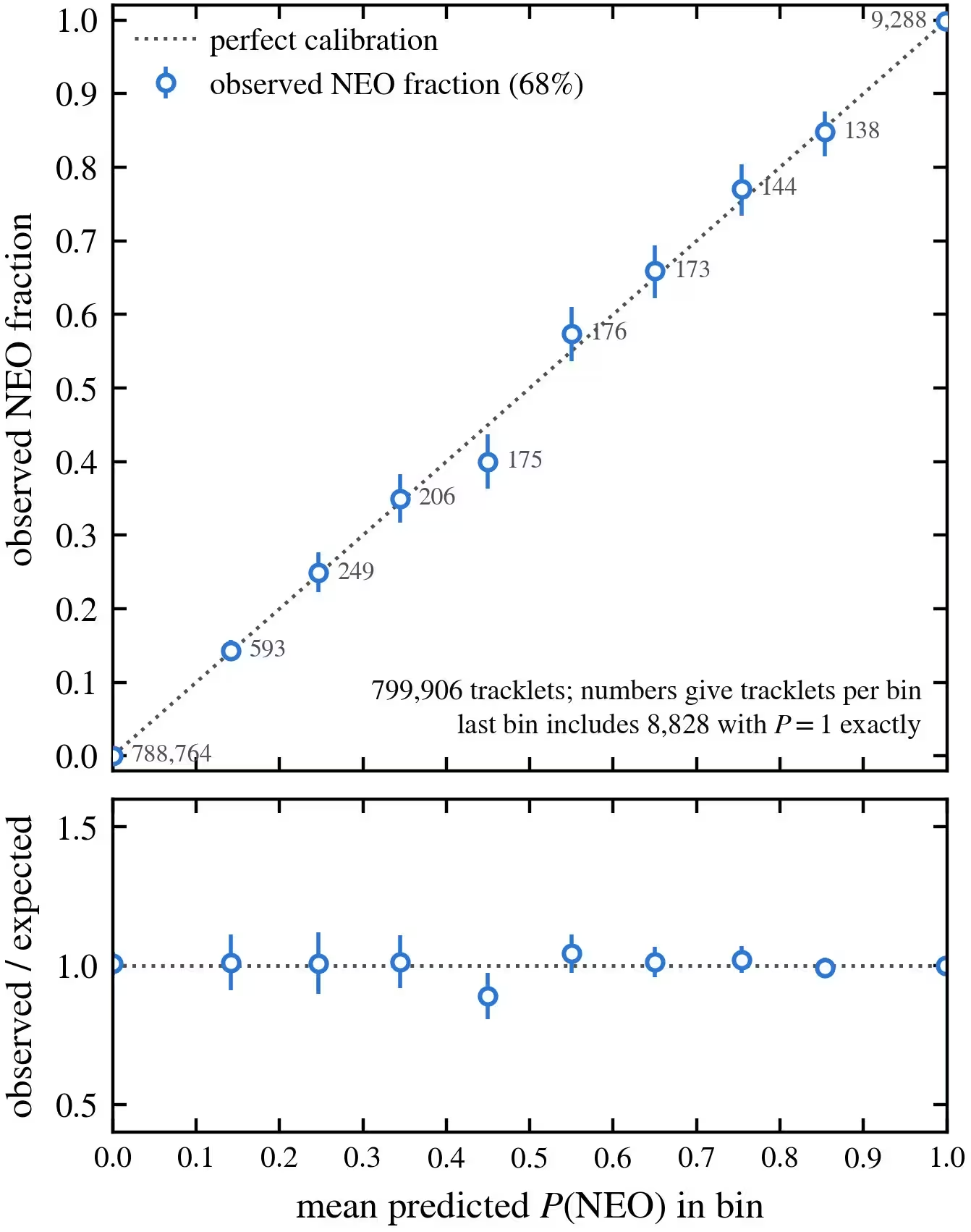
Because the new tool provides fully calibrated probabilities where a score of zero point eight corresponds to a true eighty percent chance of being a near-Earth object, follow-up facilities can quantitatively weigh planetary defense targets against other time-critical astrophysical transients. The authors note that the open-source Python and Rust implementation processes millions of tracklets per hour, making it fully optimized for real-time operations during full survey operations.
The study was posted to the arXiv preprint server on November 25, 2026.
This article has been fact checked for accuracy, with information verified against reputable sources. Learn more about us and our editorial process.
Last reviewed on .
Article history
- Latest version
Reference(s)
- Singh, Devanshi. “A Bayesian Approach to Prioritizing the Follow-Up of Near-Earth Objects.” arXiv.org <http://arxiv.org/abs/2611.34790v1>.
Cite this page:
- Posted by Farah Siddiqui